

A work intake process is the controlled front door for new work: a fixed channel and named owner who review, score, and decide on every request before it touches your team's capacity. The single most important action is to create that agreed submission channel and assign one triage owner. Skip that step, and every other fix you make to intake will collapse under executive bypass and shadow requests.
TL;DR:
- A single owner and a mandatory submission channel are essential to prevent shadow requests and ensure requests go through proper triage.
- Short-form intake for quick requests and detailed proposals for large projects must be routed differently to maintain efficiency and clarity.
- Every request moves through stages with designated owners, clear outputs, and timely updates to build trust and streamline decision-making.
- Scoring requests on value, urgency, effort, risk, and alignment helps prioritize effectively, but capacity checks are critical before approval.
- Building a functional intake process in 90 days involves choosing a channel, assigning ownership, piloting, and scaling with KPI tracking, not relying on software alone.
Table of Contents
- What Is a Work Intake Process, Exactly?
- What Are the Benefits of a Structured Intake Process?
- What Should an Intake Form Actually Capture?
- How Does a Request Move From Submission to Handoff?
- How Do You Score and Prioritize Competing Requests?
- Who Owns Intake and Who Gets to Say Yes?
- Which KPIs Actually Tell You Intake Is Working?
- Do You Need Software to Run Intake, or Just Better Discipline?
- What Mistakes Break Intake Processes Most Often?
- How Do You Build This in 90 Days?
- How Strategy Haus Approaches Intake Design
- Why Most Intake Advice Undersells the Governance Problem
- Ready to Put a Real Intake System in Place?
- Sources
What Is a Work Intake Process, Exactly?
A work intake process sits at the very start of the project lifecycle, before scoping or planning begins. It's the decision layer that determines whether a request should proceed at all, and it acts as a "front door" that makes capacity, ownership, and risk visible before anything enters execution, according to Workhint's operations research.
Project intake and work intake get used interchangeably, but they aren't identical. Project intake usually covers larger, resourced initiatives with defined start and end dates. Work intake is broader. It captures everything from a five-minute report tweak to a six-month system rebuild, all funneled through the same triage logic.
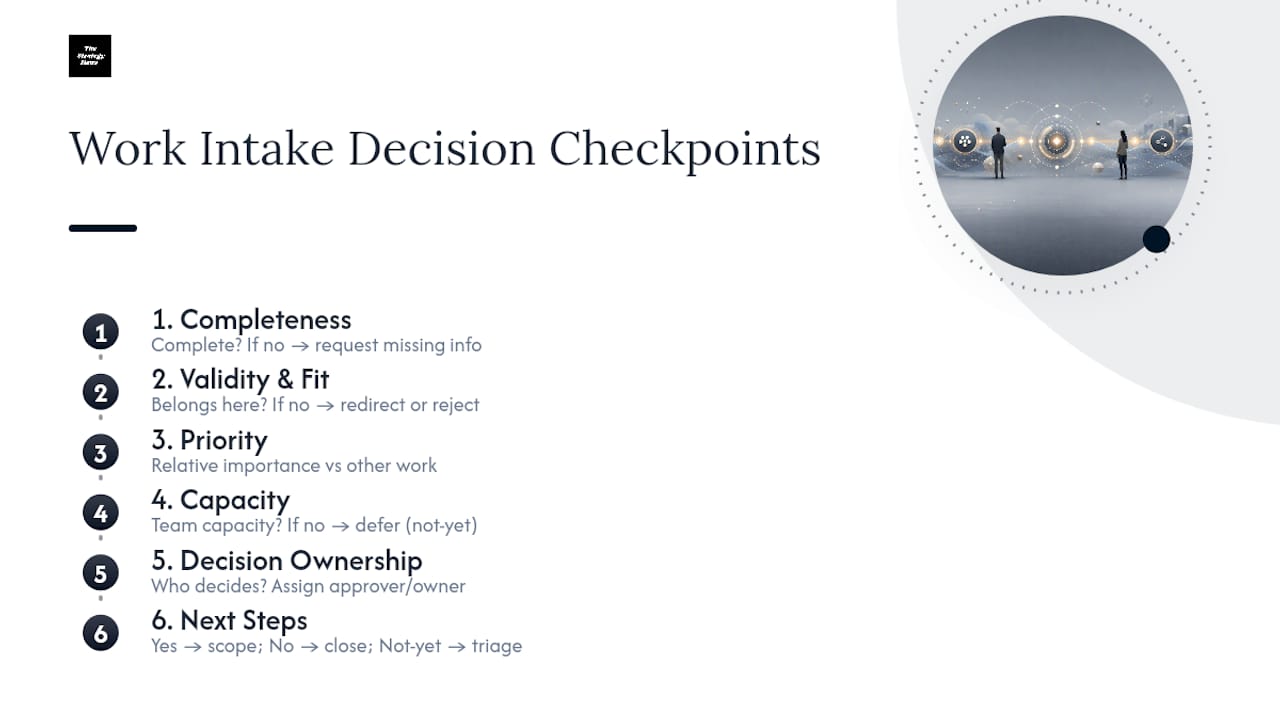
Before any request enters the queue, a solid intake process answers six questions: Is the submission complete? Is it valid and does it belong here? How important is it relative to other work? Do we have the capacity to take it on? Who owns the decision? And what happens next if we say yes, no, or not yet? PMO research on step-by-step intake design frames these six checkpoints as the real job of intake, not the form itself.
What Are the Benefits of a Structured Intake Process?
Teams that build a real intake process, not just a request form, see the payoff show up in four places.
- Better prioritization and alignment. Every request gets measured against the same criteria, so leadership stops arguing about whose project matters more.
- Fewer surprises. Stakeholders get a decision, not silence, so the promises your team makes are ones it can actually keep.
- Sharper capacity planning. You see committed work against available hours before you say yes, not after someone's already behind.
- Stronger requester trust. People submitting requests can see where their idea sits and why, which cuts down on the "did anyone even look at this?" emails.
Industry write-ups on work intake maturity report that organizations with a working intake process see higher-quality submissions and a more predictable pipeline, largely because requesters learn what "ready" looks like and stop lobbing half-formed ideas over the wall.
What Should an Intake Form Actually Capture?
Not every request needs the same level of detail, and that's the first mistake most intake forms make: they treat a one-hour fix and a six-month initiative identically. Build two tiers instead.
Quick triage requests (bug fixes, small content edits, minor process tweaks) need a short form: requester name, one-line description, urgency, and impacted team. That's it. Anything longer pushes people back to email, which defeats the entire point of having a front door.
Full proposal requests (new projects, system changes, anything touching multiple teams) need more: business justification, estimated effort, dependencies, budget owner, and a named sponsor. This is where you also collect required attachments, like a rough scope document or a stakeholder sign-off.
Route requests by type at submission, not after triage starts:
- Bug or defect reports go straight to a technical reviewer, bypassing the full scoring model.
- Small enhancements enter the standard queue with quick triage.
- New projects and cross-team initiatives require the full proposal path.
- Compliance or security-related requests get flagged for mandatory legal or risk review before scoring.
Incomplete submissions should never sit in limbo. Set a rule: if required fields are missing, the request is automatically returned to the requester with a specific note on what's needed, not a generic rejection.
Pro Tip: Cap your quick-triage form at five fields. If your team can't decide "yes, no, or not yet" from five answers, the problem is your scoring criteria, not your form length.
How Does a Request Move From Submission to Handoff?
A request should move through distinct stages, each with a named owner and a clear output. This is the part most teams get wrong. They build a form and call it a process, but a form without stages is just a mailbox.
Detailed workflow standards for maintenance and operations, like the Army Corps of Engineers' work order requirements, map staged lifecycles with explicit status codes and role responsibilities at every handoff. That same discipline applies whether you're managing infrastructure work orders or marketing campaign requests.
- Submit. Requester files through the agreed channel. Output: a timestamped, logged request.
- Triage. Triage owner checks completeness and routes by type. Output: valid request or a return-to-sender note.
- Evaluate. Functional reviewer scores value, urgency, effort, and risk. Output: a numeric priority score.
- Capacity check. Delivery owner compares the request against current team load. Output: a go/no-go read on resourcing.
- Decide. Decision owner approves, defers, rejects, or redirects. Output: a documented decision with a reason.
- Handoff. Delivery owner receives the approved request with context intact. Output: work enters planning.
Every stage change should trigger two things: a system status update and a message to the requester. Silence between stages is what erodes trust fastest.
Set service level agreements for the two moments requesters actually notice: time to first review (how fast someone acknowledges the request, ideally within two business days) and time to decision (how fast they get a yes, no, or not yet, ideally within two weeks for standard requests). Adjust both based on request volume, not aspiration.
| Stage | Owner | Typical Output |
|---|---|---|
| Submit | Requester | Logged, timestamped request |
| Triage | Triage owner | Routed and validated request |
| Evaluate | Functional reviewer | Priority score |
| Capacity check | Delivery owner | Go/no go resourcing read |
| Decide | Decision owner | Approved, deferred, rejected, or redirected |
| Handoff | Delivery owner | Work enters planning with context |
How Do You Score and Prioritize Competing Requests?
Scoring turns "everyone thinks their project is urgent" into a number you can actually compare across a full queue. A simple 1 to 5 scale across five dimensions works better than a complicated weighted formula that nobody remembers how to use six months later, per Jotform's intake research.
- Business value. How much revenue, risk reduction, or strategic benefit does this deliver? Score 1 (minimal) to 5 (critical).
- Urgency. What happens if this waits three months? Score 1 (nothing) to 5 (major consequence).
- Effort. How much time and how many people does this take? Score 1 (heavy) to 5 (light), inverted so low effort scores high.
- Risk. What's the downside if this goes wrong or gets delayed? Score 1 (high risk) to 5 (low risk).
- Strategic alignment. Does this map to a current organizational priority? Score 1 (unrelated) to 5 (direct fit).
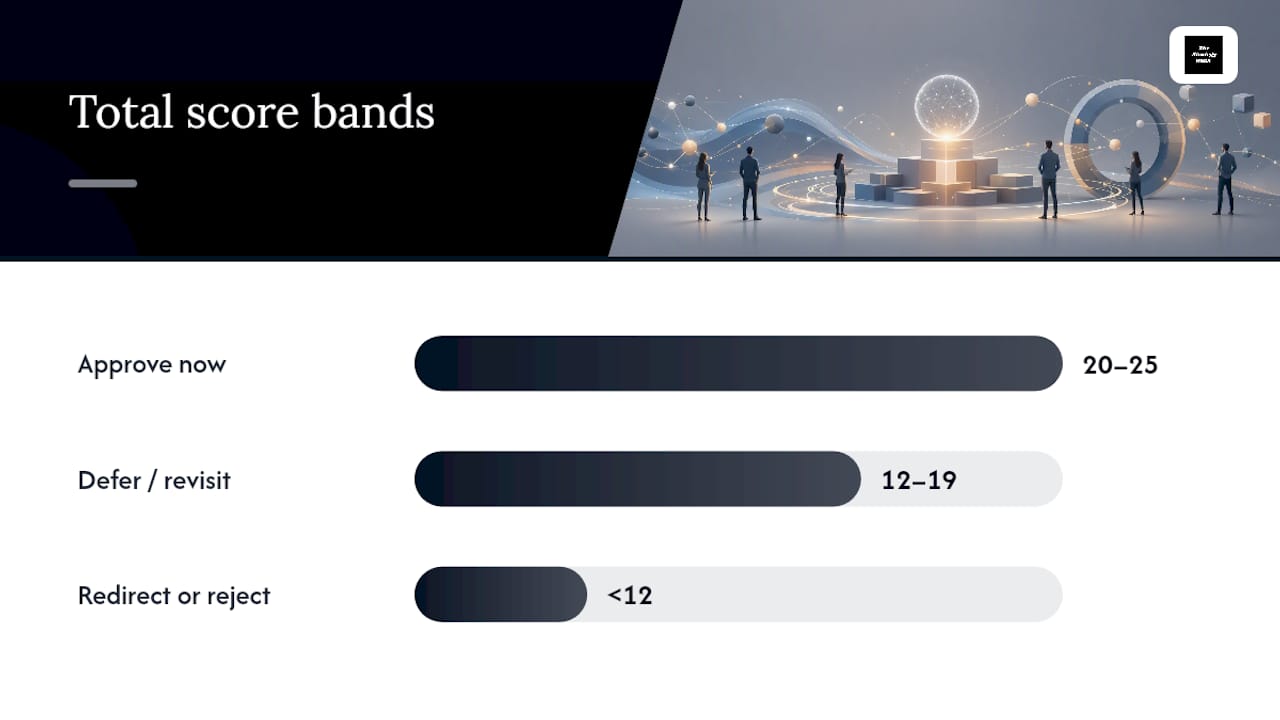
Add the five scores. A combined total of 20 to 25 lands in the "approve now" band. Scores of 12 to 19 go into a "defer and revisit next cycle" band. Anything under 12 gets redirected or rejected outright, with a reason logged so the requester understands why.
The score is not the decision by itself. A request can score 23 and still get deferred if the capacity check comes back negative. Those are the trade-offs approvers need to see side by side: score and available capacity, together, before signing off.
Pro Tip: Print the scoring rubric on one page and hand it to every functional reviewer. If two reviewers score the same request five points apart, your definitions are too vague, not your reviewers.
Who Owns Intake and Who Gets to Say Yes?
Intake fails most often not because the form is bad, but because nobody actually owns the door. Four roles need clear names attached, not just job titles.
- Triage owner. The single person who checks every submission for completeness and routes it. This role should never be a rotating duty; consistency matters more than fairness of workload.
- Functional reviewer. Subject-matter experts who score requests within their domain (technical feasibility, legal risk, financial impact).
- Decision owner. The person with actual authority to approve, defer, reject, or redirect. One name, not a committee that meets when it feels like it.
- Delivery owner. Whoever receives the approved work and confirms the team has room to execute it.
Governance is what keeps this from falling apart under pressure. Requests submitted outside the agreed channel, an executive's Slack message, a hallway ask, should be treated as though they don't exist until they're logged properly. Guidance on intake enforcement from Maritime Gateway's operations coverage makes this point directly: the channel only works if it's mandatory, with no side doors for anyone regardless of rank.
Build one exception path, not a dozen. Emergency requests get a fast-track review with the decision owner, but they still get logged and scored retroactively.
Which KPIs Actually Tell You Intake Is Working?
Seven numbers reveal whether your intake process is healthy or quietly breaking down.
- Time to first review — how fast a request gets acknowledged.
- Time to decision — how fast a request gets a final yes, no, or not yet.
- Incomplete request rate — the share of submissions returned for missing information.
- Approval and deferral rates — the split between requests that move forward versus wait.
- Intake queue age — how long requests sit before any action.
- Accepted work versus available capacity — whether you're approving more than the team can absorb.
- Requester satisfaction — whether people trust the process enough to keep using it.
A rising incomplete request rate almost always points to a form problem, not a requester problem. If half your submissions bounce back for missing fields, the form is asking for the wrong things at the wrong stage. A widening gap between accepted work and available capacity is the clearest warning sign of all: it means approvals are happening without anyone actually checking the math, which is exactly how broken promises start.
Review these numbers monthly at minimum, and put queue age and capacity utilization on a live dashboard if you can. Waiting for a quarterly report to catch a capacity problem means you're finding out three months after it already hurt delivery.
Do You Need Software to Run Intake, or Just Better Discipline?
You need three things at minimum, and none of them require an enterprise platform on day one: a form (even a shared document works to start), a place to track status (a board or simple ticketing tool), and a way to view capacity against committed work.
The automations worth building first are routing rules that send requests to the right reviewer automatically, duplicate detection so the same idea doesn't get submitted three times by three departments, automated reminders when a request sits too long at one stage, and status updates that fire without someone remembering to send them.
Here's the part most teams skip: fix your governance and form design before you buy anything. Research on intake tooling from Jotform's process guide is blunt about this, automation amplifies whatever process you already have. A messy process with software behind it is still a messy process, just faster and harder to unwind.
- Start with a form and a spreadsheet or basic board.
- Add automated routing once request volume makes manual sorting slow.
- Add capacity dashboards once you have at least two full cycles of data to trust.
- Only move to a dedicated intake platform once volume or complexity genuinely outgrows the basics.
What Mistakes Break Intake Processes Most Often?
Five mistakes show up again and again, and each one has a specific, fixable cause.
- Treating intake as a form, not a process. A form collects information; it doesn't decide anything. Fix: assign a triage owner who actually reviews, not just files, every submission.
- Executive bypass. Leadership routes around the front door because it's "urgent." Fix: build one fast track that still logs and scores the request, so no one gets a free pass around visibility.
- Approving without checking capacity. This is how teams end up double booked and behind. Fix: make the capacity check a mandatory stage, not an optional gut check.
- Overly long forms. Requesters abandon the form and go back to email or chat. Fix: split into a short triage version and a longer proposal version, per request type, as detailed in Saviom's intake research.
- Never closing the loop. Requesters submit and hear nothing. Fix: automate a status message at every stage change, even if the message is just "still in review."
Pro Tip: Scope creep almost always enters during intake, not during delivery. Lock the request's stated outcome at approval, and require a fresh intake ticket for any change beyond a small threshold, rather than quietly expanding the original scope.
How Do You Build This in 90 Days?
Standing up a working intake process doesn't require a quarter of planning meetings. It requires a sequence.
- Days 0 to 14: Pick the one official channel (a form, a ticketing tool, whatever already exists), assign a named triage owner, and build the minimal short-form intake fields. Announce that requests outside this channel won't be actioned.
- Weeks 3 to 6: Pilot the scoring model with one team or department. Set your first SLAs for time to first review and time to decision, even if they're rough guesses. Run a small batch of real requests through the full workflow to find where it breaks.
- Weeks 7 to 12: Expand to additional request types and teams. Add the capacity check as a mandatory stage. Build a basic dashboard tracking your core KPIs. Schedule a monthly governance review to catch bypass attempts and form gaps before they become habits.
By day 90, you should have a documented workflow, a named owner at every stage, and at least one full reporting cycle showing whether approved work matches actual capacity.
How Strategy Haus Approaches Intake Design
Thestrategyhaus treats intake as an operating system, not a form to fill out and forget. The framework starts by aligning organizational priorities so every scoring dimension actually reflects what leadership cares about, then defines ownership at each stage so decisions don't stall waiting on an unnamed approver.
From there, implementation focuses on building the actual flow: submission channel, triage rules, capacity checks, and handoff, wired together so requests move without manual chasing. The last step is adoption support, because a workflow diagram that nobody follows after week three isn't a process. It's documentation nobody reads.
Why Most Intake Advice Undersells the Governance Problem
Most guidance on this topic treats intake as a forms and scoring exercise. Build a good template, add a scoring rubric, done. That advice isn't wrong, but it's incomplete in a way that causes real damage.
The research consistently points to a harder truth: intake fails at the enforcement layer, not the design layer. A beautifully designed scoring model means nothing if an executive can still route around it with a Slack message, and a five-field form means nothing if the capacity check gets skipped under deadline pressure.
If you're building intake for the first time, prioritize the triage owner and the mandatory-channel rule before you touch scoring models or software. A rough scoring system enforced consistently beats a sophisticated one that gets ignored whenever things get busy. Fix the door before you decorate the lobby.
— Ashanti
Ready to Put a Real Intake System in Place?
Reading about staged workflows and scoring models is one thing. Getting a team to actually follow them under deadline pressure is another. We build the execution layer by working alongside your team to design the workflow, assign real ownership, and get people actually using it instead of routing around it three weeks later.

The approach starts with a diagnostic look at how work currently enters your organization, followed by a pilot with one department before scaling intake across teams. If you're also building out request templates or capacity tracking, resources like this lean canvas template and this pre-launch readiness checklist pair well with the governance work Thestrategyhaus puts in place. If your intake process exists on paper but breaks down the moment someone senior wants an exception, connect with Thestrategyhaus to scope a pilot and get a working front door built with your team, not just handed to it.