

A user adoption strategy is a plan for turning first-time users into people who come back and get value from your product on a regular basis. It is not the same as acquisition (getting people to sign up) or onboarding (getting them through setup). Start today with three moves: pick one activation metric that predicts long-term use, run a small pilot before rolling anything out wide, and set a 30-day measurement cadence to check progress. Most product changes need a 30 to 90 day stabilization window before you know if they worked, so build your calendar around that timeline, not your launch date.
- Set one activation metric your team agrees on before launch.
- Run a focused pilot with a small, defined group first.
- Schedule a 30-day check-in using laddered metrics, not gut feel.
Key Takeaways
A user adoption strategy succeeds when it pairs a single clear activation metric with a laddered measurement model that links weekly behavior signals to quarterly business outcomes.
| Point | Details |
|---|---|
| Define activation early | Pick one metric that predicts habitual use before you design onboarding. |
| Pilot before scaling | Test one change on a small cohort, then compare against a control group. |
| Use laddered metrics | Track readiness, activation, behavior, and outcomes on separate timelines. |
| Match windows to change type | Expect 30 to 60 days for technical rollouts, up to 12 months for culture change. |
| Get execution support | Thestrategyhaus helps teams run the pilot and own the measurement cadence, not just the framework. |
Table of Contents
- Why a Strong User Adoption Plan Matters for Retention
- The Core Pillars of a Winning Adoption Framework
- How Do You Build and Roll Out an Adoption Strategy?
- What Should You Measure, and When?
- Who Should Own User Adoption?
- Which Tactics Actually Move Adoption Numbers?
- What Does Success Look Like at 30, 90, and 180 Days?
- What Mistakes Most Often Derail Adoption Programs?
- Why Execution Beats Theory in Adoption Work
- How Strategy Haus Helps You Execute Your Adoption Plan
- Where to Go for Deeper Reading on Adoption Metrics
- Sources
Why a Strong User Adoption Plan Matters for Retention
Adoption is the cheapest lever you have to protect revenue you already earned. Every user who stalls out mid-onboarding costs you the acquisition spend that got them there, and every user who reaches habitual use pays that cost back many times over. Better adoption shows up as lower churn, higher lifetime value, and a faster read on whether you actually have product-market fit.
Retention benchmarks give teams something concrete to compare against instead of guessing. G2's retention research is a useful reference point when you're setting realistic targets for your own segment rather than picking an arbitrary number out of thin air.
Picture a mid-market software team that redesigned its first-run experience around a single activation event, a completed setup task, instead of a generic welcome tour. Within two monthly cohorts, the share of users hitting that event climbed, and support tickets tied to setup confusion dropped. Nothing else about the product changed. The lesson holds regardless of your category: adoption work pays back fast when you aim it at one clear behavior.
- Lower churn from users who never reached "aha."
- Higher lifetime value from habitual, repeat use.
- Clearer signal on product-market fit, good or bad.
The Core Pillars of a Winning Adoption Framework
A user adoption strategy holds together on seven pillars: segmentation, activation milestones, onboarding design, personalization, feedback loops, governance, and reinforcement. Each one answers a different question about how users actually get to value.
- User segmentation and jobs-to-be-done personas. Not every user wants the same outcome. A three-step framework that defines personas by the job they're trying to do, before you touch onboarding screens, keeps your later tactics aimed at real behavior instead of assumptions.
- Activation milestones and "aha" events. Define the specific action that predicts a user will stick around. For a project tool, that might be inviting a teammate. For analytics software, it might be building a first dashboard.
- Onboarding design. Success looks like a user reaching their activation event without needing to talk to support. Keep the path short and specific to the persona.
- Personalization and role-based enablement. An admin and a frontline user need different first experiences. Route each to what actually matters for their role.
- Data and feedback loops. Build a habit of watching behavior data weekly during rollout, not just at the end of a quarter.
- Governance and sponsor alignment. Someone senior needs to own the outcome, not just the launch date.
- Reinforcement and continuous optimization. Adoption doesn't end at week one. Revisit the plan monthly and adjust based on what the data shows.
Pro Tip: Limit initial onboarding to the three to five tasks that actually predict retention. Every extra step you add to a first-run flow is a place a user can quit before reaching value.
How Do You Build and Roll Out an Adoption Strategy?
Build your rollout in four moves: define the goal, map the journey and activation events, run a pilot, then scale with measurement. Each step produces a specific artifact your team can point to later.
- Define the goal and pick a metric. Ask directly: what does activation mean for this persona? Write down one number everyone agrees to track. The output is a one-page goal brief.
- Map user journeys and activation events. Product and CSM teams sketch the path from signup to habitual use, marking where users tend to drop off. The output is a journey map with friction points flagged.
- Design and run a focused pilot. Pick a small cohort, ideally 50 to 200 users depending on your base size, and test one change at a time. The output is baseline and post-change data for that cohort.
- Measure, then scale with confidence. Compare the pilot cohort against a control group before rolling the change out to everyone.
Before you launch the pilot, run through a short checklist:
- Is the cohort large enough to produce a readable signal, not just noise?
- Have you set a success threshold in advance (for example, a 10 percentage point lift in activation)?
- Are you testing one change, or several at once?
That last question matters more than it looks. A/B testing works well when you're comparing two clear versions of one thing, like two onboarding flows. When you're bundling multiple changes into a single pilot, a single-change experiment is safer; it costs more time but tells you which lever actually moved the number. Mixpanel's adoption framework frames this as comparing the value a user gets against the effort it takes to get it, which is a useful lens when you're deciding which single change to test first.
What Should You Measure, and When?
Use a laddered measurement model that tracks readiness, activation, behavior, and outcomes in sequence, and tie each tier to a specific decision point. This approach, described in change management research, prevents teams from leaning on one point-in-time number and missing the bigger pattern.
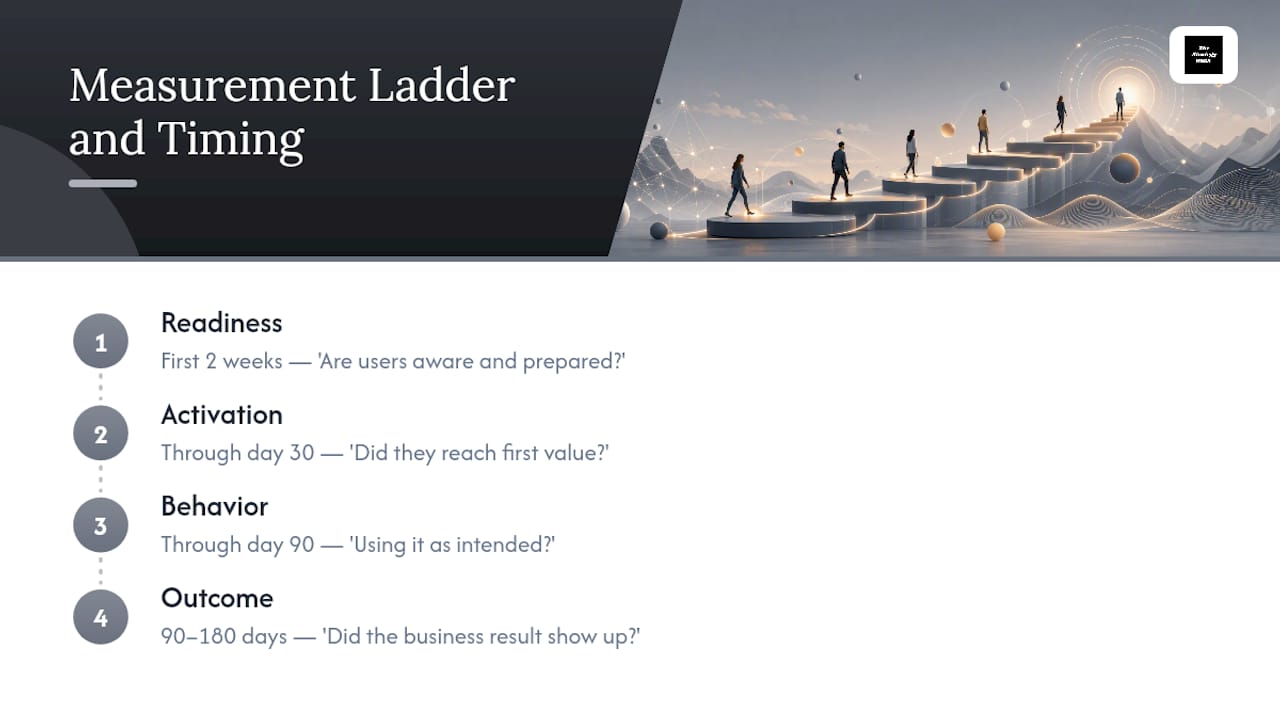
Each rung answers a different question. Readiness metrics (are users aware and prepared?) matter in the first two weeks. Activation metrics (did they reach first value?) matter through day 30. Behavior metrics (are they using it the way it's meant to be used?) matter through day 90. Outcome metrics (did the business result show up?) often take 90 to 180 days, longer for culture-level change.
Report weekly during a pilot, biweekly for high-touch enterprise accounts, and monthly once you're looking at portfolio-level results across multiple teams.
Pro Tip: Put your metric review on the same calendar as your team's regular decision meetings. A dashboard nobody looks at during planning is just a report, not a management tool.
Completion numbers, like training attendance or first logins, tend to overstate progress. Change management research recommends watching behavioral compliance and stakeholder confidence instead, along with fast-moving signals like help desk volume and how often managers are discussing the rollout in their own meetings. Those numbers tell you something is wrong within a week, not a quarter.
Who Should Own User Adoption?
Product owns activation design, customer success owns post-launch adoption, operations or analytics owns measurement, and an executive sponsor owns prioritization when trade-offs come up. Splitting ownership this way keeps each team accountable for the piece they actually control.
A simple RACI keeps this from turning into a turf war: product is Responsible for onboarding design, CSM is Accountable for the adoption outcome, operations is Consulted on data, and the sponsor is Informed at each milestone. Set escalation triggers in advance: a missed activation target for two weeks running, a spike in support volume, or open resistance from a manager should all trigger a review, not a wait-and-see approach.
- Run weekly sprint reviews during the pilot phase.
- Move to a monthly adoption board once the program scales past one team.
- Document decisions and thresholds in one shared place, not scattered across chat threads.
- Name an owner for each pillar before kickoff, not after.
- Set the escalation triggers in writing, before the first metric even ships.
- Review governance quarterly. Ownership drifts if nobody checks it.
Which Tactics Actually Move Adoption Numbers?
Match your tactic to the type of friction you're seeing: activation friction, discoverability friction, or effort friction. A tactic aimed at the wrong friction type wastes a rollout cycle.

| Tactic | Problem it solves | Sample success metric |
|---|---|---|
| In-app walkthroughs | Users don't know where to start | Completion rate of first task |
| Onboarding checklists | Users lose track of setup steps | Percent of checklist items completed in 7 days |
| Role-based training | Generic training doesn't match the job | Activation rate by role |
| Coaching or office hours | Complex workflows need human help | Support ticket reduction after coaching |
| Incentives | Users have no reason to return | Return visit rate within 30 days |
| Gamification | Low motivation for repeat use | Weekly active use streaks |
| Community forums | Users feel stuck without peer answers | Forum engagement tied to retention |
For tooling, lean on generic categories rather than chasing a specific vendor: product analytics platforms for behavior tracking, in-app guidance tools for walkthroughs, and survey tools for pulse feedback. Review sites are a reasonable place to shortlist categories, not to pick a single winner sight unseen.
A self-serve SaaS product usually gets more out of in-app walkthroughs and checklists first, since there's no human in the loop to guide a new user. Enterprise rollouts usually need role-based training and coaching first, because the workflows are more complex and the stakes of getting it wrong are higher.
Pro Tip: Pick one tactic per friction type per quarter. Running five tactics at once makes it impossible to tell which one actually worked.
What Does Success Look Like at 30, 90, and 180 Days?
At 30 days you're looking for pilot signals; at 90 days, scaled cohort improvement; at 180 days, measurable business outcomes. Matching your expectations to the right window keeps you from calling a program a failure before it's had time to work.
- Day 30: Activation rate and early behavior signals from the pilot cohort. Watch help desk volume closely here.
- Day 90: Behavior metrics across a wider rollout. This is where you confirm the change holds outside the pilot group.
- Day 180: Outcome metrics tied to retention, revenue, or cost. This window stretches longer for culture-level change than for a purely technical rollout.
Technical rollouts often show results inside a 30 to 60 day window, while process changes need closer to 90, and culture change can take up to 12 months to show up cleanly in the data. Set your expectations to match the change type, not a generic quarter-end deadline.
What Mistakes Most Often Derail Adoption Programs?
The most common failures are measuring activity instead of behavior, overloading onboarding, skipping governance, ignoring segmentation, launching without a pilot, and never linking the work back to a business outcome.
- Measuring activity, not behavior: Swap login counts for a real activation metric within a week.
- Overloaded onboarding: Cut the flow down to three to five critical tasks immediately.
- No governance: Name an owner and set escalation triggers before the next sprint.
- Ignoring segmentation: Split your metric by persona before the next report.
- Skipping the pilot: Roll back to a small cohort test if you're already mid-rollout.
- No link to outcomes: Tie your activation metric to one revenue or retention number your leadership already tracks.
Why Execution Beats Theory in Adoption Work
Most adoption advice stops at frameworks and never gets to the messy work of running a pilot, watching a dashboard weekly, and making a call when the numbers disagree with the plan. That gap between framework and follow-through is where most programs actually die.
A mid-size team once tracked completion of a training module as its adoption metric for two quarters, and the number looked fine the whole time. Once they switched to a laddered model and started watching behavior compliance instead, they found usage had quietly stalled. The correction took one pilot cycle, not another two quarters of false confidence.
How Strategy Haus Helps You Execute Your Adoption Plan
Thestrategyhaus turns the frameworks in this article into a working rollout, with someone accountable for the outcome instead of just the slide deck. Where most guidance stops at "here's a framework," Thestrategyhaus stays through the pilot, the measurement cadence, and the course corrections that actually decide whether adoption sticks.

Services map directly to what you just read: strategy-to-execution planning, laddered measurement frameworks, pilot design and support, and ongoing execution coaching once the program scales past your first team. If your adoption plan is stuck at the framework stage and needs someone to run the pilot and own the metrics with you, Thestrategyhaus offers a short diagnostic call to map out where your rollout is actually stalling.
Where to Go for Deeper Reading on Adoption Metrics
These five sources cover measurement frameworks, tactics, and benchmarking in more depth than a single article can.
- Mixpanel's adoption guide: the value-versus-effort framing and a step-by-step measurement plan.
- Userpilot's 2026 tactics guide: persona-based framework plus notes on measuring AI agent activity separately.
- Td: the readiness to outcome ladder used throughout this piece.
- The Change Compass's metrics guide: why behavioral compliance beats completion metrics.
- AWS's OCA scorecard framework: a structured scorecard for governance-heavy programs.
- G2's retention benchmark data: reference points for setting realistic targets.
Sources
- Developing a product adoption strategy | Signals & Stories
- Product Adoption Strategy in 2026: 12 Tactics That Work
- A Laddered Approach to Measuring Change
- The comprehensive guide to change management metrics for adoption
- Change adoption metrics — AWS OCA framework (Mobilize team)