

Strategic plan implementation succeeds when three things are true at once: goals are measurable, every priority has one named owner, and a short visibility cadence forces a decision every week. Miss any one of those, and even a brilliant plan stalls. Frameworks like OKRs help set the targets, but the real engine is the weekly check-in that surfaces trouble early. What follows is a practical checklist plus the governance, measurement, and communication tactics that make it stick.
TL;DR:
- Assign a single owner to each priority and ensure they are accountable for progress, not just task completion, to prevent drift and improve execution.
- Develop clear, outcome-based phases with defined exit criteria and track progress through measurable milestones aligned with resource commitments.
- Use weekly check-ins and real-time dashboards to surface issues early and enforce ownership, making drift visible without adding bureaucracy.
- Track both lagging and leading metrics, with thresholds set for quick escalation if indicators underperform over defined short-term periods.
- Prioritize ongoing communication tailored for leaders, managers, and team members, and build capacity through role-specific training and informal coaching for better adoption.
Table of Contents
- What Are the First Steps in Strategic Plan Implementation?
- Who Should Own Each Strategic Priority?
- How Do You Set Milestones Without Losing the Timeline?
- Which Metrics Actually Show Whether the Plan Is Working?
- How Do You Communicate Strategy So Teams Actually Act on It?
- What Tools Keep Execution Visible Without Adding Bureaucracy?
- What Are the Most Common Reasons Strategic Plans Fail?
- How Does Strategy Haus Put This Framework Into Practice?
- Change Management Strategies During Implementation
- Training and Capacity Building for Involved Teams
- Risk Management and Contingency Planning
- Continuous Feedback Loops and Iterative Improvement
- Why Execution Discipline Beats a Better Plan
- Get Hands-On Support Implementing Your Strategic Plan
- Sources
What Are the First Steps in Strategic Plan Implementation?
Strategy execution falls apart most often in the first 30 days, before momentum ever has a chance to build. The fix is a sequence, not a single meeting.
- Lock scope and define success metrics. Decide what's in and out of the plan, and attach a number to each priority. "Improve customer retention" is a wish; "raise 90-day retention from 62% to 70%" is a target.
- Map stakeholders and assign single owners. Every priority gets one named person accountable for it, not a committee. Named ownership paired with a visible cadence reduces drift more than any planning template does.
- Sequence work into three to five phases with exit criteria. Each phase needs a defined outcome and a clear signal that it's finished before the next one starts.
- Design approval points and decision rights. Decide in advance who has authority to continue, revise, or kill a workstream, and put it in writing.
- Set milestones, budgets, and resource commitments per phase. Vague budgets produce vague accountability.
- Establish your cadence. Weekly 30 minute check-ins, monthly reviews, and quarterly go/no go decisions.
- Kick off visibility tools and baseline metrics. You cannot track progress against a number you never recorded on day one.
A few habits separate teams that execute from teams that just plan:
- Write the metric before you write the initiative name.
- Put the owner's name in the plan document itself, not just in a meeting note.
- Treat the first check-in as a baseline, not a status update.
Organizing work into phases with defined ownership and approvals is what keeps a plan from being quietly ignored after the kickoff excitement fades.
Who Should Own Each Strategic Priority?
Ownership is the single most skipped step in strategy execution, and it's the one that costs teams the most time later. The rule is simple: one name per priority, always a person, never a department or a team.
That owner is accountable for progress, not necessarily the one doing every task. A useful separation:
- Executive sponsor: removes organizational obstacles and protects budget and priority status.
- Project manager or lead: runs the weekly cadence, updates status, and flags risk.
- Team members: execute assigned work and report blockers upward, not sideways.
A lightweight RACI chart, a one-page decision log, and a short owner checklist ("What's on track, what's at risk, what decision do you need from leadership") are enough. You don't need a governance binder. Management competence and context-sensitive design matter more than the sophistication of the framework itself.
Pro Tip: If you can't name the single person accountable for a priority in five seconds, that priority doesn't have an owner yet. Fix that before the next check-in, not after.
How Do You Set Milestones Without Losing the Timeline?
Milestones only work when each phase produces a defined outcome and a visible exit condition, not just a date on a calendar. Group your plan into phases, and for each one, write down four things: the outcome, the owner, the inputs required, and the exit criteria.
That last item matters most. Treating phases as coordination points rather than task dumps means teams know exactly when a stage is done and the next one can start, instead of everything running in parallel and colliding.
Practical sequencing tips:
- Identify the critical path items early, the tasks that block everything downstream, and protect them from scope creep first.
- Build in a buffer of roughly 15 to 20% per phase for dependencies that slip; plans with zero slack break at the first delay.
- Align resource commitments to the phase, not the whole year, so budget conversations happen when they're actually relevant.
- Revisit the timeline at every monthly review, not just when something breaks.
A phase template worth stealing: outcome statement, named owner, required inputs, exit criteria. Four lines, one page, no ambiguity about what "done" means.
Which Metrics Actually Show Whether the Plan Is Working?
You need two kinds of numbers, and most plans track only one. Lagging indicators show what already happened, revenue, churn, completed launches. Leading indicators predict what's about to happen, pipeline volume, adoption rate, cycle time. Track only lagging metrics and you'll find out about a problem months after it started.
Convert each strategic objective into a key result with a numeric threshold. "Improve onboarding" becomes "cut time to first value from 14 days to 7."
A monitoring rhythm that works in practice:
- Weekly: quick signal check, is the leading indicator moving in the right direction.
- Monthly: a diagnostic review of the lagging metrics against target.
- Quarterly: a continue, revise, or kill decision, logged in writing.
Set an escalation rule ahead of time, for example, if a leading indicator misses its threshold two weeks running, it automatically triggers a review, not a quiet wait-and-see.
Weekly check-ins that surface blockers early are consistently cited by practitioners as the single highest-leverage habit for keeping strategic work on track.
How Do You Communicate Strategy So Teams Actually Act on It?
A strategy document changes nothing until people translate it into daily behavior. That takes different messages for different audiences, not one deck reused everywhere.
- Give leaders a one-page executive summary tied to the top three priorities.
- Give managers a tactical brief: what changes in their team's work this quarter.
- Give individual contributors a short, concrete signal: what to do differently starting Monday.
Train managers to connect daily tasks back to the strategic priority explicitly, and to call out small wins as they happen, not just at quarter end. Ongoing communication, not a one-time rollout, is one of the five keys Harvard Business School identifies for execution that actually holds.
Give the plan one durable home everyone can find, a shared dashboard or document, backed by short weekly briefings instead of long quarterly ones.
Pro Tip: Recruit one champion per team, someone who already believes in the plan, and ask them to model the new behavior publicly. Peer influence moves faster than a memo from leadership.
What Tools Keep Execution Visible Without Adding Bureaucracy?
Spreadsheets fail at scale because nobody updates them once the novelty wears off, and drift goes unnoticed for weeks. A workable system needs four things: a durable home for the plan, a way to cascade priorities down to team tasks, automated check-ins instead of manual chasing, and a mechanism that enforces ownership rather than just displaying names.
- Small teams often do fine with a shared board plus a recurring calendar hold for the weekly check-in.
- Larger organizations need a platform that connects individual tasks back to the strategic priority automatically, so leaders see drift without asking.
- Either way, introduce the tool as a replacement for an existing habit, not an addition to it, or adoption dies within a month.
Named, connected, visible, and decided are the four properties any infrastructure choice should protect, regardless of company size.
What Are the Most Common Reasons Strategic Plans Fail?
Most failures repeat across industries, and each one has a fast fix.
- Visibility lag. Problems surface too late because updates are monthly instead of weekly. Fix: automate weekly checks and flag misses immediately.
- Ambiguous ownership. Two people think someone else is handling it. Fix: apply the single-owner rule and log every decision in writing.
- Too many priorities. Ten "top" priorities means none of them are actually top. Fix: cap the list and protect the capacity behind it.
- No closure on failing work. Struggling initiatives quietly fade instead of getting a decision. Fix: force a continue, revise, or kill call every cycle, no exceptions.
How Does Strategy Haus Put This Framework Into Practice?
Strategy Haus builds its consulting work around the same four levers this guide covers: naming a single owner per priority, connecting daily tasks to strategic goals, keeping progress visible on a shared dashboard, and forcing a logged decision when something drifts off track.
Client engagements typically follow a diagnostic, then a roadmap, then hands-on implementation support, so the plan doesn't stall the moment the strategy session ends. Clients working through operational rebuilds or product launches consistently report the same shift: less chaos, clearer accountability, and faster decisions when something isn't working. The specific engagement details vary by client need, but the underlying discipline stays the same across every project.
Change Management Strategies During Implementation
Every strategic plan changes how people work, and resistance is normal, not a sign the plan is wrong. The mistake is treating change management as a communications problem alone.
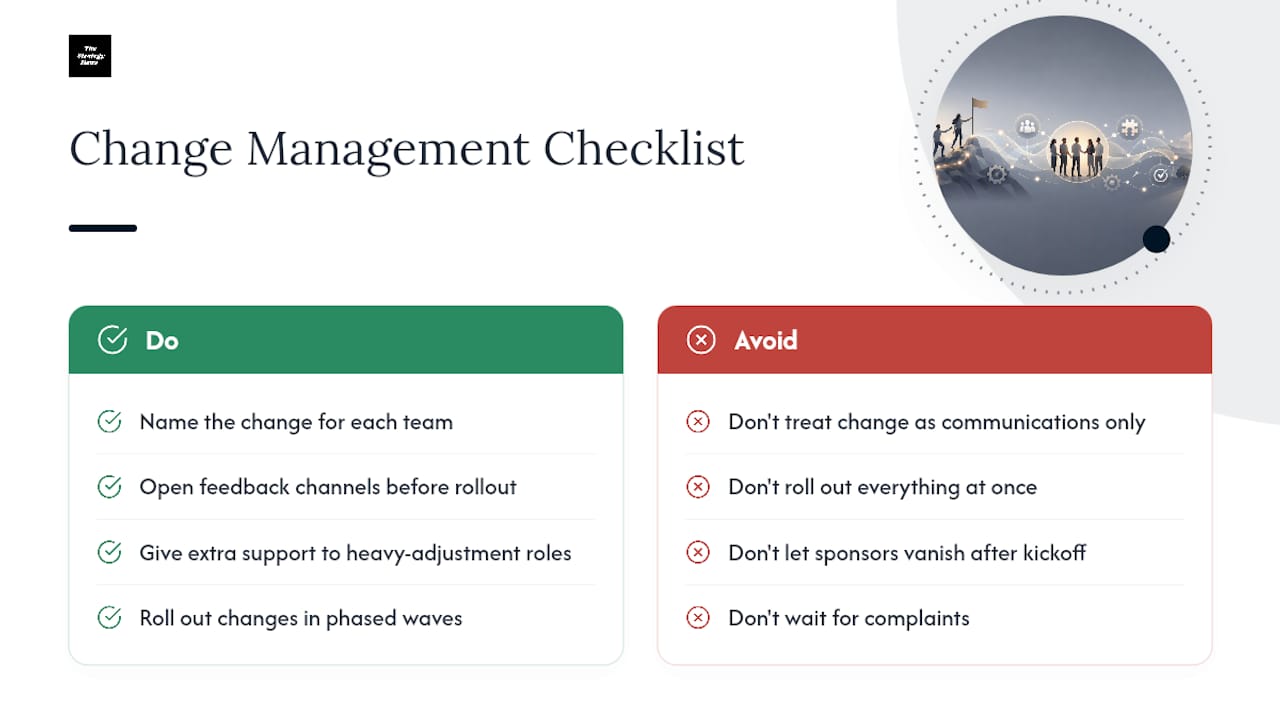
Start by naming what's actually changing for each team, not just what's changing at the company level. A sales team hearing "we're pursuing operational excellence" learns nothing useful; hearing "your weekly forecast call moves from Friday to Wednesday" tells them exactly what's different.
Build in a feedback channel before rollout, not after complaints start. A short survey or open office hour in week one catches confusion while it's still cheap to fix. Identify which roles carry the heaviest adjustment and give them extra support, a dedicated point of contact, more frequent check-ins, or a longer transition window.
Sequence change in waves rather than all at once when possible. A phased rollout lets you catch friction with one team before it multiplies across the whole organization. And keep leadership visibly involved past the kickoff; sponsors who disappear after the announcement send a signal that the change isn't really a priority, no matter what the memo said.
Training and Capacity Building for Involved Teams
Skills gaps are one of the quietest reasons strategic plans stall. Leaders assume teams can execute new processes or tools immediately, and then wonder why adoption crawls.
Audit capability against the plan's actual demands before rollout, not during it. If the strategy depends on a new CRM workflow or a different approval process, identify who has never used it and build training time into the timeline, not around it.
Short, role-specific training beats one long all-hands session every time. A 20-minute walkthrough tied to a person's actual daily tasks sticks better than a 90-minute overview of the entire plan. Pair new processes with a reference document people can return to later, since most training gets forgotten within a week without reinforcement.
Build capacity gradually by giving early adopters a head start and letting them become informal coaches for their teams. That spreads knowledge faster than a central training function ever can, and it gives the plan visible champions at the team level, which reinforces the communication tactics covered earlier.
Risk Management and Contingency Planning
Every strategic plan carries assumptions that might not hold, budget availability, a vendor delivering on time, a market not shifting underneath the plan. Naming those risks before they happen is far cheaper than reacting to them mid-execution.
For each major phase, list the two or three things most likely to derail it, and assign a likelihood and impact to each. This doesn't need to be an elaborate risk register, a short table reviewed at the monthly check-in works fine for most organizations.
For the highest-impact risks, write a one-line contingency in advance: what happens if the vendor misses the deadline, what happens if the key hire falls through. Decide the trigger point ahead of time too, so the response isn't improvised under pressure.
Revisit the risk list at every quarterly review, since the risks that mattered at kickoff are rarely the same ones that matter three months in.
Continuous Feedback Loops and Iterative Improvement
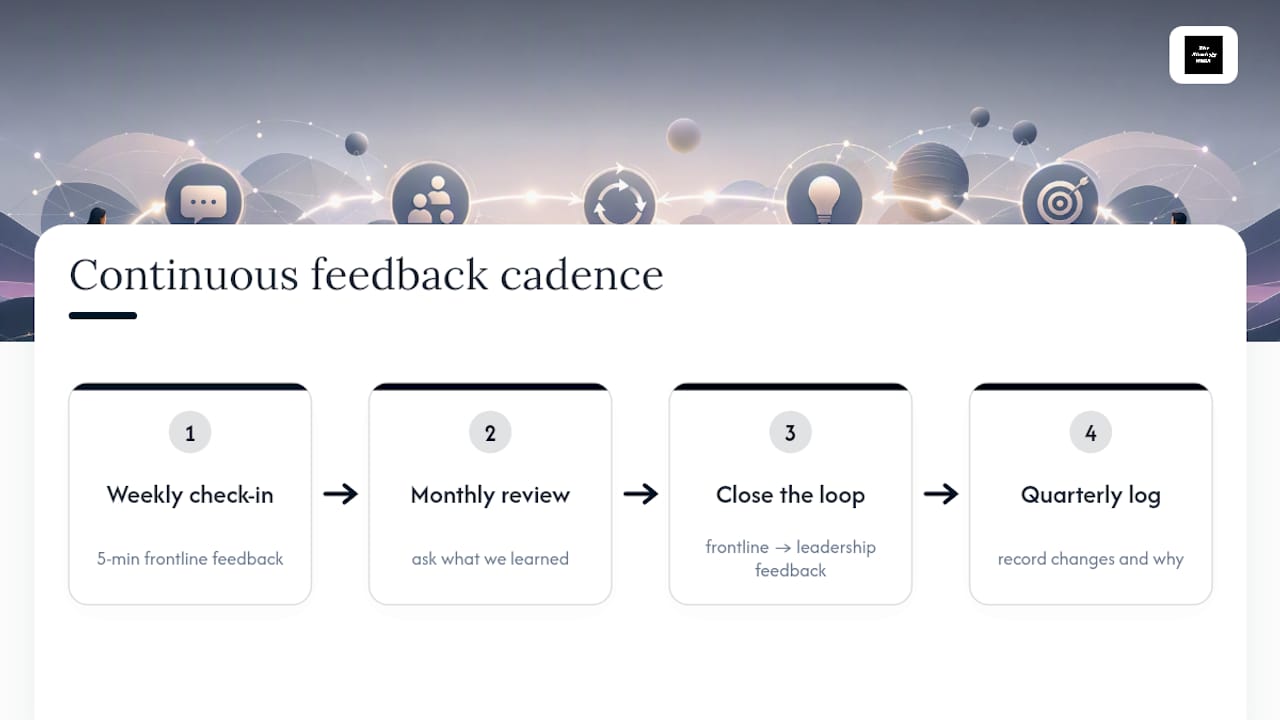
A strategic plan written once and never revisited is already out of date by the second quarter. The weekly and monthly cadence covered earlier isn't just for tracking progress, it's the mechanism for catching what needs to change.
Treat every monthly review as a chance to ask a different question than "are we on track": ask what you've learned that the original plan didn't anticipate. Markets shift, a competitor moves, a resource falls through, and a plan that can't absorb that information becomes a liability rather than a guide.
Close the loop with the people doing the work, not just with leadership. Frontline teams often spot friction weeks before it shows up in a lagging metric, and a short, simple channel for that feedback, even a five-minute item in the weekly check-in, catches it early. Balancing measurement discipline with room to adapt is one of the traits that separates plans that survive contact with reality from ones that don't.
Log what changed and why at each quarterly decision point. That record becomes the input for the next planning cycle, so lessons don't get relearned from scratch every year.
Why Execution Discipline Beats a Better Plan
Most failed strategies weren't bad ideas. They were good ideas with no single owner and no weekly forcing function to catch drift. Leaders who pick one priority, name one accountable person, and repeat the check-in every week, without skipping it when things get busy, outperform teams with more polished planning decks. Discipline in the repetition matters more than brilliance in the plan. When that discipline is missing internally, bringing in outside execution support can fill the gap faster than building it from scratch.
— Ashanti
Get Hands-On Support Implementing Your Strategic Plan
Some consulting firms specialize in closing the gap between well-written plans and poor execution by providing ongoing implementation support, including managing weekly cadences, holding owners accountable, and maintaining dashboards to catch drift early.
A typical engagement starts with a short diagnostic of where your current plan is stalling, followed by a roadmap that assigns real owners and phases, then hands-on implementation support to keep the cadence running. This fits leadership teams mid product launch, mid operational rebuild, or anyone who has a strategy document sitting untouched since the last planning offsite. If your plan needs someone to actually run the execution engine alongside you, book a consultation with Strategy Haus and start with the diagnostic.