

An SOP defines the process, and a work instruction defines the task. If you're deciding whether you need both, ask this: does the task require step-by-step detail at the exact spot where someone does the work? If yes, write a separate work instruction and link it to the SOP that governs the process around it.
TL;DR:
- A work instruction is necessary only when detailed, step-by-step guidance is required at a specific workstation, especially for high-risk or complex tasks.
- Work instructions are more frequently updated than SOPs due to changes in tools, suppliers, or methods, and should be published at the point of use for maximum effectiveness.
- Proper linking and version control between SOPs and work instructions are essential for compliance and audit readiness, with evidence like logs and checklists confirming they are used.
- Most organizations fail not because of poor documentation but because the instructions are not easily accessible at the moment of need.
- Use a straightforward decision process: if a task involves risk, variability, or requires frequent training, a detailed work instruction should be created and kept current.
Table of Contents
- SOP vs Work Instruction: What Is an SOP?
- SOP vs Work Instruction: What Is a Work Instruction?
- How Do SOPs and Work Instructions Actually Differ?
- When Do You Need an SOP, a Work Instruction, or Both?
- How Should You Organize and Publish These Documents?
- What Do Auditors Expect From SOPs and Work Instructions?
- A Quick Decision Test for Choosing the Right Document
- Why Documentation Only Works When People Actually Use It
- Where to Go for Deeper Standards Guidance
- Sources
SOP vs Work Instruction: What Is an SOP?
A standard operating procedure exists to govern a process, not to walk someone through a single task. It answers who does what, when, and why across an entire workflow, including what happens when something goes wrong. A procedure explains the flow of responsibility while leaving detailed execution to a separate document, and that division is what keeps SOPs from ballooning into unreadable manuals.
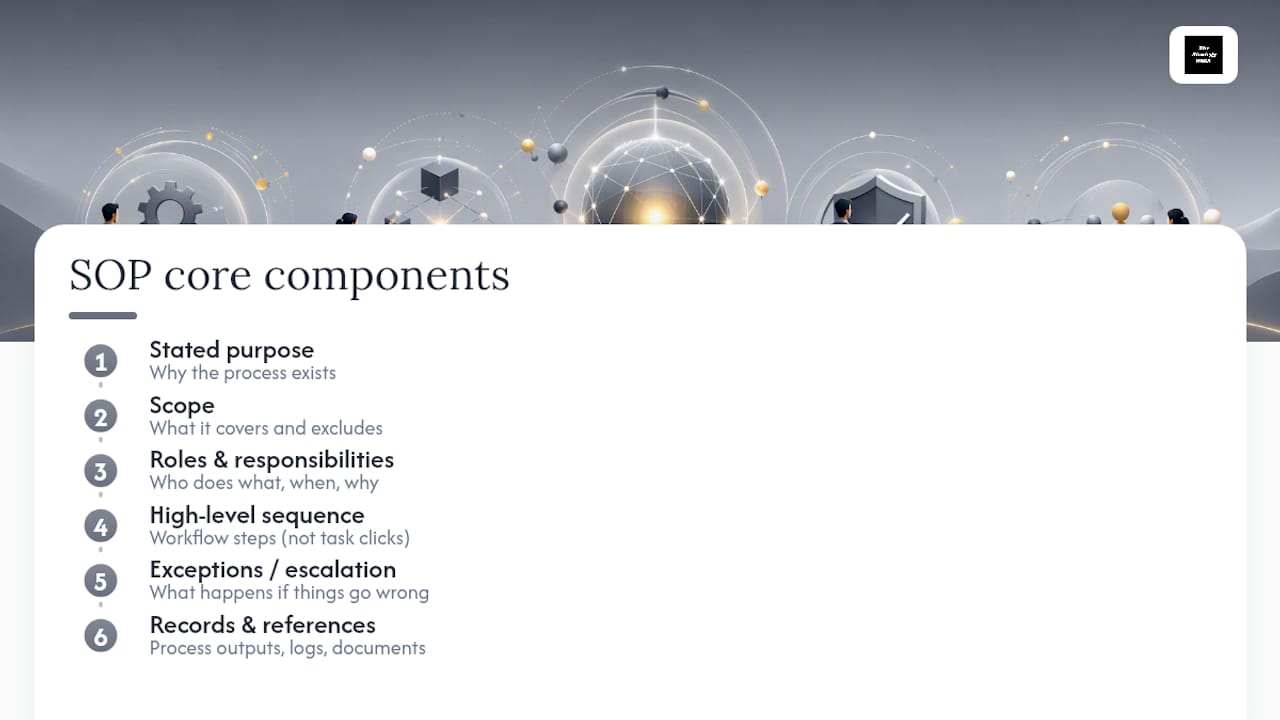
A well-built SOP usually includes six things: a stated purpose, the scope of what it covers and doesn't, defined roles and responsibilities, a high-level sequence of steps, exceptions or escalation paths, and a list of records or references the process generates. Notice what's missing: exact click paths, torque settings, or screen-by-screen instructions. That level of detail belongs elsewhere.
The audience for an SOP is different, too. Managers use it to confirm ownership. Auditors use it to trace accountability. Trainers use it to explain the shape of a process before drilling into specifics. Because of that audience, SOPs typically live in a formal document control system with version history, approval signatures, and a defined owner. Standard operating procedure examples that get this right tend to read more like a governance document than a how-to guide, because that's exactly what they are.
SOP vs Work Instruction: What Is a Work Instruction?
A work instruction exists for one purpose: to tell a specific person, standing at a specific workstation, exactly how to do one task correctly. It's ordered steps, acceptance criteria, and often the exact state a tool or machine should be in before and after each step. Where an SOP might say "inspect the unit before packaging," a work instruction says which gauge to use, what reading passes, and what a failed reading looks like in a photo.
Work instruction examples take a lot of different shapes depending on the environment. A laminated card bolted next to a machine works fine on a factory floor. A short screen-recorded video works better for software onboarding. A one-page visual guide with annotated screenshots works for anything involving a computer interface. The format should match wherever the person is standing when they need it, not wherever it's easiest to store.

The audience is narrower than an SOP's, mostly operators and apprentices doing the task directly, and that narrower focus is exactly why work instructions change more often. A new tool version, a supplier swap, or a tweak in equipment settings can force a WI update without touching the SOP above it at all. That churn is normal. Treating it as instability is a mistake that trips up a lot of teams.
How Do SOPs and Work Instructions Actually Differ?
The two documents solve different problems, and the confusion usually starts when someone tries to make one document do both jobs. An SOP governs the process; a work instruction executes the task inside it. Scope, audience, and level of detail all shift accordingly, and so does who owns the document and how often it gets touched.
Overlap happens most in smaller organizations where a single document tries to cover governance and execution at once. That works fine until the task gets more complex or a new hire needs granular guidance, at which point the combined document becomes too detailed for managers and too vague for operators. Splitting it once that tension shows up is usually cheaper than living with a document that serves nobody well.
| Dimension | Standard operating procedure | Work instruction |
|---|---|---|
| Governs | The process | The task |
| Primary audience | Managers, auditors, trainers | Operators, apprentices |
| Level of detail | High-level sequence and exceptions | Exact steps and acceptance criteria |
| Typical owner | Process owner or department lead | Task supervisor or trainer |
| Where it lives | Document control system | Point of use (station, terminal, kit) |
| Change trigger | Policy shift, org change, audit finding | Tool, supplier, or method change |
| Audit role | Shows accountability and control | Shows execution matched the standard |
Auditors expect a chain that runs from policy through SOP to work instruction to records, and a gap in that chain is one of the most common findings in a documentation review. If the SOP claims an inspection happens but there's no WI at the actual station describing it, that's a control gap, not a paperwork nitpick.
When Do You Need an SOP, a Work Instruction, or Both?
Not every process needs a work instruction, and writing one for every task just creates documentation nobody reads. Use these four factors to decide:
- Risk. If a mistake causes injury, regulatory exposure, or product failure, write a work instruction even for a task that looks simple.
- Complexity. If the task has more than a handful of steps or depends on conditional judgment, a work instruction removes ambiguity that an SOP's high-level language can't.
- Frequency of turnover. If new employees or temporary staff perform the task often, a work instruction shortens training time and reduces variation between people.
- Competence assumed. If reasonable, trained people could still perform a task differently from each other, that's the clearest signal a work instruction is missing.
An SOP alone is often enough for something like an approval workflow between departments, where the "how" is basically a conversation. A work instruction alone, without a governing SOP, works for a narrow, self-contained task with no cross-functional dependency. Most regulated or safety-relevant processes need both: the SOP to satisfy governance and audit trail, the work instruction to actually keep people safe and consistent at the bench.
How Should You Organize and Publish These Documents?
Every SOP and work instruction needs a stable identifier, something like a document number and version tag, so they can reference each other without ambiguity. The SOP should cross-reference every work instruction that supports it, and each work instruction should point back to the SOP it lives under. That two-way link is what auditors look for first.
Not every WI edit needs to trigger SOP review. A supplier swap or a minor tooling change can update the work instruction on its own, as long as the change doesn't alter what the SOP promises upstream. Save formal SOP review for changes that shift responsibility, sequence, or risk exposure.
Point-of-use publication matters more than most teams assume. A work instruction that requires someone to leave their station or dig through folders to find it stops functioning as a work instruction, no matter how well it's written.
- QR codes at the workstation linking straight to the current version
- One-page laminated cards for environments without reliable device access
- Mobile-accessible formats for distributed or field teams
- Translated versions and plain-language formatting where the workforce needs it
Pro Tip: Test your point-of-use delivery by timing how long it takes a new hire to find the instruction from a cold start. If it takes more than a few seconds, the placement is wrong, not the content.
What Do Auditors Expect From SOPs and Work Instructions?
Auditors check three things above all else: clear ownership of each document, visible links between SOP and WI, and evidence that the work instruction was actually followed. That last piece matters more than people expect. A perfectly written WI with no completed checklists, logs, or training records behind it looks unused, and unused documentation raises more questions than missing documentation.
Keep completed checklists, inspection logs, and training sign-off records as your primary evidence set. Review SOPs on a scheduled cadence, often annually or after a major policy shift, while work instructions get reviewed reactively, whenever a tool, method, or supplier changes underneath them.
A Quick Decision Test for Choosing the Right Document
Run through this before you write anything:
- Does the task carry real risk if done wrong? If yes, a work instruction is required.
- Could two trained people reasonably do it differently? If yes, write the WI.
- Does it get done rarely enough that written detail would go stale before anyone reads it? If yes, an SOP-level description may be enough.
- Will new or temporary staff need to perform it without direct supervision? If yes, a work instruction shortens the ramp.
If you land on "yes, write a work instruction," use a minimal template so it doesn't sprawl: task name, prerequisites, ordered steps, acceptance criteria, document owner, and version number. Assign the owner immediately, link it to its parent SOP, and publish it at the point of use before calling it done.
Why Documentation Only Works When People Actually Use It
Most organizations don't fail at writing SOPs. They fail at making sure a work instruction is sitting where someone needs it at the moment they need it. A technically perfect document buried three folders deep in a shared drive protects nobody and satisfies no auditor.
At Thestrategyhaus, we treat documentation as an execution problem first and a compliance problem second. That means building the SOP and work instruction structure alongside the actual workflow, then testing whether someone new to the task can follow it without asking a question. If they can't, the fix isn't more training. It's a shorter, better-placed work instruction.
If your team is drowning in documents nobody opens, Thestrategyhaus helps you rebuild the system around actual point-of-use behavior instead of paperwork for its own sake.
— Ashanti
Where to Go for Deeper Standards Guidance
For normative structure, start with ANSI's breakdown of ISO 10013:2021, which confirms there's no single mandated hierarchy, just a need for clear internal conventions. For a practical audit lens, The Auditor's take on procedures versus flowcharts and iSixSigma's comparison of SOPs and work instructions both fill in the sector-specific variation this guide couldn't cover in full.