

Start by creating a concise PMO mandate and getting executive sign-off on it, with a named sponsor attached. Once that's signed, run a 90-day pilot on two or three strategic projects, collect baseline KPIs, and hold your first steering committee review before you scale anything. That sequence, mandate first, pilot second, is the entire game. Everything else in this guide exists to help you execute those two moves well.
TL;DR:
- Choose a tightly focused PMO mandate and secure executive sign-off with a clear sponsor before launching a 90-day pilot on two to three strategic projects.
- Select your PMO type based on your organization's maturity, portfolio complexity, and leadership governance appetite, starting with supportive or light controlling models.
- Build a simple, one-page charter with definitive decision rights, stakeholder roles, and measurable success factors, supported by proportionate governance artifacts.
- Staff only essential roles such as a director, analyst, and process lead at first, using internal or fractional resources to minimize costs and resistance during the pilot.
- Track core KPIs like on-time delivery, budget variance, and stakeholder satisfaction from the outset, reporting honest results to build credibility and guide scaling decisions.
Table of Contents
- How To Set Up A PMO Step By Step
- Types Of PMOs And How To Choose The Right Model
- PMO Charter And Governance: What You Actually Need
- Staffing And Resourcing: Who To Hire First
- Choosing Tools And Templates Teams Will Actually Use
- The First 90 Days: A Pilot Launch Checklist
- KPIs That Prove The PMO Is Working
- Common PMO Setup Mistakes That Sink Momentum
- Why Execution, Not Planning, Decides Whether A PMO Survives
- Get Help Launching Your PMO The Right Way
- Sources
How To Set Up A PMO Step By Step
A PMO setup guide only works if it gives you an order of operations, not just a list of ingredients. Skip a step here and you'll feel it later, usually around week six, when someone on the leadership team asks why the PMO exists and nobody has a crisp answer.
Here's the sequence that holds up in practice:
- Build the business case first. Tie the PMO's existence to specific strategic objectives, whether that's faster product launches, fewer failed projects, or better resource visibility. Attach a rough expected return, even a directional one, because a business case without a number gets ignored in budget season.
- Secure a senior sponsor and get the mandate signed. This is the step people rush past and regret. Your sponsor needs to be someone with actual authority to resolve conflicts between departments, not just a cheerleader. PMI's guidance on PMO strategy and execution stresses that PMO form and function should be tailored to the organization, but the sponsor's authority is non-negotiable regardless of the model you pick.
- Choose your PMO type and pilot scope. Decide whether you're launching supportive, controlling, or directive (more on that below), and pick a governance structure to match: a RACI matrix, a steering committee, and stage gates that fit your organization's actual pace of decision making.
- Select your minimum viable toolset and templates before you staff up. Pick your project management information system, build your core templates, and decide what gets reported to whom, before you hire anyone beyond a director. Staffing around a tool nobody's chosen yet wastes months.
- Staff in order, onboard stakeholders, and run the pilot. Bring people in as the work demands them, not all at once. Run two to three pilot projects, gather baseline data, and adjust before you commit to a permanent structure.
A few things trip up teams at each stage:
- Business cases that promise transformation instead of a specific, measurable outcome tend to lose funding by month four.
- Sponsors who sign the charter but never show up to steering committee meetings undermine the PMO faster than any process gap.
- Governance built for a Fortune 500 portfolio, applied to a 40-person pilot, creates more friction than it prevents.
- Tool selection driven by IT preference rather than what project teams will actually open each morning kills adoption before it starts.
- Hiring a full team before the pilot proves anything locks in cost structure you can't easily unwind.
Pro Tip: Write your mandate to fit on one page. If you can't summarize the PMO's purpose, authority, and success metric in a single page, your sponsor won't be able to defend it in a budget meeting either.
Types Of PMOs And How To Choose The Right Model
PMI describes three broad PMO types, and picking the wrong one is the single most common reason new PMOs get sidelined within a year. PMI's framework for PMO strategy recommends tailoring the model to the organization rather than defaulting to whichever version looks most impressive on paper.
- Supportive PMOs act as a consulting resource. They offer templates, training, and best practices, but carry no real authority over how projects run. This fits organizations with mature project managers who need better tools, not more oversight.
- Controlling PMOs require compliance with specific frameworks, templates, and governance checkpoints. Projects must use the PMO's methods, though the PMO doesn't run the projects directly. This suits organizations with inconsistent project outcomes and a real appetite for standardization.
- Directive PMOs actually manage the projects. Project managers report into the PMO, and the PMO controls the projects directly. This fits organizations running complex, high-stakes portfolios where consistency matters more than local autonomy.
Your decision comes down to three factors: how mature your current project practices are, how much governance appetite your leadership team actually has (not the appetite they claim to have), and how complex your portfolio is right now, not where you hope it'll be in three years.
Most organizations do better starting supportive or lightly controlling, then expanding authority once the pilot proves value. Jumping straight to a directive model before anyone trusts the PMO usually triggers resistance from project managers who feel like they've lost control overnight. The exception is a genuine crisis, repeated project failures, blown budgets, missed launches, where leadership already wants stronger central control and will back it from day one.
PMO Charter And Governance: What You Actually Need
Your PMO charter is the document that keeps the PMO from getting quietly ignored the first time a delivery team decides governance is optional. Gartner's guidance on PMOs treats clear decision rights as the core defense against exactly that kind of bypass.
A working PMO charter template needs these sections, drawn from the structure Projectmanagement:
- Statement of purpose: why the PMO exists, in plain language.
- Stakeholders and customers: who the PMO serves and who it answers to.
- Services offered: what the PMO will and won't do in its first phase.
- PMO structure: supportive, controlling, or directive, plus reporting lines.
- Roles and responsibilities: who owns what, tied to a RACI matrix.
- Critical success factors and measures of success: the specific metrics that define whether the pilot worked.
- Sponsor sign-off: a dated signature, not just an email approval.
Beyond the charter itself, you need governance artifacts that give the mandate teeth: terms of reference for your steering committee, a documented escalation path for when project teams and the PMO disagree, a stage-gate checklist for major decision points, and a reporting cadence everyone actually follows.
Pro Tip: Keep governance proportionate to what you're actually managing. A stage-gate process built for a $10 million portfolio, applied to a three-project pilot, will get bypassed within a month because it slows everything down without adding proportional value.
The most common governance failure isn't too little structure. It's structure nobody uses because it doesn't match the pace of real decisions.
Staffing And Resourcing: Who To Hire First
Overstaffing before you've proven anything is one of the fastest ways to make a PMO look like overhead instead of value. Practitioner guidance on early PMO builds recommends a lean, staged hiring order, and Gururo's PMO structure guide is explicit that overhiring before value is demonstrated undermines credibility with the same executives you need for renewal funding.
A minimum launch team, hired roughly in this order:
- PMO director: owns the mandate, sits with the sponsor, makes the first governance calls.
- PMO analyst: builds and maintains the reporting, tracks the pilot KPIs, keeps the dashboard honest.
- Process lead: documents the templates and workflows so they survive turnover.
- Portfolio manager: added once you're managing more than the initial pilot projects.
- Change lead: added when adoption resistance becomes the bigger risk than process gaps.
You don't need to hire every one of these roles as permanent staff before launch. Internal secondments work well for the process lead role, since someone who already knows how projects actually get done internally will build more credible templates than an outside hire. Fractional or contract hires can cover the analyst role during the pilot if budget is tight. Short consulting engagements can fill gaps in governance design or tool configuration without committing to headcount before the pilot proves anything.
Whatever mix you choose, build a short training and coaching plan alongside it. Project managers who feel like the PMO is auditing them will resist it quietly, missing status updates, working around the new templates. A coaching approach, where the PMO helps teams succeed rather than just checking compliance, heads off that resistance before it calcifies.
Choosing Tools And Templates Teams Will Actually Use
The tool you pick matters less than whether project teams will actually open it. Planisware's guidance on building a PMO makes the point directly: sophisticated software doesn't guarantee PMO success, and a project management information system should serve the PMO's users, not the other way around.
Judge any tool against four criteria: how easy it is for a non-project-manager to use without training, whether it produces the reports your executives actually want to see, whether it integrates with the systems your teams already live in (email, chat, existing trackers), and whether it's focused on producing real deliverables rather than just tracking activity.
Before you buy anything, build these five templates:
- A one-page project charter.
- A weekly or biweekly status report format.
- A risk register with a simple scoring method.
- A change log that captures scope shifts and who approved them.
- A portfolio dashboard that rolls individual project status into one view.
Design your reporting in layers. Project teams need granular, weekly detail. The PMO needs a portfolio-level view updated on the same cadence. Executives need a monthly summary with three or four numbers, on-time delivery, budget variance, and a plain-language note on risk, not a 20-tab spreadsheet. Building one report and forcing everyone to read the parts relevant to them is the fastest way to lose executive attention entirely.
The First 90 Days: A Pilot Launch Checklist
A short, credible pilot is how new PMOs earn the right to exist past their first budget cycle. PMI's guide to building a PMO from the ground up recommends exactly this approach: treat the setup itself as a project, with a defined pilot window and a performance audit at the end of it.
Here's a workable 12-week breakdown:
- Weeks 0 to 2: Interview key stakeholders and inventory active projects. This tells you what's actually running, what's failing quietly, and what baseline numbers you're working from before you change anything.
- Weeks 2 to 4: Finalize and publish the signed mandate. Configure your core tools and roll out the five essential templates to the pilot project teams.
- Weeks 4 to 10: Run the pilot on two or three strategic projects. Collect KPI baselines weekly, and treat early feedback from project teams as data, not noise to ignore.
- Weeks 10 to 12: Hold your first steering committee review. Publish a short 90-day report covering what worked, what the KPIs show, and a clear recommendation: scale the model, adjust it, or extend the pilot with specific changes.
This structure mirrors what a similar 30/90-day project management plan for startups recommends for any new operational function trying to prove itself fast: short windows, real deliverables, a hard checkpoint. The point of the 90-day frame isn't ceremony. It's giving leadership a fixed date where they see real numbers instead of promises.
KPIs That Prove The PMO Is Working
Set your KPI baselines before the pilot starts, not after. Practitioner guides on building a PMO consistently point to the same core measures: on-time delivery rate, budget variance, and resource utilization as the metrics that actually persuade skeptical leadership teams.
Track these five at minimum:
- On-time delivery rate: the percentage of pilot projects hitting agreed milestones.
- Budget variance: how far actual spend deviates from the approved plan.
- Resource utilization: whether people assigned to pilot projects are actually working at capacity, not double-booked into invisibility.
- Benefits realization: whether the outcomes promised in the original business case are showing up.
- Stakeholder satisfaction: a short survey of project sponsors and team leads after the pilot.
Set targets at three intervals, a rough baseline at 90 days, a firmer target at six months, and a maturity target at twelve months. At your first steering committee meeting, report the baseline numbers plainly rather than dressing them up. A PMO that shows honest early numbers and a credible improvement trend earns more trust than one that oversells results it can't yet back up.
Common PMO Setup Mistakes That Sink Momentum
Most failed PMO launches trace back to one of four repeatable mistakes.
- An unclear mandate. If the sponsor never formally signs off, the PMO has no real authority the first time a delivery team pushes back. Fix it by requiring a dated signature on a one-page mandate before you do anything else.
- Governance that's too heavy for the portfolio's actual size. Stage gates built for enterprise complexity, applied to a small pilot, get quietly bypassed. Match governance weight to what you're actually managing.
- Overstaffing before the pilot proves value. Hiring a full team on day one locks in cost structure before anyone's confirmed the model works. Start lean and scale after the KPIs justify it.
- Choosing tools before understanding the users. A PMIS selected for its feature list, not for what your project teams will actually open daily, fails on adoption within weeks.
Why Execution, Not Planning, Decides Whether A PMO Survives
Most PMO failures aren't planning failures. Organizations write reasonable charters and pick reasonable governance models constantly. What kills PMOs is the gap between the signed mandate and the first proof of value, the months where nobody's coaching the pilot teams through the new templates or tracking whether the KPIs are even being collected correctly.
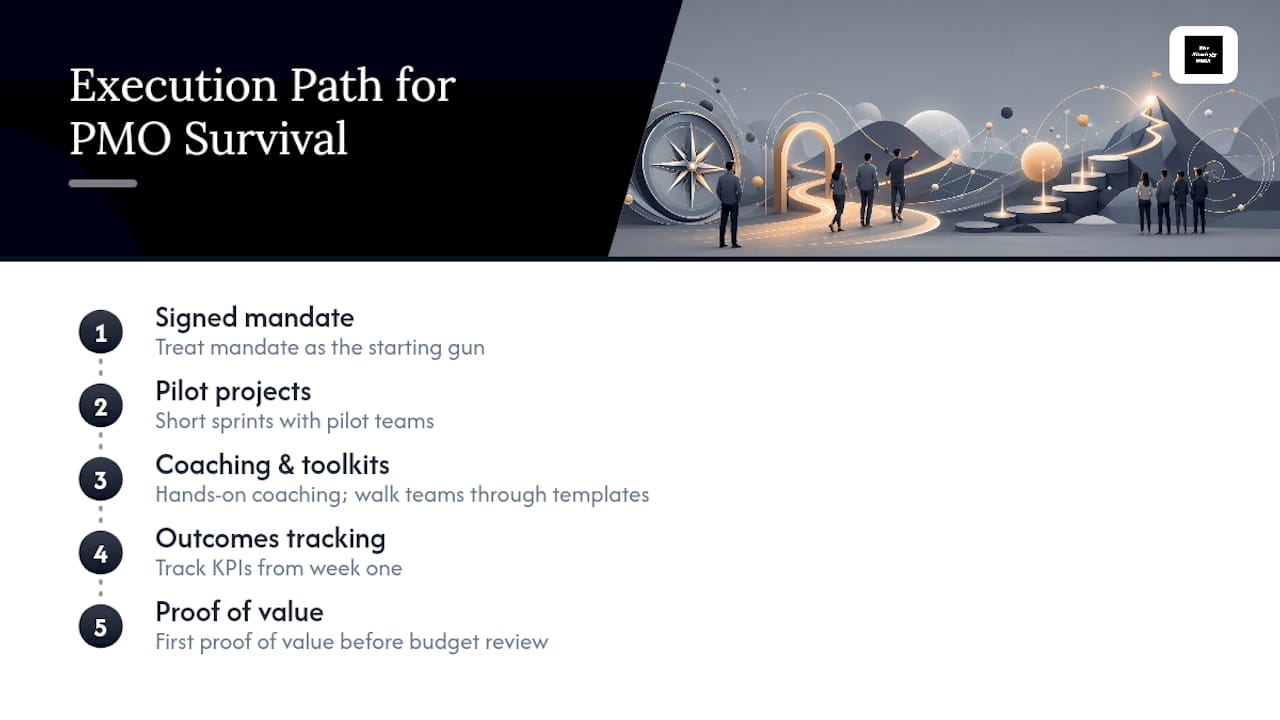
An execution-first approach treats the mandate as the starting gun, not the finish line. Effective PMO rollouts involve short sprints, hands-on coaching for pilot teams, and operational toolkits that get used because someone walks the team through them, rather than emailing a template and hoping. Outcomes tracking runs alongside the pilot from week one, not bolted on after the fact when leadership starts asking questions.
That sequence, mandate, pilot, coaching, measured outcomes, is what separates PMOs that survive their first budget review from ones that quietly disappear.
— Ashanti
Get Help Launching Your PMO The Right Way
If you've read this far, you already know the hard part isn't understanding the steps. It's executing them while running your actual job. Consultants can work directly with PMO leaders and organizational decision-makers to turn a signed mandate into a working 90-day pilot, avoiding the months of trial and error teams often spend figuring out governance weight, tool selection, and staffing order on their own.

Consulting engagements can cover the full setup process: building the business case, drafting the charter, designing proportionate governance, and coaching pilot teams through the first 90 days so the KPIs reported to steering committees are ones that can be defended. For teams tackling the operational side of a rollout, operationalizing service delivery alongside the PMO launch is worth planning for at the same time, not after.
If you're ready to move from a mandate on paper to a pilot with real numbers behind it, start with Thestrategyhaus's business strategy and project management services and get a plan built around your organization's actual pace, not a generic template.