

An operating rhythm is a decision pipeline, not a calendar. It's the repeating set of rituals, data sources, and decision rights that turns raw performance signals into named actions with owners and deadlines. Get it right and you catch problems weeks earlier, remove ambiguity about who decides what, and make follow-up automatic instead of optional.
That's the payoff. Here's what a working rhythm delivers for a leadership team:
- Faster detection of issues before they become quarter-killing surprises
- Clear ownership attached to every metric and every decision
- Predictable follow-up so actions don't die in a slide deck
The rest of this guide walks through the four cadence layers, the scorecards that feed them, and a 90-day plan to build one without drowning your team in meetings.
Key Takeaways
An operating rhythm works because it assigns each meeting frequency a specific class of decision, backed by a scorecard with named owners.
| Point | Details |
|---|---|
| Cadence is a decision pipeline | Rituals, a single source of truth, and clear decision rights, not just a shared calendar. |
| Match frequency to decision class | Daily handles triage, weekly diagnoses and assigns, monthly reallocates, quarterly resets targets. |
| Scorecards need named owners | Track five to seven metrics per layer, each tied to one person accountable for movement. |
| Roll out in stages | Start with one weekly review, add monthly by week 12, run the first QBR in quarter two. |
| Get hands-on help scaling it | Thestrategyhaus builds the scorecards, meeting templates, and escalation rules with your leadership team. |
Table of Contents
- What Is Operating Cadence, and How Does It Differ From a Meeting Schedule?
- How Should You Structure Daily, Weekly, Monthly, and Quarterly Reviews?
- How Do You Build Scorecards and Assign Decision Rights?
- How Do You Roll Out an Operating Rhythm in 90 Days?
- How Strategy Haus Helps Leaders Turn Cadence Into a Real System
- How Does an Operating Rhythm Mature Over Time?
- What Does an Operating Rhythm Look Like at Different Company Sizes?
- What Tools Actually Support an Operating Rhythm?
- How Do Communication Habits Keep an Operating Rhythm Alive Between Meetings?
- How Should Remote and Hybrid Teams Adjust Their Operating Rhythm?
- Sources
What Is Operating Cadence, and How Does It Differ From a Meeting Schedule?
An operating rhythm rests on three parts: recurring rituals, a source of truth for the numbers, and clear decision rights. Miss any one of those and you get a meeting schedule that looks organized but produces nothing.
The difference matters more than it sounds. A meeting schedule tells people where to be. An operating cadence tells them what decision gets made there, using what data, and who owns the outcome. Fairview's framework for operating cadence makes this distinction directly: cadence prespecifies decision rights and pre-populates the metrics before anyone walks in. Without that structure, you get what practitioners call "meeting theater": people reciting updates that were already visible in a dashboard, then leaving without deciding anything.
The mechanics of a working cadence follow a simple logic:
- Data gets collected and standardized in one source of truth, not five spreadsheets.
- A recurring ritual reviews that data at a frequency matched to how fast the underlying work moves.
- A named owner has the authority to decide, right there, without escalating.
- The decision gets logged as an action with a deadline, and someone checks it at the next cycle.
A cadence built this way often reduces total meeting hours, because routine status updates move to async channels and the actual meeting time gets reserved for exceptions and calls that need a room full of the right people, a point Fairview also emphasizes. The risk of skipping this design work isn't just wasted time. It's late discovery: the moment a leader learns about a problem three weeks after it was fixable.
How Should You Structure Daily, Weekly, Monthly, and Quarterly Reviews?
Operating cadence works because each frequency owns a specific class of decision. Rhythms lays this out clearly: daily handles triage, weekly handles diagnosis and action assignment, monthly handles resource shifts, and quarterly resets the targets themselves. Mixing those classes, letting a weekly stand up drift into a strategy debate, is one of the fastest ways to break a rhythm.
Duration and format should scale with the stakes. A 15-minute daily huddle can't carry a half-day strategic reset, and forcing a quarterly-level decision into a daily slot just means it gets made badly and fast.
| Layer | Time investment | Who attends | Decision owned |
|---|---|---|---|
| Daily | 15 minutes | Frontline team, team lead | Binary calls: proceed, block, or escalate |
| Weekly | 60–90 minutes | Team leads, functional managers | Diagnose gaps, assign named actions |
| Monthly | Half day | Department heads, senior leaders | Reallocate resources, fix broken processes |
| Quarterly | Half day to full day | Executive team, sometimes offsite | Reset targets, test assumptions, strategic pivots |
These durations aren't arbitrary. PMGuru's research on scaling operating cadence converges on roughly the same windows across multiple organizations, because the format matches the size of the decision each layer is built to make.
A few operating rules keep the layers from bleeding into each other:
- The weekly review needs a pre-read and a live scorecard. No one should be building slides during the meeting.
- Monthly sessions exist to move resources, headcount, budget, priority, not to relitigate weekly tactics.
- Quarterly resets are the only layer authorized to change targets or kill an initiative outright.
- Escalate immediately, don't wait for the next scheduled layer, whenever the current level lacks the authority or the data to decide.
That last rule is the one most teams skip, and it's usually why small problems sit unresolved for a month.
How Do You Build Scorecards and Assign Decision Rights?
A scorecard works when it ties an objective to a small set of key results, each with a named owner. Without an owner, a metric is just a number nobody feels responsible for moving.
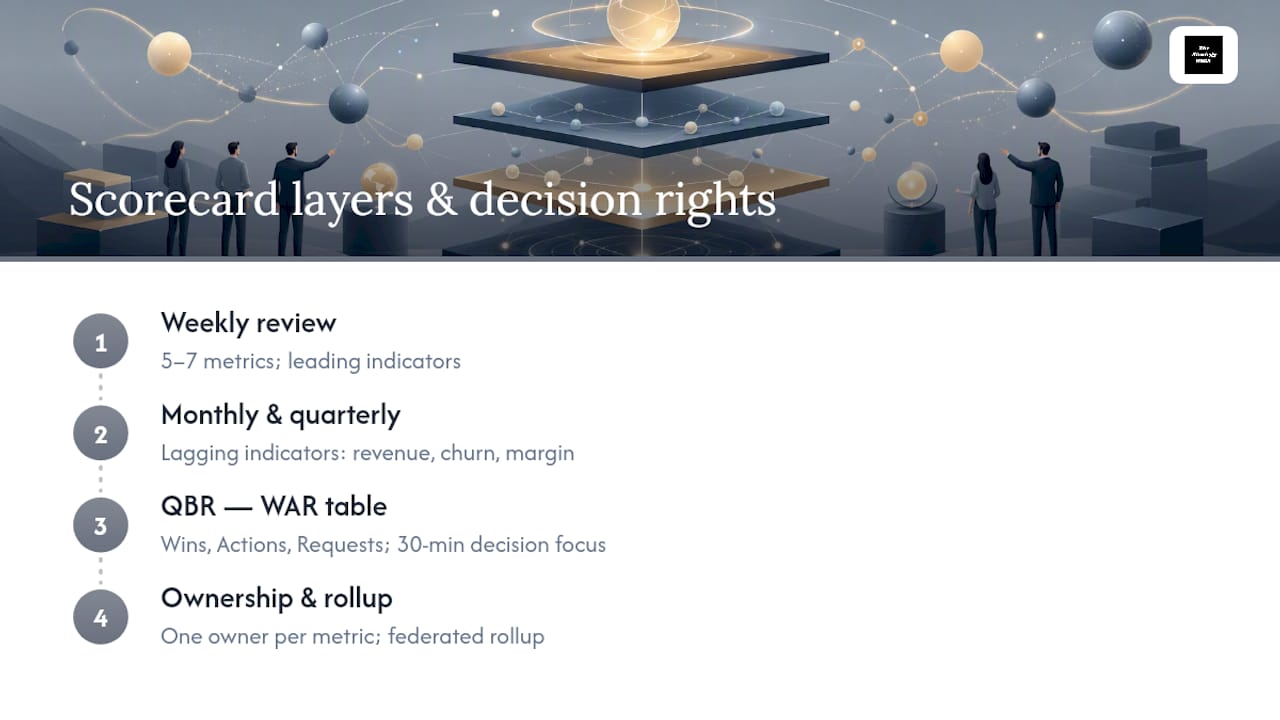
Pick five to seven metrics for the weekly review, no more. Leading indicators (pipeline created, cycle time, defect rate) belong in the weekly cadence because they give you time to react. Lagging indicators (revenue, churn, quarterly margin) belong in the monthly and quarterly layers, where the decision is about resource allocation or strategic direction rather than this week's execution. A resource like Cognistry's work on decision systems is useful here for thinking through how goals, metrics, and recurring practices connect structurally rather than as isolated dashboards.
For quarterly business reviews, the WAR table format, Wins, Actions, Requests, gives structure that a status deck never will. HashiCorp's own operating cadence runs 30-minute QBRs built entirely around reviewing the WAR table, with participants reading it beforehand so the meeting time goes to decisions, not narration.
Pro Tip: Assign one owner per metric, not per team. "The sales team owns pipeline conversion" invites diffusion of responsibility. "Maria owns pipeline conversion" doesn't.
If you run multiple product lines or regions, segment your scorecards by unit but keep a central rollup visible to everyone. HashiCorp calls this federated accountability with central visibility: local teams own their numbers, leadership sees the whole picture without micromanaging each one.
How Do You Roll Out an Operating Rhythm in 90 Days?
Start with one ritual, not four. Launching daily, weekly, monthly, and quarterly reviews simultaneously guarantees fatigue and half-hearted attendance. PMGuru's guidance on scaling cadence is blunt about this: begin with the weekly execution review, prove it changes decisions, then layer in monthly and quarterly.
Before you launch anything, build four templates: a one-page pre-read, a standard weekly agenda, a scorecard with named owners, and an action tracker that carries items from one week to the next.
- Weeks 1 to 4: Pilot the weekly review only. Same day, same time, same five to seven metrics. Judge it by whether decisions actually get made, not by attendance.
- Weeks 5 to 12: Add the monthly session once the weekly rhythm is producing real actions. Use it strictly for resource and process decisions the weekly layer can't make on its own.
- Quarter 2: Run your first formal quarterly business review, built around a WAR table, with participants reading it in advance.
- Ongoing: Revisit the daily layer only if frontline teams need faster triage than the weekly cadence provides.
Watch for two failure modes as you scale. The first is meeting theater, sessions that run on schedule but produce no decisions because no one has clear authority in the room. The second is missing ownership, where an action gets discussed but no single person is on the hook for it by the next cycle. Workhint's research on operating rhythm pitfalls flags both as the most common reasons rollouts stall, alongside starting too many layers at once.
How Strategy Haus Helps Leaders Turn Cadence Into a Real System
Thestrategyhaus works with leadership teams to convert a strategic plan into the rituals, scorecards, and decision rights that actually run week to week. The gap most teams hit isn't a lack of strategy. It's the absence of a system that translates that strategy into repeatable action.
External support tends to earn its cost when the barrier isn't knowledge but capacity or cross-functional friction, when department heads agree on the destination but can't align on who owns what between them.
Signals that suggest it's time to bring in outside help:
- Your leadership team can describe the strategy but can't describe this week's top three decisions
- Scorecards exist but no one owns the numbers on them
- Cross-functional priorities keep colliding at the monthly review with no resolution process
How Does an Operating Rhythm Mature Over Time?
A first-year operating rhythm looks nothing like a five-year one, and expecting otherwise sets teams up to abandon the whole effort at the first rough patch.
Stage one is survival: a single weekly review, inconsistent attendance, scorecards built by hand. The goal here is simply proving that a scheduled decision point beats no decision point, which it almost always does.
Stage two is standardization. The weekly ritual has a fixed agenda, a scorecard with named owners, and a pre-read that people actually open before the meeting. Monthly reviews get added, focused strictly on resource and process decisions.
Stage three is integration, where the quarterly layer runs formally, usually with a WAR table, and the outputs of one layer visibly feed the next: a weekly action that stalls twice becomes a monthly agenda item, and a pattern across three monthly reviews becomes a quarterly reset topic.
Stage four is where automation and connected tooling start replacing manual prep, pulling live data into the scorecard rather than someone rebuilding it in a spreadsheet every Friday night. Few organizations reach this stage in the first year, and rushing toward automation before the rituals are stable usually just automates confusion faster.
The honest marker of maturity isn't how sophisticated the tooling looks. It's whether a new hire could sit in any layer of the rhythm and understand, within minutes, who owns the decision on the table.
What Does an Operating Rhythm Look Like at Different Company Sizes?
A ten-person startup and a five-hundred-person division need the same underlying logic, decisions matched to the right frequency and owner, but the formats look nothing alike.
At a small team, the weekly review often is the entire operating rhythm. One 60-minute session covers what would elsewhere be split across weekly and monthly layers, because there's no organizational distance between frontline work and resource decisions. The founder or team lead usually holds decision rights across most metrics directly.
At a mid-size company running multiple functions, the four-layer structure earns its complexity. Sales might run a daily 15-minute pipeline huddle, marketing a weekly campaign review, and the leadership team a monthly cross-functional session where budget gets reallocated between departments that don't talk otherwise.
At the enterprise level, industry shapes the template as much as size does. A software company's quarterly review might center on adoption and retention metrics tied to a WAR table, the same format HashiCorp uses. A manufacturing operation's monthly layer might focus almost entirely on throughput and defect rates, with the weekly cadence dedicated to supply chain exceptions rather than sales pipeline. A professional services firm often centers its weekly rhythm on utilization and project margin instead of either.
The template changes. The principle, that each layer owns one class of decision, holds constant across all three.
What Tools Actually Support an Operating Rhythm?
Software doesn't create an operating rhythm, but the right tools remove the manual overhead that kills one. The distinction matters because plenty of teams buy a dashboard tool and mistake the purchase for the design work.
Scheduling and meeting management tools keep the rhythm's timing consistent, the unglamorous but essential job of making sure the weekly review actually happens at the same time every week without three reschedules. Project and task tracking platforms hold the action tracker between cycles, so a decision made on Tuesday doesn't quietly disappear by the following Tuesday.

Metrics and scorecard platforms matter most at the monthly and quarterly layers, where data needs to roll up from multiple teams into one central view without each department rebuilding its own version. Connected, automated tooling can go further: Rhythms.ai describes platforms that pull live data automatically, generate review materials, and trigger playbooks when a metric crosses a threshold, cutting the hours a team spends on what practitioners call "work about work."
That automation is genuinely useful once a rhythm is stable. It's a poor substitute for the design work earlier: deciding which five to seven metrics matter, who owns each one, and what decision each layer is authorized to make. A well-connected dashboard feeding an undefined meeting just produces theater faster.
How Do Communication Habits Keep an Operating Rhythm Alive Between Meetings?
An operating rhythm dies quietly in the gaps between meetings if nothing carries the thread from one session to the next. The ritual itself is only half the system; the documentation and communication around it is the other half.
Async channels should absorb routine status updates entirely, freeing meeting time for exceptions and decisions rather than recitation. If a Slack channel or a written weekly update can answer "where do things stand," the live meeting shouldn't be spending time on it.
Written pre-reads matter more than most teams treat them. A scorecard and a short narrative sent 24 hours ahead lets people arrive ready to decide instead of ready to be informed for the first time. The action tracker, meanwhile, needs to be visible outside the meeting itself, not buried in someone's personal notes, so an owner can be reminded of a commitment without waiting for the next cycle to surface it.
Documentation practices that separate decisions from discussion tend to age better than raw meeting notes. A short log of "what we decided, who owns it, by when" outlives a transcript of who said what, and it's what a new hire or a returning executive can scan in two minutes to understand where things stand.
How Should Remote and Hybrid Teams Adjust Their Operating Rhythm?
Remote teams lose the informal hallway update that used to carry half the daily triage, which means the formal daily and weekly layers have to work harder than they do in an office.
The daily layer often needs to become fully async for distributed teams spanning multiple time zones, a written check-in rather than a synchronous huddle, with a synchronous version reserved for genuine blockers that need real-time discussion. Weekly reviews stay synchronous because diagnosis and action assignment benefit from real conversation, but recording the session matters more for remote teams, since someone in a different time zone needs to catch up without waiting a full week.
Pre-reads carry more weight in a remote setting because there's no shared physical room to absorb context informally beforehand. A scorecard sent with real lead time, not an hour before the call, does more work for a distributed team than it does for a co-located one.
Monthly and quarterly layers translate reasonably well to remote formats since they're less frequent and can justify a longer synchronous block or even a rare in-person offsite. What doesn't translate is skipping the documentation step: hybrid teams that rely on "we'll just talk about it at the next meeting" lose far more continuity than co-located teams do, simply because there's no shared hallway to fill the gap.
The One Habit That Determines Whether a Rhythm Actually Sticks
Most rollouts fail not from the wrong template, but from treating cadence as reporting instead of a decision forum. Enforce decision rights ruthlessly: a named owner decides, on the spot, or the item escalates immediately. Teams that hold this line often see one weekly review save an entire quarter's worth of drift.
— Ashanti
Thinking About Bringing In Help to Build This Out?
Designing an operating rhythm from scratch while running the business at the same time is where most leadership teams stall, not from lack of understanding, but from lack of hours. Thestrategyhaus builds the rhythm with you instead of leaving you to translate a framework into your own meetings, scorecards, and escalation rules alone.
An engagement typically runs as a short workshop to map your decision classes, followed by an implementation sprint that produces your actual templates: pre-read format, weekly agenda, scorecard, and action tracker, built around your metrics rather than a generic model. Clients come out with scorecards that already have named owners, meeting formats that fit their team size, and escalation rules that remove the guesswork about who decides what. For teams that want the rhythm to keep running without a consultant in the room permanently, ongoing operations support keeps it maintained as the business changes.
If your weekly reviews currently produce updates instead of decisions, that's the exact gap this closes. Visit the Strategy Haus services page to scope what a workshop or implementation sprint would look like for your team.
Sources
- How HashiCorp works — Operating cadence (HashiCorp)
- Operating cadence: structuring meetings and decisions (Fairview)
- Rhythms