

Launch a pilot in one week, run weekly 20-minute check-ins, and write 1-2 outcome objectives per team with 2-3 measurable key results and one named owner each. Book your first check-in within 72 hours. Score every KR at cycle's end using a 0.7 to 0.8 target, not a perfect 1.0.
TL;DR:
- Teams that move quickly from decision to first check-in see significantly higher cycle completion rates, with increases of up to 50 percent.
- Focus on a small pilot group, clearly assign owners, and set a recurring weekly check-in for optimal early momentum and habit formation.
- Limit objectives to one or two per team with three key results each, ensuring all KRs have measurable outcomes and a single owner.
- Conduct concise weekly check-ins of 15 to 20 minutes, focusing on KR progress, blockers, and next actions to sustain engagement.
- Leadership should write their own OKRs, participate in weekly routines, and maintain transparency to build trust and drive widespread adoption.
Table of Contents
- What Should You Do in Week One of OKR Implementation?
- The Five-Phase OKR Rollout: Day 1 to Week 12
- How Do You Write Effective Objectives and Key Results?
- What Does a Good Weekly Check-In Actually Look Like?
- Common OKR Pitfalls (And How to Fix Them)
- Choosing the Right Tools and Building Your Launch Template
- Strategy Haus's Approach to Turning OKR Plans Into Delivery
- How Do You Keep OKRs Transparent Across the Organization?
- How Do You Train Teams to Adopt OKRs?
- How Do You Get Leadership Buy-In for OKRs?
- The One Habit That Determines Whether Your First Cycle Sticks
- How Strategy Haus Helps You Move From Plan to Delivery
- Sources
What Should You Do in Week One of OKR Implementation?
Speed beats polish in week one. Decide your pilot scope first: either leadership alone or one cross-functional team, never the whole company at once. Then lock these five items before Friday:
- Scope and size: Pick a pilot group small enough to move fast, whether that's the leadership team or a single department.
- Owners and roles: Name a sponsor, a program lead, and one or two OKR coaches who will chase updates.
- Calendar blocks: Set the cycle start date, a recurring weekly check-in slot, a week 6 mid-cycle review, and a week 12 retrospective.
- Visibility surface: Stand up a shared doc or simple dashboard so anyone can see progress without asking.
- Communication draft: Write a short note explaining why OKR implementation matters now and what's expected of each team.
Teams that move from decision to first check-in in under a week see notably higher first-cycle completion rates, with benchmarks citing gains as high as 50 percent, according to Okrstool. Momentum built early carries through the rest of the cycle.
The Five-Phase OKR Rollout: Day 1 to Week 12
A successful OKR implementation guide breaks the work into five phases, each with a tight deadline. Rushing the paperwork and slowing down on execution is the opposite of what works.
Phase 1: Align on purpose (Day 1 to 2). Leadership meets for a half-day session to agree on why OKRs matter this cycle and what problem they're solving. The output is a one-line "why" statement everyone in the pilot can repeat from memory. Skip this and every team drafts objectives that drift in different directions.
Phase 2: Set cycle structure (Day 2 to 3). Decide your cadence (most pilots run 12-week cycles), then book the weekly check-in slot and the retrospective date before anything else fills the calendar. A recurring 20-minute weekly check-in, blocked before day one, is what separates teams that finish the cycle from teams that quietly abandon it, per okrstool.com's step-by-step guide.
Phase 3: Write and align OKRs (Day 3 to 5). Leadership sets 1-2 company objectives. Teams draft their own in parallel half-day sessions, then meet for a 30-minute cross-team alignment review to catch overlap and conflict. Every key result gets one named owner before this phase ends.
Phase 4: Launch and execute (Weeks 1 to 11). Attach 2-3 concrete initiatives to each KR immediately so the goal connects to real work, not just intention. Run the weekly check-in without fail. Hold the mid-cycle review at week 6 to catch KRs that have stalled while there's still time to course-correct.
Phase 5: Retrospective and reset (Week 12). Score every KR honestly. A range of 0.7 to 0.8 signals a healthy stretch goal. Scoring 1.0 every quarter means the bar was set too low; scoring below 0.5 usually points to unclear ownership or an unrealistic target, based on scoring guidance from implementation playbooks. Decide what carries forward and what gets retired before the next cycle starts.
| Phase | Timing | Primary output |
|---|---|---|
| Align on purpose | Day 1 to 2 | One-line "why" statement |
| Set cycle structure | Day 2 to 3 | Cadence, check-in slot, retro date booked |
| Write and align OKRs | Day 3 to 5 | Draft OKRs with named owners |
| Launch and execute | Weeks 1 to 11 | Weekly check-ins, week 6 mid-cycle review |
| Retrospective and reset | Week 12 | KR scores, carry-forward decisions |
How Do You Write Effective Objectives and Key Results?
Cap it at 1-2 objectives per team, three at the absolute most. More than that and attention splinters across too many priorities to make real progress on any of them. Each objective gets 2-3 key results, no more.
Every key result needs four parts: a metric, a baseline, a target with a timeframe, and exactly one owner's name attached to it. A KR without an owner is a task waiting to be forgotten.
Here's the difference between a task dressed up as a KR and an actual one:
- ✗ "Launch the new onboarding flow." (This is a task. It has no measurable outcome.)
- ✓ "Increase 30-day activation rate from 42% to 60% by March 15, owned by Priya." (This is a KR. It states a baseline, a target, a deadline, and an owner.)
- ✗ "Hold four customer interviews." (This describes activity, not impact.)
- ✓ "Reduce support ticket volume from 340/month to 220/month by cycle end, owned by Marcus."
Run your drafts through this check: does the KR describe an outcome that moves if the work succeeds, or does it just describe the work itself? If you could complete it by doing nothing but checking a box, rewrite it. Outcome-focused goals like these also track with academic findings that clear, meaningful goals improve motivation and performance, a pattern documented in Wharton's task significance research.
What Does a Good Weekly Check-In Actually Look Like?
Keep every check-in between 15 and 20 minutes. Organizations that hold this rhythm weekly complete more OKRs than those running monthly or ad hoc reviews, according to okrstool.com's implementation guide. Structure the meeting around four questions:
- What's the current score or percentage for each KR?
- What moved the number this week, and what didn't?
- What's blocked, and who needs to unblock it?
- What's the single next action before the next check-in?
Attach 2-3 initiatives to each KR in week one so the goal is tied to identifiable work rather than a vague aspiration. At week 6, hold a 60-minute mid-cycle review with a stricter agenda: review every KR's trajectory, decide whether any goal needs to be re-scoped, and reassign ownership on anything stalled.
Your dashboard doesn't need to be elaborate. Track four things: KR progress as a percentage, the ownership list, the top three at-risk items, and how recently each was updated.
Pro Tip: Make the weekly update take under two minutes. If someone has to open five tabs to log a number, they'll skip it by week four. A single dropdown or a one-line Slack update beats a form nobody fills out.
Common OKR Pitfalls (And How to Fix Them)
Most OKR implementations don't fail from bad strategy. They fail from predictable operational mistakes that show up in the first cycle.
- Too many OKRs: Teams draft five or six objectives out of enthusiasm. Enforce the 1-2 objective limit hard in cycle one, even when it feels restrictive.
- KRs written as tasks: Run every draft through the outcome check above before the cycle launches, not after.
- Low update discipline: Automate check-in reminders and cut the update process to under two minutes; friction is the main reason updates stop.
- Vague ownership: Assign one named person per KR, including who's responsible for publishing the weekly number.
- Tool paralysis: Teams spend weeks debating software before writing a single objective. Start with a shared doc and revisit tooling after cycle two, once you know what you actually need.
Choosing the Right Tools and Building Your Launch Template
A shared doc or spreadsheet is genuinely enough for a pilot of one team or a leadership group. Adoption friction, not missing features, is the biggest barrier to OKR tools sticking, and picking tooling that reduces friction matters more than picking one with more features, per G2's review data on OKR software. Move to dedicated OKR software once you're running multiple teams and need cross-team visibility a spreadsheet can't show.
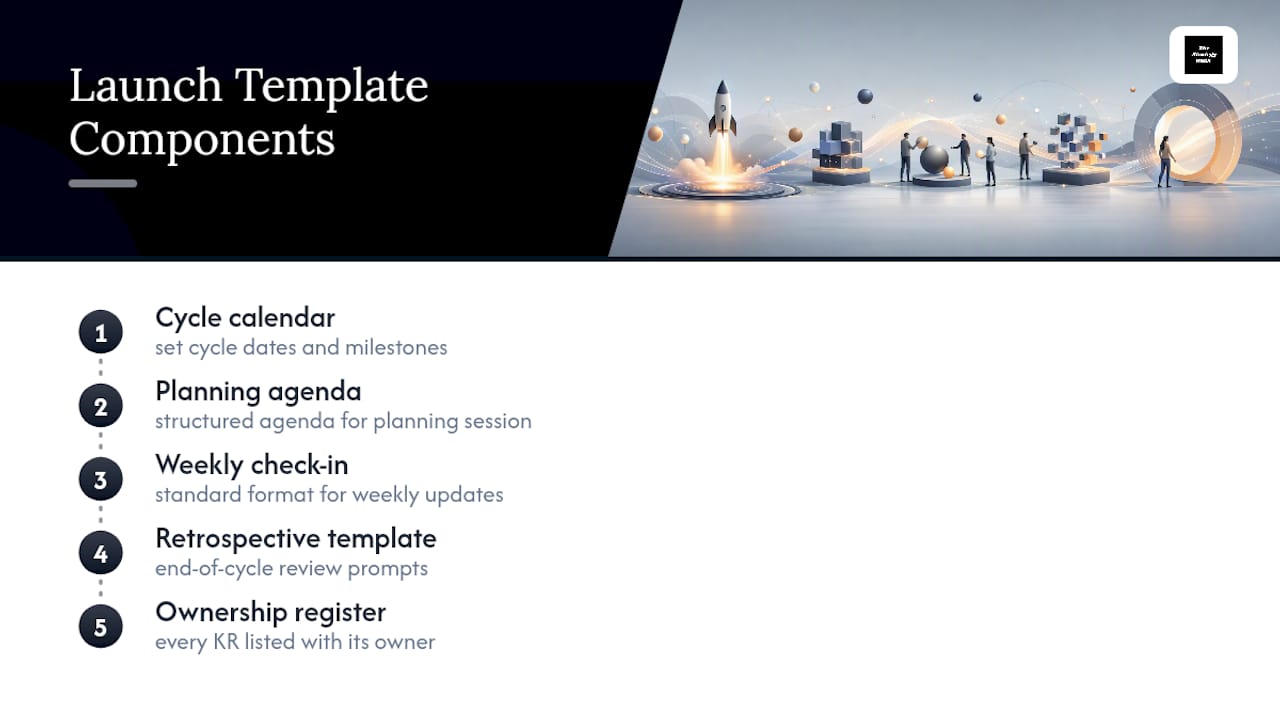
Your launch template needs five things regardless of scale: the cycle calendar, a planning session agenda, the weekly check-in format, a retrospective template, and an ownership register listing every KR and its owner.
Consider outside help when your rollout crosses team boundaries at scale or when you've already seen a cycle stall from the same execution gaps twice.
Strategy Haus's Approach to Turning OKR Plans Into Delivery
Most OKR failures aren't strategy problems. They're execution gaps. Thestrategyhaus works with organizations to build the operating rhythm that makes OKRs stick after the planning session ends, including cycle templates, coaching for named owners, and the check-in structure that keeps a pilot alive past week three.
Organizations don't struggle to write good objectives. They struggle to keep a weekly rhythm running once the initial excitement fades. That's an execution problem, not a planning problem, and it needs an execution-focused answer.
Clients report clearer priorities and steadier follow-through once a real operating rhythm is in place, not just a plan on a slide.
How Do You Keep OKRs Transparent Across the Organization?
Transparency is what makes OKR implementation trustworthy instead of another top-down mandate. If teams can't see each other's goals, alignment reviews turn into guesswork and duplicated effort.
Publish every team's OKRs in one shared, accessible location from day one. Anyone in the pilot should be able to check another team's progress without asking permission or scheduling a meeting. This single act does more for buy-in than any announcement.
Share progress at a regular cadence beyond the weekly check-in. A brief written update, even three sentences, sent to the wider organization at the mid-cycle mark keeps people outside the pilot informed and reduces the sense that OKRs are happening in a closed room.
Be honest about misses in the retrospective, not just wins. Teams that only publicize green scores train everyone else to hide red ones. A KR scored at 0.4 with a clear explanation builds more trust than a suspiciously perfect 1.0 across the board.
Give people a way to ask questions or flag confusion about how their work connects to a KR. A simple comment thread on the shared doc or a five-minute slot in a team meeting works. Confusion about "why this metric" is one of the fastest ways engagement quietly drops mid-cycle.
Consistency in format matters too. If every team reports progress differently, cross-team alignment reviews take twice as long and comparisons become meaningless.
How Do You Train Teams to Adopt OKRs?
Training doesn't need to be a formal program. It needs to answer three questions clearly: what an OKR is, how to write one, and what's expected of them week to week.
Start with a short session, no longer than an hour, that walks through the difference between an objective and a key result using real examples from your own industry, not generic templates. Abstract examples don't stick; a KR built from your own team's actual numbers does.
Pair new team members or new pilot participants with someone who's already run a cycle. A 15-minute working session where someone reviews a draft KR against the outcome checklist teaches the skill faster than a slide deck.
Build a one-page reference: the four check-in questions, the KR structure (metric, baseline, target, owner), and the scoring scale. Keep it visible in the same shared doc where OKRs live so nobody has to hunt for it.
Expect the first cycle's OKRs to be imperfect. Teams new to the framework often draft KRs that are really tasks in disguise, and that's normal. The goal of cycle one isn't perfect objectives. It's building the habit of writing them, checking in weekly, and scoring honestly. Cycle two is where the quality of the OKRs themselves improves.
Revisit training briefly at the mid-cycle review, not just at launch. A five-minute refresher on what a strong KR looks like, using an example from the pilot itself, reinforces the skill better than a one-time onboarding session ever does.
How Do You Get Leadership Buy-In for OKRs?
Leadership commitment isn't a formality. It's the difference between OKRs surviving past one cycle and quietly disappearing. Guides on rolling out OKRs for the first time consistently point to piloting with leadership or a complete unit so the rest of the organization sees a visible, credible example before being asked to adopt it themselves, according to WhatMatters' guidance on first-time OKR rollouts.
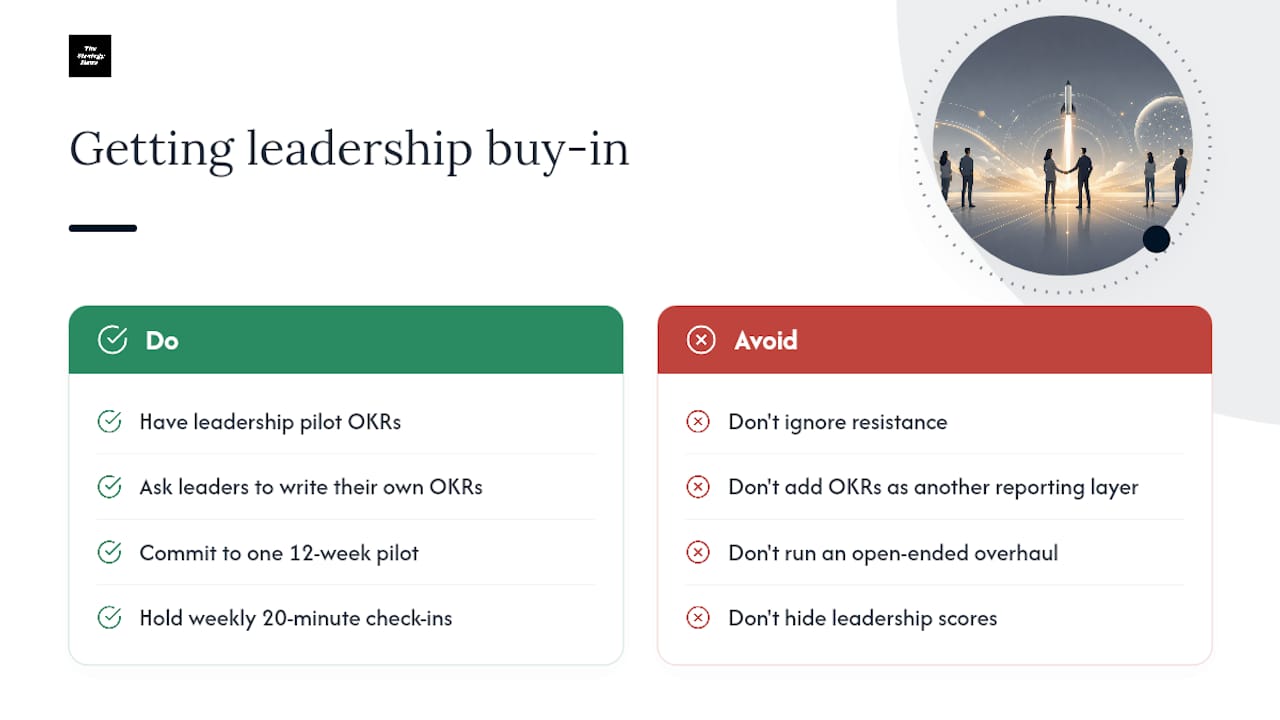
Ask leadership to write their own OKRs first, not just approve everyone else's. A leadership team that sets 1-2 objectives and shows up to its own weekly check-in sends a stronger signal than any company-wide memo.
Frame the ask around a specific, contained commitment: one pilot, one 12-week cycle, one weekly 20-minute meeting. Leaders are far more likely to commit to a bounded pilot than an open-ended organizational overhaul.
Address the resistance directly instead of ignoring it. The most common pushback is "we already have goals" or "this is just another reporting layer." Acknowledge that OKRs replace vague target lists with named owners and weekly visibility, rather than adding a parallel system on top of what already exists.
Involving stakeholders early and tying OKRs to the broader strategy, rather than treating them as a side project, is one of the core practices behind IBM's guide to successful OKR implementation. Loop finance, operations, or whichever function feels the most skeptical into the alignment review, not just the rollout announcement.
Set the expectation up front that the retrospective will surface both wins and misses, and that leadership will show its own scores alongside everyone else's. Nothing kills buy-in faster than a leadership team that expects transparency from others but not from itself.
The One Habit That Determines Whether Your First Cycle Sticks
Skip the debate over whether your first OKRs are good enough. They won't be, and that's fine. What determines whether the whole thing survives past week four is whether the weekly check-in happens, on schedule, with named owners reporting real numbers. Everything else compounds from that single habit.
If you monitor one metric in cycle one, monitor check-in attendance and update frequency, not KR scores. A team that shows up every week with an honest 0.4 will outperform a team that skips check-ins and reports a suspicious 1.0 at the end.
— Ashanti
How Strategy Haus Helps You Move From Plan to Delivery
Writing OKRs is the easy part. Keeping the weekly rhythm alive past the third check-in, when the initial energy fades and competing priorities crowd back in, is where most rollouts quietly stall. Thestrategyhaus is built for exactly that gap: not another planning workshop, but hands-on support that keeps the operating rhythm running.

A typical first-phase engagement runs alongside your pilot: a launch session to align on objectives and owners, a customized cycle template covering the calendar, check-in format, and scoring guide, and coaching through the first two check-ins so the habit takes hold before support steps back. Clients get a system built around their actual team, not a generic template pulled from a blog post.
If your OKR rollout has stalled before, or you want the first cycle to work without relearning every lesson the hard way, look at Thestrategyhaus's business strategy and project management services and book a conversation about what a first-phase engagement would look like for your team.