

Meeting cadence is the deliberate frequency, timing, and duration of your team's recurring meetings, matched to the purpose each one serves. Most teams should start with a minimal baseline like several standups a week, weekly syncs, and monthly reviews, then run an experiment for a few weeks before adding anything else.
TL;DR:
- Focusing meetings on the right frequency and duration for each purpose prevents drift, long sessions, and unnecessary participants that drain productivity.
- Testing cadence changes over four to six weeks with clear hypotheses and metrics ensures adjustments improve team focus and decision-making without long-term disruption.
- Starting with a meeting audit, then matching cadence to decision speed and team size, helps avoid typical pitfalls of ad hoc scheduling and poor outcome focus.
- Signals of broken cadence include repetitive updates, declining attendance, and meetings running beyond defined 'done' criteria, which require pruning or shifting to asynchronous communication.
- External support from an expert partner can help redesign and implement an effective, outcome-oriented meeting system, especially during rapid changes or calendar chaos.
Table of Contents
- What Is Meeting Cadence and Why Does It Matter?
- What Cadence Should Different Meeting Types Follow?
- How Do You Choose the Right Cadence for Your Team?
- How Do You Test and Measure a New Cadence?
- What Are Good Starter Cadences by Team Type?
- How Do You Know Your Meeting Cadence Is Broken?
- A Practical Implementation Framework From Strategy Haus
- Where Most Teams Get Meeting Cadence Wrong
- How Strategy Haus Helps You Redesign Meeting Cadence
- Sources
What Is Meeting Cadence and Why Does It Matter?
Meeting cadence has five moving parts: frequency, timing, duration, participants, and purpose. Get any one of these wrong and the whole rhythm feels off, even if the meeting itself is well run.
A predictable cadence does something most managers underestimate: it removes the mental tax of scheduling. When people know Tuesday at 10 a.m. is the sync, they stop wondering whether a meeting will get sprung on them and start protecting the rest of their calendar around it. Atlassian's research on meeting cadence found that structured schedules, daily standups, weekly syncs, monthly reviews move teams from reactive, ad-hoc scheduling to a proactive rhythm that reduces interruptions.
The five components to define for every recurring meeting:
- Frequency: how often it recurs (daily, weekly, biweekly, monthly, quarterly)
- Timing: the day and time slot, chosen to avoid fragmenting focus blocks
- Duration: a hard time limit, not an open-ended slot
- Participants: only the people who need to make or hear a decision
- Purpose: the single job the meeting exists to do
Skip defining any of these and the meeting drifts. It grows longer, pulls in more people, and eventually nobody remembers why it's on the calendar.
What Cadence Should Different Meeting Types Follow?
The right frequency depends entirely on how fast information decays. A standup update from three days ago is often useless; a quarterly roadmap update from three months ago usually still holds. Plane's guide to setting meeting cadence breaks this down by meeting type, and the pattern holds across most teams we've seen: short and frequent for tactical updates, longer and rarer for strategic ones.
Daily standups typically last about a quarter of an hour. If updates start repeating themselves day to day, cut back to three times a week instead of five, the content hasn't changed enough to justify daily. Weekly team syncs usually last about half an hour to an hour with a structured agenda. Biweekly retrospectives and planning sessions generally align to the sprint cycle. Monthly and quarterly reviews and planning need preparation because they require thoughtful discussion.
| Meeting Type | Recommended Cadence | Typical Duration |
|---|---|---|
| Standup | Daily or 3x/week | Short (several minutes) |
| Team sync | Weekly | Approximately half an hour to an hour |
| Sprint retro/planning | Biweekly (per sprint) | Around 45 to 60 minutes |
| Roadmap/OKR review | Monthly | About one hour |
| Strategic review | Quarterly | Several hours or more |
How Do You Choose the Right Cadence for Your Team?
Start with an audit, not a preference. Most managers set cadence based on what felt normal at a past job. That's a weak foundation. Here's a better process:
- Run a meeting time audit. List every recurring meeting, its attendees, and its duration for one full month.
- Ask "what breaks if we skip this?" for each one. If the honest answer is "nothing," that's your first cut.
- Match cadence to the pace of change. Fast-moving decisions need frequent, short touchpoints. Stable, slow-moving work needs less.
- Account for team size and time zones. A 12-person distributed team across four time zones needs a different rhythm than five people in one office.
- Give every meeting a job, an owner, and an expected outcome. No owner, no meeting.
- Cluster meetings to protect deep work. Group recurring meetings onto two or three days and leave the rest open, a practice Kill One Meeting's cadence guide recommends specifically to preserve uninterrupted focus time.
Pro Tip: Before scheduling anything new, ask whether the update could go async in a shared doc or Slack thread instead. If real-time discussion isn't required, it doesn't need a meeting.
How Do You Test and Measure a New Cadence?
Don't overhaul your entire schedule at once. Pick one change, one team, one hypothesis, and give it a defined window.
Slack recommends running experiments for four to six weeks before deciding whether a cadence change should stick, long enough to see a real pattern, short enough that a bad idea doesn't calcify into permanent habit.
A workable experiment needs:
- A written hypothesis ("cutting standups from daily to 3x/week won't slow down blocker resolution")
- A clear scope (which team, which meeting, start and end dates)
- A named owner who checks in weekly
- Quantitative signals: meeting hours per person, action item completion rate, attendance and engagement
- Qualitative feedback: a short survey or retro at week 6
Treat weekly meeting hours per person as a team health number worth tracking on its own, the same way you'd track uninterrupted focus time. If hours drop and output holds steady or improves, institutionalize the change. If action items start slipping or people report feeling out of the loop, revert and try a smaller adjustment instead.
What Are Good Starter Cadences by Team Type?
Copy one of these as a starting point, then adjust based on what your audit turns up. ItsConvo's research on meeting frequency suggests most healthy teams land somewhere between three and five structured meetings a week, not more.
- Engineering: standup 3x/week (15 min), sprint planning and retro biweekly, 1:1s biweekly
- Product: weekly roadmap sync, biweekly stakeholder update, monthly metrics review
- Sales: daily pipeline check-in (10 min), weekly forecast call, monthly pipeline review
- Consulting or client-facing teams: weekly internal sync, biweekly client status call, monthly executive update
- Leadership: weekly leadership sync, monthly cross-functional review, quarterly strategy session
During a launch or an incident, compress the rhythm temporarily, daily check-ins even for teams that normally meet weekly, then step back down once things stabilize. A sample clustered week might put standups Monday through Thursday, the team sync and 1:1s on Tuesday afternoon, and leave Wednesday and Friday mornings meeting-free for deep work.
How Do You Know Your Meeting Cadence Is Broken?
A few signals show up consistently once cadence drifts out of shape:
- Less than two hours of uninterrupted focus time anywhere in a typical day
- The same update getting repeated across two or three different meetings
- Rising decline rates or people quietly skipping recurring invites
- Meetings running long because nobody defined what "done" looks like
The fix is rarely "add more structure." It's usually prune, consolidate, or move to async. Apply the "what breaks if we skip this?" test to every meeting on the calendar, rank the answers, and cut from the bottom up. Anything with a clear owner and outcome usually survives that test. Anything vague doesn't.
A Practical Implementation Framework From Strategy Haus
Thestrategyhaus works with teams through a four-step framework: audit current meeting load and time cost, design a cadence matched to team size and pace, experiment for 4 to 6 weeks with defined metrics, then institutionalize what works into standing templates and toolkits.
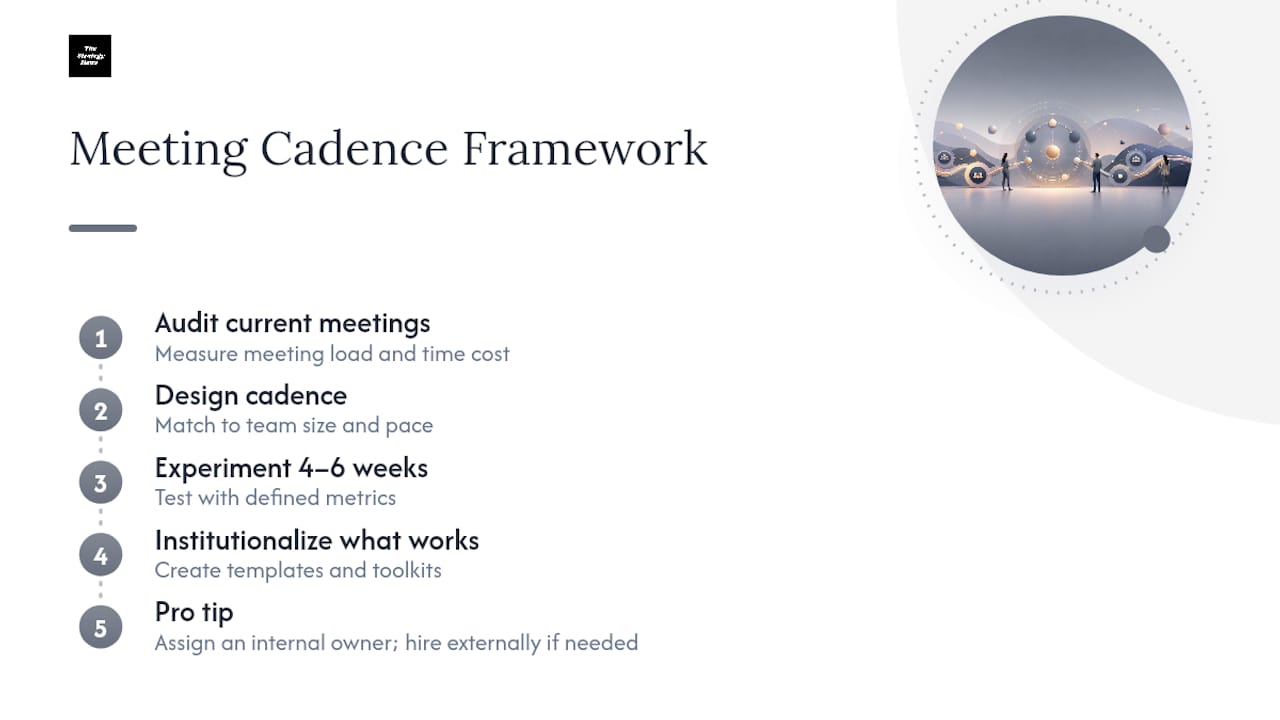
Pro Tip: Run this internally if you have one person who can own the audit and follow-through. Bring in outside help when the redesign touches multiple departments or when nobody has bandwidth to own the six-week check-in.
Where Most Teams Get Meeting Cadence Wrong
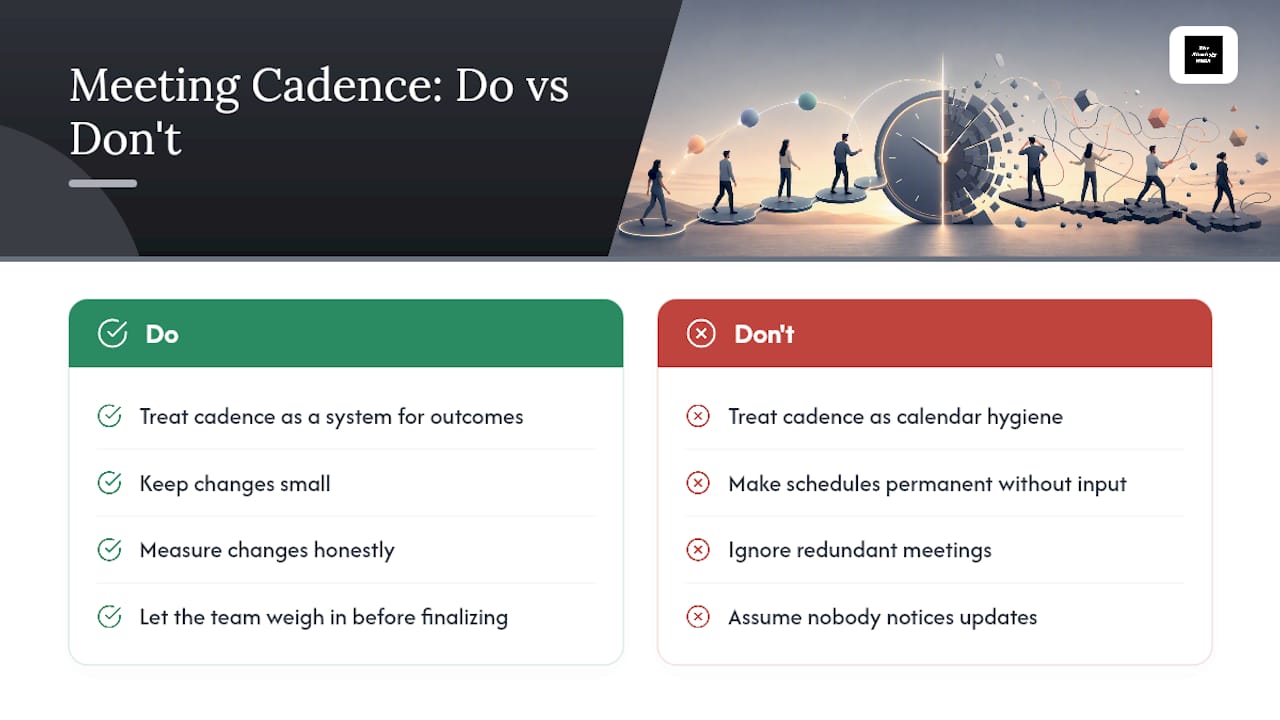
The biggest mistake isn't picking the wrong frequency. It's treating cadence as calendar hygiene instead of a system that's supposed to produce outcomes. A team can have a perfectly tidy schedule and still be drowning, because nobody asked what each meeting is actually for.
Keep changes small, measure them honestly, and let the team weigh in before anything becomes permanent. One team we've seen described in case studies cut a standing status meeting entirely after realizing the update had already been posted in a shared doc for two weeks straight. Nobody had noticed.
— Ashanti
How Strategy Haus Helps You Redesign Meeting Cadence
Thestrategyhaus is the execution partner for teams that know their meeting schedule is broken but don't have the bandwidth to fix it while also running the business. Instead of another generic productivity framework, you get a cadence audit, a redesigned meeting structure matched to your team's actual pace of work, ready-to-use templates and toolkits, and support through the full 4 to 6 week experiment window until the new rhythm sticks.
If your team has more standing meetings than anyone can explain, or if a launch, reorg, or operational rebuild has left your calendar in chaos, that's exactly when outside structure pays off fastest. Hiring an implementation partner makes sense once the redesign touches more than one team or nobody internally has time to own the six-week follow-through.
Visit the Strategy Haus services page to see how a project management engagement can turn your meeting schedule into a system that actually supports your team's outcomes, not just its calendar.
Sources
- How to Set the Perfect Meeting Cadence for Remote Teams | Slack
- Understanding meeting cadence and how to set one | Atlassian
- Stop the Meeting Madness | Harvard Business Review