

An implementation roadmap is a phase-based plan that turns strategy into sequenced, stakeholder-aligned execution. It maps who does what, when, and how success gets measured, while budgeting for the work that keeps results alive after launch. Done well, it replaces guesswork with a shared reference point everyone can point to when priorities shift.
TL;DR:
- Roadmaps are essential for projects crossing multiple departments or systems, especially those requiring behavior change from unaligned teams.
- A complete implementation roadmap includes timeline, dependencies, roles, resources, and success metrics, with clear exit criteria at each phase.
- The phased approach typically involves pre-implementation, implementation, and sustainment, with milestones and stakeholder sign-offs for each.
- Keeping the roadmap updated regularly, linking it to existing tools, and incorporating agile sprints helps maintain relevance and accountability.
- Failing to dedicate sufficient time to stakeholder alignment or neglecting ongoing sustainment planning leads to reduced long-term success.
Table of Contents
- What Is an Implementation Roadmap, and When Do You Need One?
- The Core Elements Every Roadmap Needs
- A Phased Implementation Roadmap Template You Can Copy
- Sample Timelines and How to Adapt Them
- Connecting the Roadmap to Your Existing Tools and Plans
- Governance, Measurement, and Keeping Results Alive
- Common Pitfalls, Communication Habits, and Pro Tips
- Integrating Agile Methods Into Your Roadmap
- Tools and Software for Building and Managing Roadmaps
- Strategy Haus's Perspective on Structuring Roadmaps in Practice
- How Strategy Haus Turns Your Roadmap Into Real Execution
- Sources
- FAQ
What Is an Implementation Roadmap, and When Do You Need One?
An implementation roadmap sits above a project plan and below a strategic vision. A project plan tracks tasks, dates, and dependencies at a granular level. A product roadmap shows what features ship and when. An implementation roadmap connects the two: it shows how a strategic decision gets carried out across teams, systems, and time, without drowning readers in task-level detail.
You need one when the work crosses departments, touches multiple systems, or requires behavior change from people who did not design the plan. A single-team project rarely needs one. A CRM migration, a new operating model, or a company-wide policy rollout usually does.
Ask yourself:
- Does this initiative involve more than one department or vendor?
- Will people need to change how they work, not just what tool they use?
- Does leadership need a single artifact to track progress across quarters?
If you answered yes twice, build the roadmap before you build the detailed plan.
The Core Elements Every Roadmap Needs
A roadmap without these five elements is a wish list, not a plan. Skip one and you'll find out the hard way, usually around week six.
- Timeline and milestones. A milestone marks a decision point or a deliverable, not just a date on a calendar. "Pilot complete, go/no-go decision made" counts. "Week 4" does not.
- Dependencies and sequencing. Note which tasks must finish before others start, and flag any single point of failure early.
- Roles and responsibilities. Every milestone needs one accountable owner, even when several people contribute.
- Resource and budget mapping. Match people, hours, and dollars to each phase, not just to the project as a whole.
- Success metrics and exit criteria. Define what "done" looks like for each phase before the phase starts, plus how often you'll check progress against it.
Practical implementation templates typically organize exactly these five categories into a single visual so nothing gets tracked in someone's head instead of on paper.
A Phased Implementation Roadmap Template You Can Copy
Roadmaps that explicitly separate pre-implementation, implementation, and sustainability phases with clear exit criteria tend to hold up longer than ones that treat launch day as the finish line. Here's a working structure.
-
Pre-implementation. Align stakeholders on scope and expected outcomes. Run discovery to surface constraints, systems, and political landmines. Select the metrics you'll track before you need them, not after. Design a pilot with a small, low-risk group. Recommended activities in this phase include identifying the highest-priority needs, engaging the stakeholders who can approve or block progress, choosing essential metrics, assessing contextual factors like culture or existing tools, clarifying the core features of the change, and adapting the plan to local realities before scaling it. Exit criteria: stakeholders have signed off on scope, the pilot group is confirmed, and baseline metrics are recorded. Owner: program sponsor or PMO lead.
-
Implementation. Roll out in phases rather than all at once. Pair each rollout with training or coaching, not just an announcement email. Build a feedback loop so frontline users can flag friction before it becomes resistance. Gate each phase behind an acceptance checkpoint. Exit criteria usually require adoption metrics to reach a defined threshold and no unresolved critical defects remain. Owners are commonly workstream leads, with the PMO tracking cross-team dependencies.
-
Sustain. Monitor performance against the metrics you set in pre-implementation. Calculate ROI using real usage data, not projections. Transfer ownership from the project team to the operational team that will run this permanently. Build in continuous improvement checkpoints, not a one-time review. Exit criteria usually include formal transfer of ownership, approval of a sustainment budget, and scheduling of a review cadence. The owner is typically an operations or department head, with the original sponsor checking in regularly.
Sustainability steps in practice usually include analyzing the data collected during rollout, determining costs and return on investment, and establishing a business model for ongoing support before the project team disbands.
Sample Timelines and How to Adapt Them
Duration depends on scope, not ambition. Here are three common shapes.
- Quick pilot: a timeframe suitable for testing a new tool or workflow with a single team before a wider rollout.
- Product or program launch: a longer timeframe typical for a CRM rollout, a new service line, or a cross-department process change.
- Enterprise rollout: an extended timeframe fitting organization-wide system replacements or operating-model shifts touching every business unit.
Parallelize workstreams when they don't share a resource or a dependency. Gate them when one phase's output feeds directly into the next. Identify your critical path early: it's the sequence of dependent tasks with zero slack, and it's usually where delays actually happen. Execution strategy changes duration more than almost any other variable. Parallel teams working independent slices finish faster than a single team working through everything in sequence, but only when each slice has its own clear exit criteria so teams aren't blocked waiting on each other.
Connecting the Roadmap to Your Existing Tools and Plans
Your roadmap should stay high-level. The detail belongs in the tools your teams already use.
- Map each roadmap milestone to a corresponding epic or release in your delivery tool, whether that's Jira, Asana, or a similar system.
- Keep the roadmap itself limited to phases, milestones, owners, and metrics. Link out to detailed task lists rather than importing them.
- For small teams, one shared document with a simple timeline view often works. For larger organizations, connect the roadmap to a reporting dashboard that pulls status automatically from delivery tools.
- Revisit the customization checklist whenever team size, governance structure, or reporting requirements change significantly.
A product roadmap functions as a shared source of truth linking strategy to delivery, and that only holds if the roadmap stays current. A roadmap nobody's updated in two months is worse than no roadmap: it actively misleads people.
Governance, Measurement, and Keeping Results Alive
Governance doesn't need to be heavy to work. It needs to be consistent.
- Steering committee: meets monthly to review phase progress and clear roadblocks that working teams can't resolve on their own.
- Working group: meets weekly or biweekly to track task-level progress and surface risks before they escalate.
- KPIs to track: adoption rate (percentage of target users actively using the new process), value realization (measured savings or revenue tied to the initiative), and operational health (error rates, support tickets, or downtime linked to the change).
Handoff at the end of implementation matters as much as the rollout itself. Build training materials and playbooks before the project team disbands, not after. Name a permanent owner for the initiative, and budget for sustainment activities as a line item, not an afterthought. Roadmaps that build sustainment into the initial plan tend to produce better long-term outcomes than ones that treat post-launch support as optional. Teams running performance-tracking programs may find additional structure in practical guidance on measuring progress toward organizational goals.
Common Pitfalls, Communication Habits, and Pro Tips
Three mistakes show up again and again. Underbudgeting the sustain phase, leaving milestones without a single named owner, and ignoring dependencies until they cause a delay. Teams frequently underestimate how long pre-implementation actually takes; a reasonable rule of thumb is to double your initial time estimate for stakeholder alignment and discovery before you commit to a launch date.
Treat the roadmap as a living document, not a one-time deliverable. When a major change happens, a short recorded walkthrough communicates it faster and more clearly than a revised slide deck buried in an email chain.
- Keep the roadmap updated on a fixed cadence, even when nothing dramatic has changed.
- Record a two-minute walkthrough any time a milestone or owner shifts.
- Reserve a specific sustain budget at the start, not after launch reveals the gap.
Pro Tip: Schedule a recurring 15-minute demo at the end of each phase, even if attendance is optional. Momentum dies quietly when people stop seeing progress, long before anyone admits the initiative has stalled.
Integrating Agile Methods Into Your Roadmap
A phased roadmap and agile execution aren't opposites. The roadmap sets the destination and the checkpoints; agile sprints determine how teams get there week-to-week inside each phase.
Treat each phase of the roadmap as a container for multiple sprints rather than a single fixed block of work. Inside the implementation phase, for example, a team might run four two-week sprints, each ending with a demo and a retrospective that feeds directly back into the roadmap. If a sprint reveals that a milestone date was unrealistic, adjust the roadmap rather than forcing the sprint to hit an arbitrary deadline.
The discipline that matters most is keeping the roadmap's exit criteria stable even as the path to them flexes. Scope inside a phase can shift in response to what a team learns. The definition of "done" for that phase should not shift without a deliberate decision from the steering committee. That distinction keeps agility from turning into scope creep.
Iterative updates work best on a fixed cadence rather than an ad hoc one. Reviewing and revising the roadmap at the end of every phase, rather than whenever someone remembers to, keeps the document trustworthy. Teams running longer enterprise rollouts often add a lightweight monthly roadmap review on top of their regular sprint cadence, specifically to catch drift between what was planned and what's actually happening on the ground.
This hybrid approach also helps with the parallelization decisions covered earlier. When two workstreams run in parallel, giving each one its own sprint cadence, and its own exit criteria, keeps a delay in one from silently blocking the other.
Tools and Software for Building and Managing Roadmaps
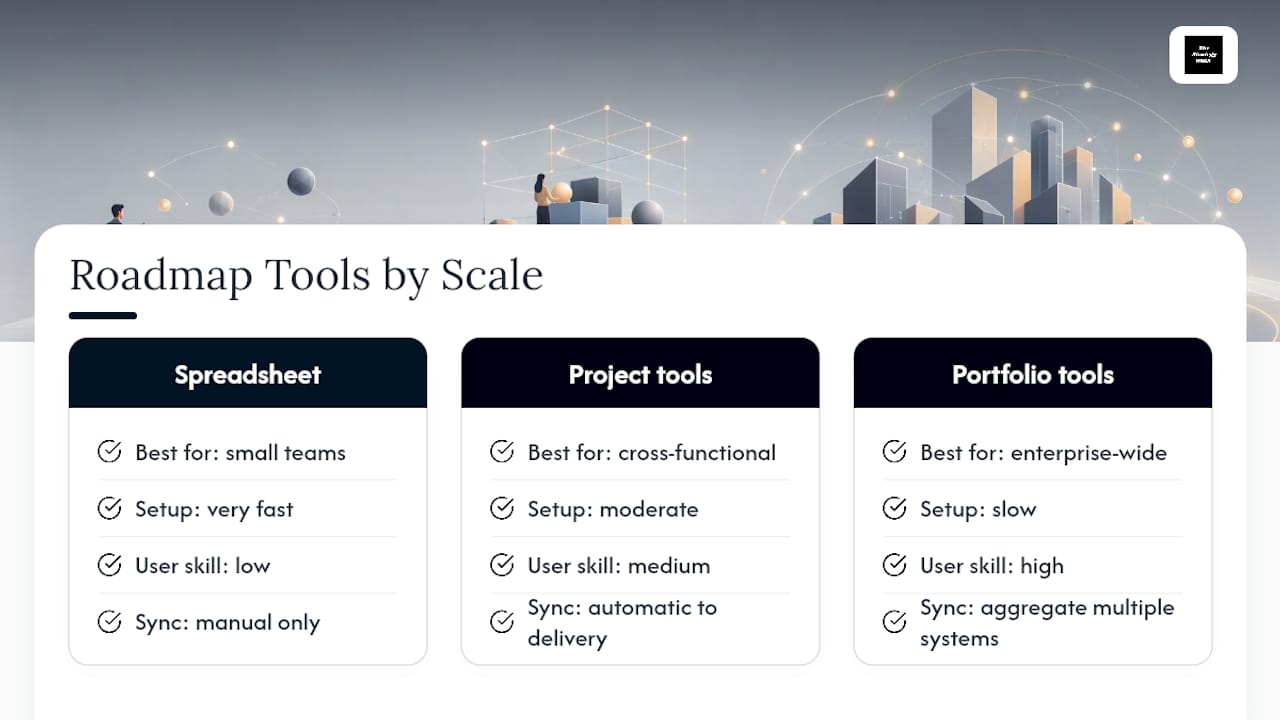
Most implementation roadmaps live in one of three types of tools, depending on team size and complexity.
For smaller teams or single-department rollouts, a shared spreadsheet or a lightweight visual planner often does the job. It's fast to set up and easy for non-technical stakeholders to read at a glance, though it demands manual updates and offers no automatic sync with delivery work.
For cross-functional programs, dedicated roadmapping and project tools like Jira and Asana add real value. They let you map roadmap milestones directly to epics, sprints, or releases, so status updates flow up from the delivery team without a separate manual reporting step. This matters most when the roadmap needs to reflect real-time progress rather than a snapshot from last week's status meeting.
For enterprise rollouts spanning multiple business units, a portfolio-level tool or a reporting dashboard that pulls from several delivery systems at once tends to work better than any single project tool. These setups take longer to configure but pay off when a steering committee needs one view across ten workstreams instead of ten separate updates.
Whatever you choose, the tool matters less than the discipline of updating it. A roadmap in a $15-per-user tool that gets reviewed weekly beats an elaborate dashboard nobody opens after the kickoff meeting. If your organization runs automation-heavy initiatives alongside the roadmap, it's worth reviewing how to build the business case and calculate ROI for automation projects before you lock in the sustain-phase budget.
Strategy Haus's Perspective on Structuring Roadmaps in Practice
Most roadmap failures we see trace back to one habit: teams treat the pre-implementation phase as a formality instead of the phase that determines everything downstream. Strategy Haus builds roadmaps that spend real time on stakeholder alignment and metric selection before a single milestone gets scheduled. Clients typically gain clearer ownership, a governance rhythm that survives leadership turnover, and someone accountable for the sustain phase after the excitement of launch day fades.
— Ashanti
How Strategy Haus Turns Your Roadmap Into Real Execution
Some consulting firms build implementation roadmaps and provide support through delivery, addressing the common gap where a polished roadmap lacks accountability for execution.

Typical consulting engagements include a tailored roadmap, hands-on implementation support through each phase, operational toolkits for the client team to keep, and ongoing execution assistance for the sustain phase. A discovery call often begins by reviewing the current state of a client's plan and ends with an outline of what a phased rollout could look like for the initiative, including identification of key risks. If you're staring at a strategy that has no clear path to execution, visit Strategy Haus's project management services and book a discovery call to see what a tailored roadmap would look like for your team.
Sources
- A Roadmap to Inform the Implementation of Evidence-Based Collaborative Care Interventions in Communities: Insights From the Michigan Mental Health Integration Partnership
- Product roadmap guide | Atlassian
- How to Make an Implementation Roadmap (Template Included) | ProjectManager
- Implementation roadmap (practitioner notes) — GitHub
FAQ
What Are the 5 Key Components of an Implementation Plan?
The five components are timeline and milestones, dependencies and sequencing, roles and responsibilities, resource and budget mapping, and success metrics with exit criteria for each phase.
What Are the Phases of Program Implementation?
Most frameworks group implementation into three broad phases: pre-implementation (alignment and discovery), implementation (phased rollout and training), and sustainability (monitoring, ROI, and ownership transfer), sometimes broken into more granular steps like assess, design, pilot, scale, and sustain.
How Long Should an Implementation Roadmap Take?
It depends on scope: a quick pilot fits a short timeframe suitable for testing with a single team, a product or program launch usually takes a longer timeframe typical for a CRM rollout or cross-department change, and an enterprise-wide rollout spans an extended period fitting organization-wide system replacements or operating-model shifts.
How Do You Keep a Roadmap From Becoming Outdated?
Update it on a fixed cadence, record a short walkthrough whenever a major milestone or owner changes, and treat it as a living communication tool rather than a one-time planning document.
Does Strategy Haus Build Custom Implementation Roadmaps?
Yes. Strategy Haus designs tailored roadmaps and provides implementation support, operational toolkits, and ongoing execution assistance; current pricing and service details are available directly on the Strategy Haus website.