

Data hygiene is the ongoing practice of auditing, standardizing, validating, and monitoring your organization's data so it stays accurate, consistent, and usable. The highest-impact starting moves are: run a data audit, standardize formats and naming conventions, enforce validation at the point of entry, and set clear ownership with monitoring in place. Done well, this work produces data that your team, and your automation, can actually trust.
TL;DR:
- Regularly auditing key datasets helps establish baseline metrics, enabling measurable improvements in data quality and compliance with data contracts and SLOs.
- Using schema alignment, blocking, entity resolution, and canonicalization in the correct sequence reduces errors that could lead to faulty insights or AI biases.
- Continuous monitoring of freshness, completeness, and duplicate rates supports early detection of data drift, preventing escalation costs and maintaining trust.
- Assigning clear ownership roles and implementing structured, scoped improvement programs ensures sustained hygiene practices over time.
Table of Contents
- What Data Hygiene Means and How Dirty Data Happens
- Why Data Hygiene Matters More Than Most Teams Admit
- The Business Case: What Clean Data Actually Buys You
- Core Best Practices: A Prioritized Checklist
- Turn This Into a 90-Day Program
- Choosing Tools and Automation That Fit Your Scale
- Governance, Roles, and the Metrics That Actually Matter
- Getting Your Team to Actually Follow the Rules
- Building Hygiene Into Your ETL/ELT Pipeline
- Why Most Hygiene Advice Never Gets Implemented
- When It Makes Sense to Bring in Execution Support
- Standards and Resources Worth Bookmarking
- Sources
- FAQ
What Data Hygiene Means and How Dirty Data Happens
Data hygiene covers four qualities: accuracy, completeness, consistency, and timeliness. A record can be technically present and still fail hygiene standards if it's stale, duplicated, or formatted in a way your systems can't reconcile with other records.
Dirty data rarely comes from one source. Manual entry introduces typos and inconsistent formatting. Integrations between platforms create mismatches when one system expects "NY" and another expects "New York." Schema drift happens when a source system changes its structure, quietly adding or removing fields, and downstream processes never get updated to match.
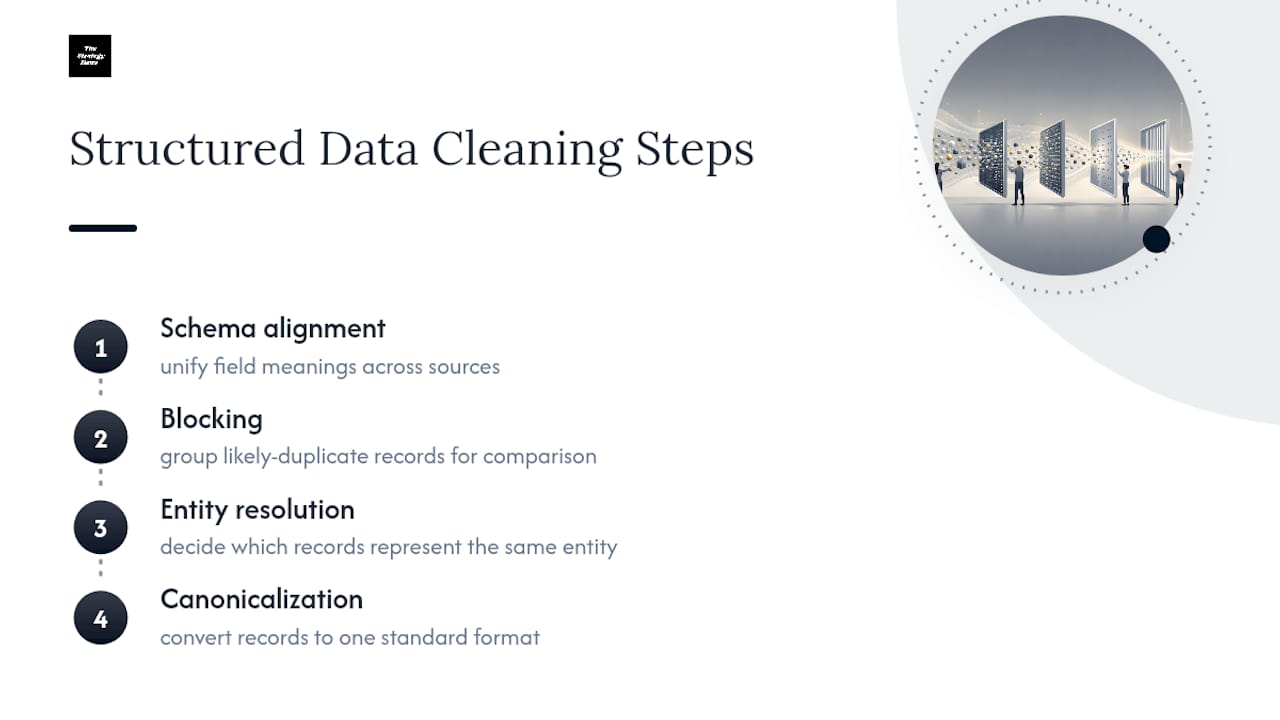
Cleaning that mess follows a logical sequence. Research on structured data cleaning pipelines describes four stages that build on each other: schema alignment (getting fields to mean the same thing across sources), blocking (grouping likely-duplicate records so comparison is computationally feasible), entity resolution (deciding which records actually represent the same real-world thing), and canonicalization (converting everything to one standard format). Skip a stage or do it out of order, and errors compound. If schema alignment is sloppy, entity resolution will match the wrong records with confidence.
Why Data Hygiene Matters More Than Most Teams Admit
Poor data quality costs organizations an average of $12.9 million every year, a figure that captures wasted labor, missed revenue, and bad decisions made on faulty inputs. That's not a rounding error for most companies. It's a budget line hiding in plain sight, spread across marketing spend on undeliverable contacts, sales time chasing duplicate leads, and analyst hours reconciling reports that shouldn't need reconciling.
Compliance raises the stakes further. Regulations like HIPAA require accurate recordkeeping in health contexts, and frameworks like GDPR and CCPA hold organizations accountable for the personal data they store and process. Getting hygiene wrong isn't just inefficient. It can be a compliance failure with real penalties attached.
The newest wrinkle is AI. Machine learning models don't correct bad inputs, they amplify them. IBM's research on data quality notes that AI systems magnify whatever problems already exist in the training data, turning small inconsistencies into biased or unreliable outputs at scale. Clean data isn't a nice foundation for AI. It's the only foundation that works.
The Business Case: What Clean Data Actually Buys You
Leadership doesn't need to care about deduplication rates. They need to see what clean data does for the business.
- Lower operational waste. Less time spent on manual reconciliation, fewer wasted marketing dollars on bad contact lists, and fewer duplicate outreach efforts that annoy customers.
- Trustworthy reporting and forecasting. When the underlying data is consistent, forecasts stop swinging wildly between reporting periods for reasons nobody can explain.
- Better deliverability and engagement. Clean email and contact data means fewer bounces, better sender reputation, and campaigns that actually reach the people they're meant to.
- Safer automation and machine learning outcomes. Models trained on clean, well-labeled data produce fewer biased or nonsensical results, which matters as more decisions get automated.
None of these benefits require exotic tooling. They require discipline applied consistently, which is the part most teams underestimate.
Core Best Practices: A Prioritized Checklist
Some of these practices deliver value in week one. Others take a quarter to mature. Here's the order that tends to work.
1. Audit and profile before you touch anything
Before fixing anything, measure it. Run a profiling pass across your key datasets and capture baseline metrics: duplicate rate, null rate on required fields, and freshness (how old is the data relative to when it should have been updated). Without a baseline, you can't prove improvement, and you can't tell leadership what "clean" is going to cost.
2. Set data contracts and SLOs
A data contract is a documented agreement about what a dataset should contain, in what format, updated on what schedule. Pair it with a service level objective (SLO), a measurable threshold like "completeness stays above 98%" or "freshness never exceeds four hours." Building in an error budget, a small tolerance for how far metrics can drift before triggering action, keeps monitoring practical instead of triggering false alarms on every minor blip.
3. Validate at the point of entry
Catching bad data before it enters your systems is far cheaper than cleaning it after the fact. Twilio's guidance on data hygiene recommends enforcing validation rules at ingestion, whether that's a web form, an API call, or a batch import, and using a documented tracking plan so every field has an expected type and format. Records that fail validation should be rejected or routed to a quarantine table, never silently accepted.
4. Standardize and canonicalize
Pick one format per field type and enforce it everywhere: ISO 8601 for dates, a single address structure, E.164 formatting for phone numbers. Canonicalization rules should live in code, not in someone's memory of "how we've always done it."
5. Deduplicate through entity resolution
Blocking strategies, including probabilistic methods and locality-sensitive hashing (LSH), group likely duplicate records so your system only compares records that are plausibly the same, instead of every record against every other one. From there, fuzzy matching decides which grouped records actually represent the same entity. Whether you use supervised, unsupervised, or hybrid matching depends on whether you have reliable training labels; supervised approaches scale well but can inherit bias if the training data was already flawed.
6. Enrich and verify selectively
Enrichment (adding missing fields from a trusted third-party source) makes sense when the gap is costing you something real, like an incomplete firmographic profile blocking a sales handoff. Verify against sources you trust, and log where enriched data came from so you can trace it later.
7. Monitor and stay observant
Track freshness, completeness, and distribution shifts continuously, not on a quarterly spot check. Continuous cleansing paired with observability catches problems while they're small, instead of during an annual cleanup project that everyone dreads.
8. Quarantine and remediate deliberately
When validation flags a bad record, route it somewhere reviewable rather than deleting it outright. Build a rollback path so a bad transformation or ingestion job can be reversed without a manual data reconstruction effort.
9. Manage the full lifecycle
Decide retention periods up front, archive what you must keep but rarely use, and delete what you no longer need through a secure, logged process. Undefined retention is its own hygiene problem: it just shows up as bloat and risk instead of duplicates.
10. Measure and iterate
Review your KPI dashboard on a fixed cadence and adjust SLOs as your data volume and use cases change.
Pro Tip: Start your audit on the dataset your revenue team touches daily, not the one that's technically most broken. Visible wins on a high-traffic dataset build the political capital to fund the less glamorous cleanup work later.
Turn This Into a 90-Day Program
A checklist without a schedule stays a checklist. Here's how to sequence it.
- Weeks 1 to 2: Assess. Run quick profiling on your top three datasets and map stakeholders, who owns each source system, who consumes the data downstream, and who gets paged when something breaks.
- Weeks 3 to 6: Pilot. Pick one high-value dataset (customer records or transaction data usually qualify) and set formal SLOs for completeness, freshness, and duplicate rate.
- Weeks 7 to 10: Implement. Build the validation gate at ingestion, stand up basic monitoring against your SLOs, and create the quarantine workflow for records that fail checks.
- Weeks 11 to 12: Scale. Codify your validation and canonicalization rules in version control, then hand ongoing ownership to designated data stewards.
- Ongoing: Govern. Hold monthly SLO reviews and a quarterly full audit to catch drift the monthly cadence might miss.
Twelve weeks won't make your data perfect. It will make it measurably better, with a repeatable process behind the improvement instead of a one-time cleanup that quietly decays six months later.
Choosing Tools and Automation That Fit Your Scale
Tooling for data hygiene splits into five categories: profiling, validation, entity resolution and deduplication, enrichment, and observability. Most teams need at least one tool from each category, though small organizations often find one platform that covers two or three.
The build versus buy decision usually comes down to four factors: your data scale, how much auditability you need for compliance, your latency requirements (real-time validation versus batch), and how deeply your data touches regulated information. A five-person startup can often get away with a lightweight validation layer and a spreadsheet-based audit log. A healthcare or financial services company generally can't.
On the technical side, look for tools that support change data capture (CDC) so you catch updates as they happen, schema enforcement at the pipeline level, LSH-based blocking for deduplication at scale, and anomaly detection models that flag unusual distribution shifts automatically. Weak data foundations create real downstream risk once AI systems start acting on that data, a concern tekRESCUE AI covers well in the context of AI security and reliability. Whatever you choose, insist on lineage tracking, API-based automation instead of manual triggers, configurable alerting, and audit logs you can hand to a compliance reviewer without extra explanation.
Governance, Roles, and the Metrics That Actually Matter
Data hygiene fails without clear ownership. A workable model assigns four roles: a data owner (accountable for a dataset's overall quality), a data steward (handles day-to-day monitoring and remediation), a data engineer (builds and maintains the pipelines), and a reviewer (approves changes to validation rules or schema). A simple RACI chart, who's Responsible, Accountable, Consulted, and Informed, per dataset keeps this from becoming a finger-pointing exercise when something breaks.

Data contracts need a change-control process too. A schema change shouldn't ship silently; it should go through the same review as a code change, because downstream consumers depend on the contract holding steady. Frameworks like the DAMA-NL Data Quality Management System recommend documenting quality objectives and running structured improvement cycles rather than treating fixes as one-off firefighting.
Track five metrics on a recurring dashboard: completeness, uniqueness, freshness, null rate on required fields, and time-to-remediate when something fails validation. Some organizations go further and tie hygiene metrics to release gates, blocking a deployment if a critical dataset's SLO is breached, or fold data ownership responsibilities into performance reviews for the stewards accountable for them.
Getting Your Team to Actually Follow the Rules
The best validation rules in the world do nothing if the people entering data don't understand why they matter. Training has to start with the "why," not the "how." Show your sales team the actual dollar cost of a duplicate lead record, not just a policy memo telling them to check for duplicates before creating a new contact.
Culture change sticks better when it's tied to something people already do. Build validation checks into the tools your team uses daily, the CRM, the intake form, the support ticket system, so following the rule is the path of least resistance, not an extra step people skip under deadline pressure.
Make hygiene visible. A dashboard showing duplicate rate or data freshness by team, reviewed in a regular meeting, does more to change behavior than a training deck reviewed once and forgotten. People respond to what gets measured and discussed out loud.
Assign real accountability. If a data steward owns a dataset's quality, that ownership needs to show up somewhere that matters to them professionally, not just in an org chart nobody checks. Recognize the teams that keep their data clean; it reinforces that hygiene is valued work, not busywork layered on top of the job everyone actually gets evaluated on.
Finally, keep training current. Schema changes, new source systems, and new validation rules all require a quick refresher, not a full re-onboarding. A short update after each significant pipeline change keeps the whole team aligned without turning training into a recurring burden.
Building Hygiene Into Your ETL/ELT Pipeline
Data hygiene works best when it's not a separate process bolted onto your pipeline after the fact. It belongs inside the extract, transform, load (or extract, load, transform) sequence itself, at specific checkpoints where catching a problem early saves rework later.
At the extract stage, validate incoming data against your schema before it moves any further. This is where malformed records, missing required fields, or unexpected data types should get flagged or quarantined, not passed downstream and dealt with later.
During transformation, this is where standardization and canonicalization rules actually run: date formats get normalized, addresses get structured consistently, duplicate records get flagged for entity resolution. Build these transformations as versioned, testable code rather than manual scripts someone runs when they remember to.
At load, a final validation gate checks that the data meets your defined contract before it reaches production tables or a data warehouse. This is also where audit logs should capture what changed, when, and why, giving you transformation lineage you can trace if a downstream report suddenly looks wrong.
The pipeline stage matters because errors compound. A schema mismatch caught at extract costs minutes to fix. The same mismatch discovered three transformations later, after it has corrupted a join with another table, costs hours and possibly a wrong decision made on bad output in the meantime.
Why Most Hygiene Advice Never Gets Implemented
Most data hygiene advice fails not because it's wrong, but because nobody assigns it an owner, a deadline, or a follow-up meeting. Teams read a checklist, agree it's correct, and then watch the same duplicate customer records pile up eighteen months later because "we'll fix it next quarter" quietly became permanent.
An execution-first framework closes that gap by treating each best practice as a scoped deliverable with a named owner and a review date, not an aspiration. That's the difference between a policy document and a program that survives contact with a busy quarter. A simple pilot template, a one-page RACI chart, a short checklist tied to a specific dataset, and a fixed cadence for review, does more to change outcomes than another comprehensive strategy deck nobody revisits after the kickoff meeting.
— Ashanti
When It Makes Sense to Bring in Execution Support
Building a data hygiene program in-house works well when you have the internal bandwidth to own it past the pilot phase; where most efforts stall is in the follow-through, the monthly SLO review that gets skipped, the quarantine workflow nobody finishes building. That's usually the signal to bring in outside execution help rather than adding another initiative to an already stretched team's plate.
Thestrategyhaus works from the same execution-first logic covered in this guide: assessment, a scoped pilot, implementation, and a governance handoff, built around your actual datasets and stakeholders instead of a generic playbook. Typical consulting engagements scope the priority dataset, set the SLOs and validation rules, and provide your team a working program with documented ownership, not just a set of recommendations. If your team has the checklist but not the runway to execute it over a full quarter, Strategy Haus's business strategy and project management services are worth a scoping conversation to see what a 90-day rollout would look like for your data.
Standards and Resources Worth Bookmarking
- ISO/IEC standard for data quality management, for building an auditable Data Quality Management System aligned to analytics and ML needs.
- DAMA-NL Data Quality Management System Framework, for governance structure, documentation, and continuous improvement cycles.
- Data cleaning pipeline research (arXiv), for the technical detail behind schema alignment, blocking, and entity resolution.
- HHS HIPAA guidance, for accuracy and recordkeeping requirements in health data contexts.
Sources
FAQ
What are the core principles behind data hygiene?
Most frameworks build around accuracy, completeness, consistency, timeliness, and validity, the same dimensions covered under the four-stage cleaning pipeline of schema alignment, blocking, entity resolution, and canonicalization.
What are the five principles of data integrity?
Data integrity is commonly described through accuracy, consistency, completeness, timeliness, and auditability, the last of which depends on having transformation lineage and logs you can actually review.
What are some best practices for data cleaning?
Start with profiling to establish a baseline, validate at the point of entry rather than after the fact, standardize formats before deduplicating, and monitor continuously instead of relying on periodic batch cleanups, an approach supported by research on maintaining data health at scale.
Can you give an example of data scrubbing?
A common example is standardizing inconsistent phone number formats, correcting varied formats to a single E.164 format, then merging duplicate customer records that reference the same standardized number.
How often should a company run a full data audit?
A quarterly full audit paired with monthly SLO reviews catches most drift before it compounds, though high-velocity datasets, like real-time transaction feeds, often need continuous monitoring layered on top.