

A typical first-year CRM implementation generally ranges from low to mid five figures for a small business, mid to high five figures for a mid-market company, and reaches into the low to mid six figures or more for an enterprise rollout. Licensing fees constitute only a portion of overall costs; project scope factors such as system integration count, data quality, and custom workflows primarily influence total implementation cost.
- Small business: a typical first year, all-in cost assuming mostly DIY setup with light outside help
- Mid-market: a typical first year, depending on user count, integrations, and data cleanup
- Enterprise: typically drives higher costs due to custom development, complex migrations, and formal change management
Biggest cost driver: project complexity, not the software itself. Companies rolling out more than 42,000 new CRM systems this year saw implementation costs scale almost entirely with scope. ZoomInfo's analysis indicates average small-business implementation costs are in the low thousands, while enterprise projects often reach into the mid six figures, with the largest deployments possibly exceeding that. If you want a realistic number for your company, you need to size the project, not just price the software.
Key Takeaways
CRM implementation cost depends far more on integration count, data quality, and custom workflow scope than on the license price you're quoted.
| Point | Details |
|---|---|
| License fees are a small slice | Licensing typically runs 20 to 30% of first-year cost; implementation and data work cost more. |
| Scenario budgets vary widely | Small business runs $5,000 to $25,000; mid-market $25,000 to $150,000; enterprise $150,000 to $450,000 or more. |
| Six questions build your estimate | Users, workflows, integrations, data health, compliance needs, and internal hours map directly to budget lines. |
| Hidden fees erode budgets fast | Storage overages, renewal markups, and contact-tier triggers deserve line-by-line contract review. |
| Structured scoping controls cost | Thestrategyhaus scopes projects against acceptance criteria to limit change orders and control total spend. |
Table of Contents
- What Does CRM Implementation Cost Actually Include?
- What Do CRM Budgets Look Like By Company Size?
- How Do You Calculate Per-Bucket Costs?
- How Long Does CRM Implementation Take?
- How Do You Build Your Own CRM Cost Estimate?
- What Hidden Fees Should You Negotiate Out?
- What Does CRM Cost Over Three Years, Not Just One?
- Why Most CRM Overruns Come From Scope, Not Software
- How Strategy Haus Helps You Control CRM Costs
- Sources
What Does CRM Implementation Cost Actually Include?
Vendors quote a license fee. That number is the smallest piece of the puzzle for most buyers, yet it's the one everyone fixates on. A complete CRM implementation budget has five distinct buckets, and each behaves differently over time.
License or subscription fees are recurring and predictable. You pay per user, per month, and the price scales with the edition tier you choose. Implementation and professional services are one-time costs covering setup, configuration, and workflow build-out. Data migration and cleaning is where budgets quietly blow up, because bad data multiplies the hours a consultant needs to map and validate records. Training and change management determine whether your team actually uses what you bought. Integrations and middleware connect your CRM to email, billing, marketing automation, and whatever else runs your business.
Here's roughly how a first-year budget splits across those buckets for a mid-market deployment:
- License fees: 20-30% of first-year spend
- Implementation and professional services: 30-40%
- Data migration and cleaning: 10-20%
- Training and change management: 10-15%
- Integrations and middleware: 10-20%
Licensing being under a third of total cost surprises most finance approvers walking into their first CRM project. Practical implementation guides consistently show customization, integrations, and data migration as the categories that push budgets past initial vendor quotes.
Watch for three licensing traps before you sign anything. Contact tiers charge extra once your database crosses a threshold, sometimes triggering a jump mid-contract. Feature locks put automation, reporting, or API access behind a higher edition, forcing an upgrade you didn't budget for. Usage-based limits on emails sent, workflows run, or storage consumed can turn a flat-looking quote into a variable one within months. Read the fine print on all three before you compare vendor proposals side by side.
What Do CRM Budgets Look Like By Company Size?
Numbers mean more with assumptions attached. Here's how three realistic scenarios break down, each built on stated headcount, integration count, and data volume so you can map your own situation onto the closest one.
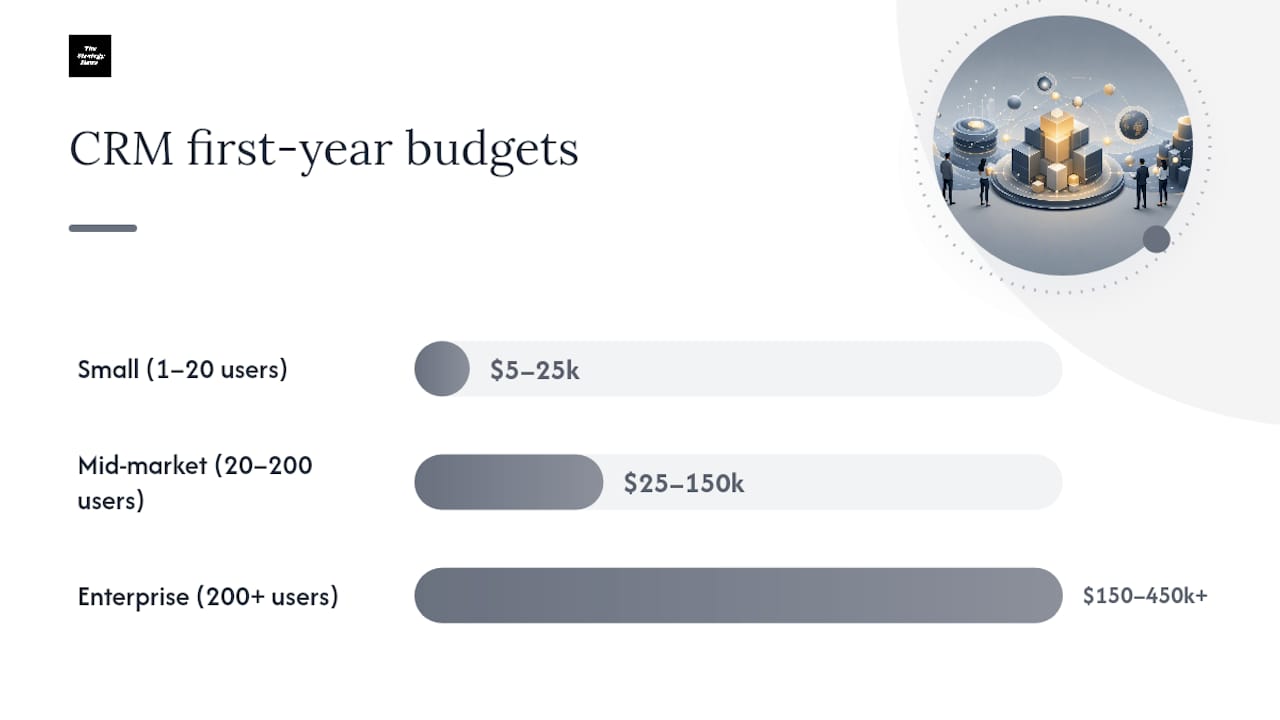
Small business (1–20 users). Assume a single sales team, one or two integrations (email and a billing tool), and a clean-ish contact list under 10,000 records. License costs land in the $3,000–$8,000 range annually. Implementation is mostly self-service or a few consulting hours, pushing total first-year spend to $5,000–$25,000. This range aligns with independent implementation benchmarks for small-team builds.
Mid-market (20–200 users). Assume multiple departments, three to five integrations (marketing automation, an ERP, a support desk), and a data set with real duplication problems across 50,000 to 250,000 records. First-year totals typically run $25,000–$150,000, with data migration and custom workflow design eating the largest share of professional services hours.
Enterprise (200+ users). Assume custom objects, five or more system integrations, multi-region data, and a formal change management program spanning 100+ hours of training design and delivery. Budgets here run $150,000–$450,000+, and the spread depends heavily on how much custom development the sales and service processes demand.
Pro Tip: Build your scenario budget around the messiest system you're replacing, not the average one. If your legacy spreadsheet or old CRM has years of duplicate records, budget migration hours at the high end of the range even if your user count looks small.
How Do You Calculate Per-Bucket Costs?
Rules of thumb turn vague quotes into numbers you can defend in a budget meeting. Here's how each bucket typically prices out.
- Per-user licensing. Entry-tier seats often run $15–$50 per user monthly, while advanced editions with automation and forecasting tools climb toward $150–$300. Right-size tiers by role. Sales reps often don't need the admin-level edition a RevOps lead requires, and category-wide pricing data from G2 shows license costs vary enough by edition that mismatched tiers waste real money fast.
- Implementation services. Partners typically price as a flat project fee, an hourly rate, or a percentage of license spend. Hourly rates for implementation partners commonly fall in the $75–$400 per hour range depending on region and skill level, so a 100-hour project could cost anywhere from $7,500 to $40,000 before you add data or integration work.
- Data migration. Pricing scales with record volume and mess level. Clean data under 100,000 records might run a few thousand dollars; duplicate-heavy, multi-source data can push migration costs several times higher per 100,000 records.
- Integrations. Off-the-shelf connectors (think a native app marketplace listing) often cost $500–$5,000 to configure. Custom API work between proprietary systems can run $10,000–$50,000 depending on complexity.
- Training. Budget by role: end-user training often runs a few hundred dollars per person in consultant time, while admin and power-user training requires deeper, more expensive sessions.
Pro Tip: Ask every vendor and partner quote for a per-bucket breakdown before you compare totals. A lump-sum number hides which line item is driving the price, and that's exactly the number you'll need when you negotiate.
How Long Does CRM Implementation Take?
Timeline and cost move together, and slow phases cost more than fast ones. A typical rollout moves through discovery (two to four weeks), build and configuration (four to eight weeks), data migration (two to six weeks, often running in parallel with build), training (one to three weeks), launch, and a 30 to 90 day optimization window.
- Multi-phase rollouts spread cost over time but extend the window where old and new systems run in parallel, adding hidden labor cost
- Compressed timelines increase risk of rushed data migration and skipped training, both of which resurface as support costs later
- Annual billing typically earns a discount over monthly, but locks you into a commitment before you've validated adoption
- Ask vendors about prepay discounts for multi-year terms only after a 90-day pilot period proves the fit
How Do You Build Your Own CRM Cost Estimate?
Six questions convert your specific situation into a defensible budget range, whether you're writing an RFP or presenting to finance.
- How many users need licenses, and what edition does each role actually require?
- How many custom workflows or objects does your sales or service process demand beyond what ships out of the box?
- How many systems need integration, and are those native connectors or custom API builds?
- How clean is your data, and how many records need migration?
- What compliance or SLA requirements apply (data residency, audit trails, uptime guarantees)?
- How many internal hours can your team dedicate versus hiring outside help?
Map answers to costs using this structure:
| Cost component | How to calculate |
|---|---|
| License fees | Users × per-seat price × 12 months |
| Implementation services | Estimated hours × partner hourly rate, or flat project quote |
| Data migration | Record volume tier × data-cleanliness multiplier |
| Integrations | Native connector fee, or custom build hours × hourly rate |
| Training | Per-role session cost × number of roles |
| First-year total | Sum of all five components above |
Worked example: a 30-user mid-market company needing three integrations and 80,000 records to migrate might land on $12,000 in licenses, $25,000 in implementation, $8,000 in migration, $6,000 in integrations, and $4,000 in training, for a first-year total near $55,000. That sits comfortably inside the mid-market range and gives you a number to defend in a budget conversation.
What Hidden Fees Should You Negotiate Out?
Contracts hide cost in predictable places.
Negotiation gives you real leverage on all five. Seat-block pricing (buying licenses in bundles of 10 or 25) can beat per-seat rates at mid-market scale. Sandbox environment access should come free during implementation, not as a paid add-on. Staged acceptance criteria, tying payment milestones to working features rather than calendar dates, protects you from paying for a rollout that isn't functional yet.

Pro Tip: Put every negotiated term in writing inside the contract, not a sales email. "Onboarding fee waived for certified partner engagement" is common language, but only the signed agreement protects you if the vendor changes account teams mid-project.
Before sending an RFP, your procurement checklist should confirm contact-tier thresholds and their triggered price jumps, data export rights if you ever leave the platform, named support contacts and response-time SLAs, and a written scope-change process so you're not renegotiating price every time a stakeholder adds a "quick" request.
What Does CRM Cost Over Three Years, Not Just One?
Year one is the expensive year. Renewal negotiations, added seats, and occasional custom development remain the main cost drivers going forward.
| Cost category | Year 1 | Year 2 | Year 3 |
|---|---|---|---|
| Licenses | Full price | Same or renewal increase | Renewal increase applied |
| Implementation/services | Largest one-time cost | Minimal (minor enhancements) | Minimal (minor enhancements) |
| Ongoing support | Included or light | Steady maintenance fee | Steady maintenance fee |
Three metrics tell you whether your CRM spend is paying off or quietly draining budget: adoption rate (percentage of licensed users actively logging activity weekly), time-to-lead (how fast a new lead gets a first touch), and support hours logged against the system monthly. A dropping adoption rate alongside rising support hours usually signals it's time to revisit configuration before you consider a costly reimplementation. Gartner's market analysis treats CRM as a strategic, high-growth software category precisely because these ongoing costs compound over a multi-year horizon, not just a single purchase decision.
Why Most CRM Overruns Come From Scope, Not Software
Most CRM budgets fail for a boring reason: nobody defined what "done" looks like before work started. A vendor quote based on a vague scope document turns into change orders the moment real requirements surface, and change orders are where the $25,000 project becomes the $75,000 project.
The fix isn't a bigger contingency line. It's front-loading the scoping work that most companies skip. At Thestrategyhaus, projects get scoped against explicit acceptance criteria before implementation begins, which means a data migration plan, an integration map, and a training schedule exist on paper before anyone touches configuration. That sequence shortens time-to-value and limits the change orders that drive most cost overruns.
A managed implementation makes financial sense once your project crosses roughly two or three integrations, involves more than a handful of custom workflows, or requires migrating data from more than one legacy source. Below that threshold, a capable internal team with vendor support can often handle it. Above it, the hours a DIY approach consumes usually cost more than a structured engagement, just in a less visible line item.
— Ashanti
How Strategy Haus Helps You Control CRM Costs
Thestrategyhaus is the alternative to guessing your way through a CRM rollout. Instead of a vendor quote you have to reverse engineer, you get a scoped project with acceptance criteria attached to every phase, so the number you approve is the number you pay.
Thestrategyhaus builds CRM and workflow implementation into its execution-focused consulting model: strategic scoping up front, hands-on configuration and data migration during build, and ongoing execution support once you're live. Projects are priced against defined deliverables, not open-ended hours, which is how you avoid the change-order spiral that turns a $50,000 budget into a $120,000 one. If you're staring down a CRM decision and want a realistic number before you talk to a vendor, visit Thestrategyhaus to scope your project and get a straight answer on what it will actually cost.
Sources
Cost ranges above draw on ZoomInfo's implementation cost analysis, Salesforce implementation benchmarks, and HubSpot onboarding cost breakdowns. Check vendor sites directly for current contact-tier and onboarding fee policies before signing.
- CRM Implementations Cost An Estimated $4.6 Billion Annually, New Analysis Says
- Gartner press release: CRM became the largest software market
- Salesforce CRM Implementation Guide 2026