

CRM governance is the system of roles, rules, and input controls that stops your customer data from decaying and keeps your revenue reporting trustworthy. If you manage this today, start with three things: run a duplicate-rate report, check required-field fill rates on your core objects, and name one owner for each data domain (contacts, accounts, opportunities).
Your starter KPIs matter because they tell you where the system is bleeding trust. Aim for a duplicate rate under 2% and a required-field fill rate above 90% as early thresholds.
- Run the duplicate-rate report this week, not next quarter.
- Check fill rates on your five most-used required fields.
- Assign a named owner, not a team, for each core object.
Key Takeaways
CRM governance succeeds when a named owner, a documented RACI, and input-layer controls work together to keep duplicate rate under 2% and field fill rate above 90%.
| Point | Details |
|---|---|
| Start with measurement | Run a duplicate-rate report and check fill rates before writing any policy. |
| Assign real ownership | Name one person per data domain instead of spreading it across a committee. |
| Build artifacts, not decks | A data dictionary, RACI, and control matrix operationalize governance faster than a policy PDF. |
| Pilot before scaling | Test controls on one domain for 30 to 60 days before rolling out organization-wide. |
| Get execution support | Thestrategyhaus delivers the artifact set and operational handoff through a 90-day pilot model. |
Table of Contents
- Why CRM Governance Matters for Revenue and AI Reliability
- Common Governance Failure Modes to Avoid
- Core Components of a CRM Governance Framework
- Phased Roadmap: Assess, Design, Pilot, Scale, Operate
- Running Governance Day to Day: Roles, Cadence, and Change Control
- Measuring Success, Timeline Expectations, and Resourcing
- How Thestrategyhaus Designs and Delivers CRM Governance
- Get Started With a CRM Governance Assessment
- Frequently Asked Questions
- Sources
Why CRM Governance Matters for Revenue and AI Reliability
Weak governance shows up first in your pipeline. Duplicate accounts split deal history, stale contacts inflate your total addressable market, and missing close-date logic makes forecasts unreliable before anyone notices. Sales reps stop trusting the CRM, so they build their own spreadsheets, and now you have two versions of the truth.
The connection to revenue operations is direct: forecast accuracy depends entirely on the data feeding it. If your win-rate calculation includes duplicate opportunities, every downstream decision, from headcount planning to territory design, inherits that error.
AI makes this worse, not better. Feed a CRM agent inconsistent picklist values or duplicate contact records, and it will confidently produce wrong summaries or misfire on outreach. Treating data and AI governance together matters more in 2026 than it did a few years ago, precisely because agentic tools now act on the data instead of just displaying it.
- Bad pipeline data leads to bad forecasts, which leads to bad staffing decisions.
- Duplicate or stale records amplify AI hallucinations rather than filtering them out.
- Reps who don't trust the CRM build shadow spreadsheets, which fragments your single source of truth.
Common Governance Failure Modes to Avoid
Most governance programs don't fail from lack of effort. They fail from a handful of predictable mistakes.
Teams jump straight to tool configuration and skip the design step entirely, building automation rules before anyone defines what "clean" even means for the business. Ownership gets diffused across a committee, so when a data quality issue surfaces, three people assume someone else owns it. Policy documents grow to 40 pages that nobody reads, while the actual working rules live in a spreadsheet someone built two years ago and never updated. Cultural resistance also creeps in: if sales comp rewards deal volume over deal accuracy, reps will game the fields that governance depends on.
- Configuring tools before defining rules and ownership.
- Assigning "everyone" as the data owner, which functions as no one.
- Letting one-off spreadsheets replace documented policy.
- Rewarding behavior that undermines the data you're trying to protect.
Pro Tip: Before writing a single policy page, ask which metric your sales team is compensated on. If it conflicts with data hygiene, fix the incentive first, or the policy will lose every time.
Core Components of a CRM Governance Framework
A working framework rests on six components, and skipping any one of them tends to create a gap the others can't cover.
Business rules and standards define what a valid record looks like: naming conventions, required fields, and picklist values that map to how the business actually operates. Lifecycle management governs how records move from creation to archival, including when a lead becomes disqualified and when a contact gets purged. Privacy and security controls determine who can see or edit sensitive fields, and this is where frameworks like ISO/IEC 27001 become a useful reference for access logging and encryption standards, alongside jurisdiction-specific rules like HIPAA for health data. Governance operating model assigns a RACI so decisions don't stall in ambiguity. Technology and platform controls cover validation rules, duplicate blocking, and integration permissions. Metrics and monitoring closes the loop by tracking whether the other five components are actually working.
Six practical artifacts operationalize this framework early, and each one needs a named owner and a review cadence:
| Artifact | Purpose |
|---|---|
| Data dictionary | Defines every field, its format, and its valid values |
| RACI matrix | Assigns decision rights across roles for each data domain |
| Data flow diagram | Maps where data enters, moves, and exits the CRM |
| Compliance control matrix | Ties fields to regulatory requirements like retention or consent |
| Escalation workflow | Defines who resolves a data quality issue and how fast |
| Platform control inventory | Lists active validation rules, permissions, and automations |
For data model hygiene specifically, check that required fields are actually enforced at entry (not just labeled required), that picklists replace free-text wherever possible, and that you have one canonical object per entity instead of three overlapping custom objects tracking the same thing.
Phased Roadmap: Assess, Design, Pilot, Scale, Operate
Standing up governance doesn't require a six-month committee process. It requires five phases, each with a clear deliverable.
- Assess. Measure your current KPIs (duplicate rate, fill rate, bounce rate), inventory every data source feeding the CRM, and map who currently owns what, even informally.
- Design. Write the policies, build the artifact set from the core components section, define access rules and how you'll handle data subject access requests, and set up a change-control process before you touch configuration.
- Pilot. Apply the new controls to a single domain, usually contacts or one business unit's opportunities, and measure the impact over 30 to 60 days before expanding.
- Scale. Roll the validated controls out across remaining objects and domains, using the pilot's results to refine thresholds.
- Operate. Establish a recurring cadence for enrichment, monitoring, and quarterly policy review.
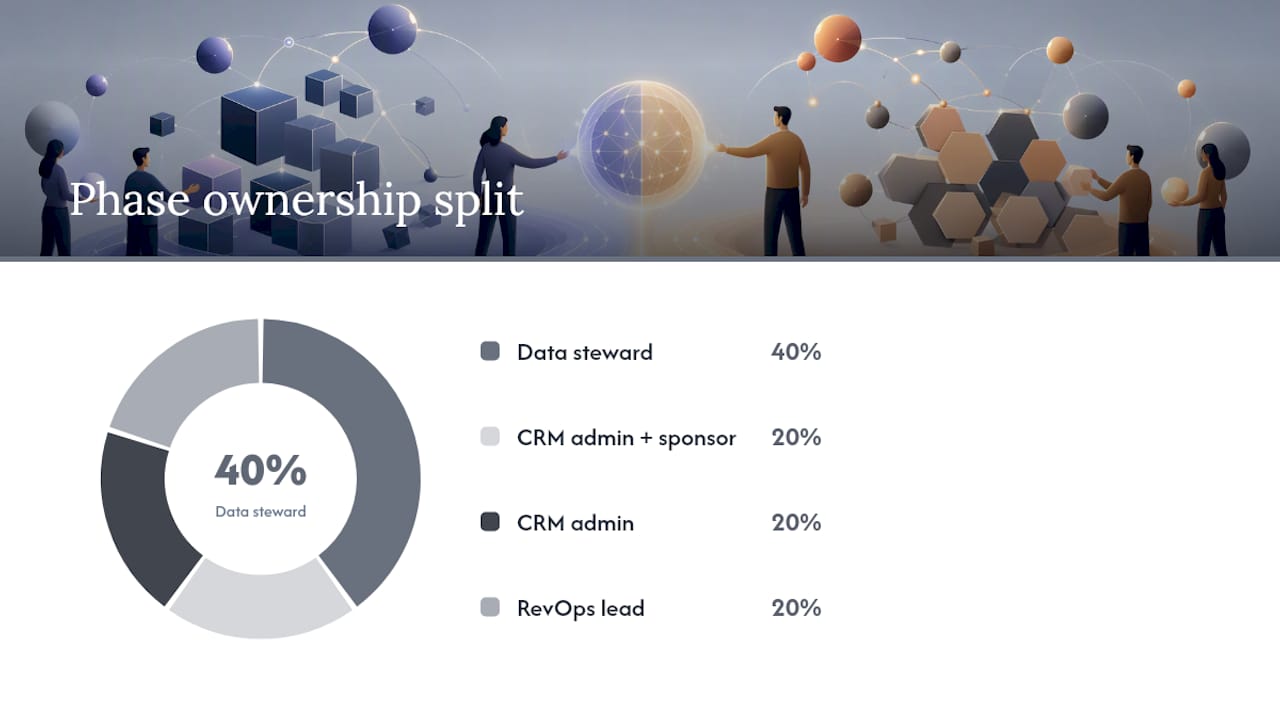
| Phase | Primary deliverable | Suggested owner |
|---|---|---|
| Assess | KPI baseline and source inventory | Data steward |
| Design | Policy set and RACI matrix | CRM admin + sponsor |
| Pilot | Single-domain control test with measured impact | CRM admin |
| Scale | Framework rollout across all domains | RevOps lead |
| Operate | Quarterly review and enrichment cadence | Data steward |
This sequencing matters because skipping the design phase and jumping straight to a full rollout is one of the most common ways governance programs collapse under their own weight.
Running Governance Day to Day: Roles, Cadence, and Change Control
Governance dies in the gap between the policy document and Tuesday afternoon. A working operating model needs an explicit RACI for your core objects, so nobody has to guess who fixes what.

For contacts and accounts, the data steward is typically Responsible for quality, the CRM admin is Accountable for configuration, sales ops is Consulted on field changes, and leadership is Informed on trends. For opportunities, sales management often takes the Accountable role since forecast accuracy is on the line.
Meeting cadence should stay light: a monthly data quality review with the steward and admin, and a quarterly session with the executive sponsor to review KPI trends and approve policy changes.
A basic change-request workflow keeps this from becoming chaotic:
- Intake the request with a clear business justification.
- Run an impact analysis on downstream reports and integrations.
- Approve based on documented criteria, not informal consensus.
- Deploy in a scheduled window, never mid-quarter during close.
- Keep the RACI visible, not buried in a slide deck nobody reopens.
- Route every field change through the same intake form, no exceptions.
Measuring Success, Timeline Expectations, and Resourcing
You'll know governance is working when the KPIs move, not when the policy document gets signed off.
Expect the assessment and design phases to take four to six weeks combined. The pilot typically needs 30 to 60 days to show a measurable KPI shift. Full scale-out runs another one to two quarters depending on how many objects and business units are involved.
- Minimum team: a CRM admin, a data steward, and an executive sponsor who can break ties.
- Budget posture: prioritize process design and artifact creation before buying additional tooling. Most governance failures come from missing process, not missing software.
Agentic AI and CRM Governance: What to Protect and Enable
Give AI agents read access before write access. Require human approval for any deletion or ownership change an agent proposes, and log every agent action with field-level detail so you can audit what changed and why.
- Restrict agent write permissions to a narrow, explicitly approved field set.
- Require human-in-the-loop review for deletions and ownership reassignments.
- Pilot new agents in a read-only sandbox before granting production access.
Pro Tip: Watch enrichment and decay metrics closely during an AI pilot. Agents that write frequently can mask data decay by overwriting stale fields with confident, wrong values.
How Thestrategyhaus Designs and Delivers CRM Governance
Thestrategyhaus builds governance the way it builds any operational system: execution first, artifacts delivered, and a clean handoff to your team, not a strategy deck that sits in a shared drive.
A typical 90-day pilot moves through assessment, artifact delivery (data dictionary, RACI, control matrix), and a single-domain rollout, closing with a measured KPI delta your team can point to.
- Faster cleanup because the artifact set is built once, correctly, instead of iterated on for months.
- Clearer ownership through a documented RACI your team actually uses.
- Fewer ad hoc spreadsheets once the platform controls replace manual tracking.
First-Person Perspective: Common Client Pitfalls We Fix Fast
The pattern repeats often enough to predict it: a CRM with three duplicate records for every real contact, and no single person accountable for fixing it. The fast fixes are almost always the same. Name one owner per domain immediately, and turn on input-layer duplicate blocking before attempting any bulk cleanup.
Get Started With a CRM Governance Assessment
If you're staring at a CRM with duplicate accounts, orphaned owners, and a policy document nobody's opened since it was written, you don't need another framework to read. You need someone to build the artifacts and hand you a working system. That's the gap Thestrategyhaus fills: execution-focused governance design instead of a slide deck, with the RACI, data dictionary, and control matrix actually delivered and handed off to your team.

An engagement typically starts with a short assessment call to baseline your current KPIs, followed by a 90-day pilot that produces the core artifact set and measurable improvement on one domain before scaling further. The first deliverable, your data dictionary and RACI matrix, is usually ready within the first two to three weeks. If you want a governance program that ships artifacts instead of accumulating meetings, request a 90-day pilot assessment and see what the first deliverable looks like for your CRM.
Frequently Asked Questions
What is CRM governance in simple terms? It's the combination of roles, policies, and input controls that keeps your customer data accurate and your reporting trustworthy over time.
Who should own CRM governance in a company? A named data steward should own day-to-day quality, a CRM admin owns configuration, and an executive sponsor should be accountable for aligning the program with broader business goals.
How long does it take to implement CRM governance? Assessment and design typically take four to six weeks, with a pilot needing another 30 to 60 days to show a measurable KPI shift.
Does CRM governance require new software? Not usually. Most failures trace back to missing process and ownership, not missing tools, so prioritize policy and roles before buying platforms.
How does AI change CRM governance requirements? Agentic tools that write to your CRM need narrower permissions, human approval for sensitive changes, and audit logging, since they can act on bad data instead of just displaying it.
Sources
For security controls, reference ISO/IEC 27001. For legal obligations on health or consumer data, check HHS HIPAA guidance. For segmenting governance by system type, review Gartner's Pace-Layered Application Strategy.
- CRM Data Governance: A Practitioner's Guide (2026)
- How To Create CRM Governance That Works
- ISO/IEC 27001 information security — ISO