

A change management plan is a document that maps the people, communication, and timeline work needed to move an organization from its current state to a new one with minimal disruption. It defines who is accountable, what gets communicated and when, and how success gets measured. The first move: run a short readiness assessment before you write anything else, so your plan targets the areas where resistance and risk actually live.
TL;DR:
- Conduct a readiness assessment to identify high-resistance areas and scope the change based on organizational capacity and affected systems.
- Build a detailed plan covering goals, stakeholders, communication, training, timelines, risks, and success metrics before rollout starts.
- Pilot the change with high-readiness groups, track adoption weekly, and gather early wins to promote manager buy-in and improve implementation.
- Integrate the change into daily operations by updating documents, adjusting performance reviews, and establishing recognition practices to ensure permanence.
- Prioritize active reinforcement and real-world usage data over messaging quality and consider outside support when internal capacity is limited or risks are high.
Table of Contents
- What Should A Change Management Plan Include?
- How Do You Build And Roll Out A Change Management Plan?
- Who Owns What? Mapping Stakeholders And Responsibilities
- Designing Communications And Training That Change Behavior
- Timelines, Risk, And The KPIs That Actually Predict Success
- Making The Change Permanent
- Templates You Can Copy Right Now
- Who's Behind This Guide, And When To Bring In Outside Help
- What Most Change Plans Get Backward
- When internal bandwidth runs out, outside execution support can help.
- Frameworks Worth Bookmarking For Your Next Rollout
- Sources
What Should A Change Management Plan Include?
A change management plan is only as strong as its weakest component. Skip the risk register or leave roles vague, and even a well-communicated change stalls once resistance shows up in the field. The Atlassian framework for building a change management plan breaks this down into a handful of components that show up in nearly every credible model, and each one answers a specific question your team will ask once the change starts moving.
Goal and scope. Write the objective in one or two sentences. State what's changing, what isn't, and who's affected. A scope that reads "we're updating the CRM for the sales team" prevents the finance department from assuming they're included, or excluded, when they shouldn't be.
Stakeholders and roles. Name the sponsor, the change lead, and the frontline managers by name, not by title alone. Ownership gaps happen when everyone assumes someone else is driving.
Communications. Define the audience, the core message, the channel, and how often you'll repeat it. One announcement email never moves behavior on its own.
Training and support. Set a minimum viable training deliverable, whether that's a 30 minute walkthrough or a job aid, and estimate the hours and budget it needs.
Timeline and milestones. Break the rollout into phases with dependencies flagged. A pilot that depends on a system upgrade that isn't finished yet is a timeline waiting to slip.
Risk register. Capture what could go wrong, how likely it is, and who owns the mitigation.
Success metrics. Track adoption rate, system usage, and the business KPI the change was meant to improve, on a set cadence, not just at the end.
- Goal and scope statement (one to two sentences)
- Stakeholder and role list with names attached
- Communications matrix (audience, message, channel, cadence)
- Training plan with time and resource estimates
- Phased timeline with dependencies flagged
- Risk register with owners and mitigation steps
- Metrics dashboard with a measurement schedule
Pro Tip: Draft the risk register and the communications matrix in the same sitting. Half the risks you'll list, like "managers won't reinforce the message" or "training lands before the system is ready," are actually communication failures in disguise, and naming them together saves you from writing two documents that contradict each other.
How Do You Build And Roll Out A Change Management Plan?
Most change initiatives don't fail because the idea was wrong. They fail because nobody sequenced the work. The five-phase structure below, prepare, plan, implement, embed, review, mirrors the process Harvard Business School Online outlines for change management and gives you a checklist for each phase instead of a vague mandate to "manage the change well."
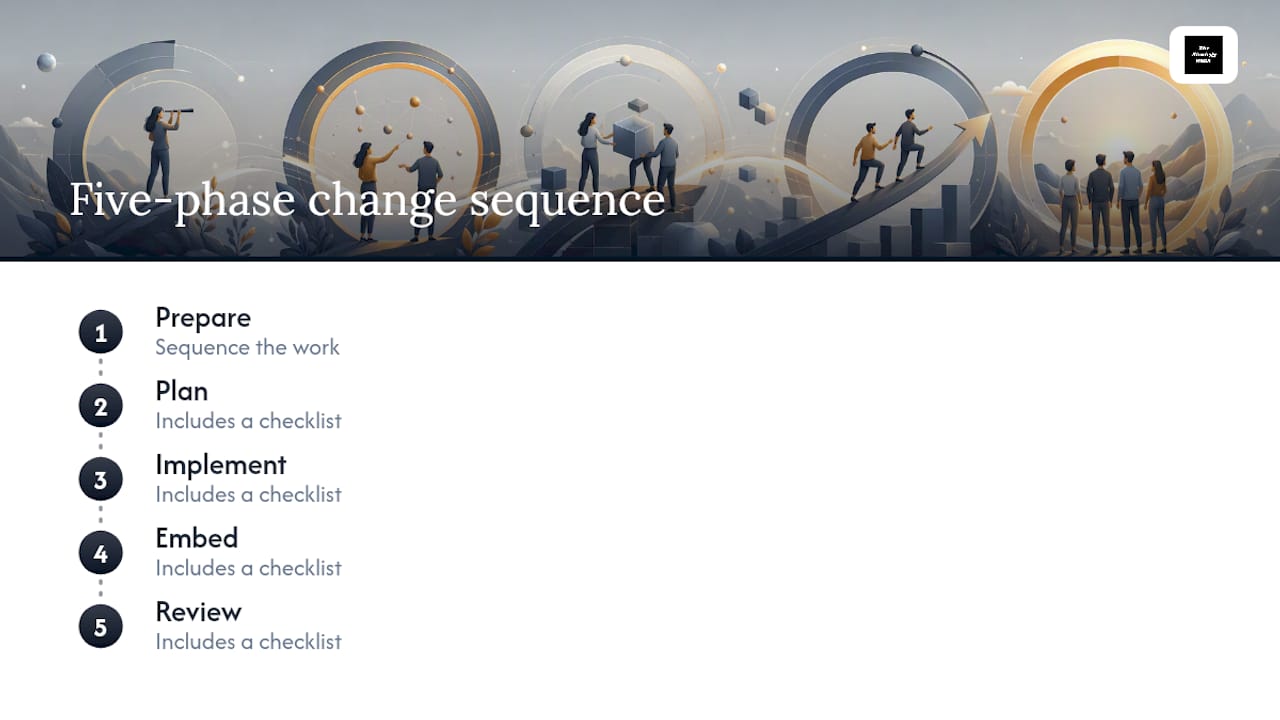
1. Prepare: assess before you plan anything
Before you write a single objective, find out how big the change actually is and how ready the organization is to absorb it. The CA-OCM framework calls this a Change Magnitude Assessment paired with an Environmental Readiness Assessment, run early and together.
The magnitude assessment asks how many people are affected, how different the new way of working is from the old one, and how visible the change will be. The readiness assessment asks whether the organization has the capacity, leadership support, and track record to pull this off. Mapping the two together tells you where the deficiencies actually sit, and those deficiencies become the priority activities on your OCM schedule.
To run this step, collect a few specific inputs:
- Interview several managers across the affected teams about past change fatigue and current workload.
- Pull attrition and engagement data if it's available. A team already stretched thin needs a longer runway.
- List every system, process, and job role the change touches, then flag the ones with the most downstream dependencies.
- Score the change on scope (number of people), depth (degree of difference in the new process), and speed (pace of rollout).
The gap this closes: teams that skip readiness assessment tend to build training and communications for the change they think they're managing, not the one they're actually facing. A change that scores high on magnitude but lands on a team with low readiness needs double the reinforcement time a standard rollout would need. Sequencing that correctly, instead of guessing, is what the assessment buys you.
2. Plan: build the actual plan document
With the assessment data in hand, this is where the plan itself gets written. Five things need to happen in this phase, and they build on each other in order.
- Vision and objectives. Translate the assessment findings into a plain statement of what success looks like in 90 days and in a year.
- Stakeholder mapping. List every group touched by the change and rank them by influence and by how much the change affects their day-to-day.
- Communications draft. Write the core messages for each stakeholder group before you pick channels. The message should answer why the change is happening, what's different, and what the reader needs to do this week.
- Training design. Decide the format, live session, e-learning module, or job aid, based on how complex the new process is and how many people need to learn it fast.
- Timeline with decision gates. Build the schedule backward from the target end state, and mark the points where leadership must approve before you move to the next phase.
3. Implement: run the pilot, watch the data
Rolling out to everyone at once is how you turn a manageable change into an unmanageable one. Start with a pilot group, ideally the team with the highest readiness score from your assessment, and track adoption in the first two weeks rather than waiting for a quarterly review.
Short-term wins matter more here than they get credit for. HBS Online's research on the change process points to phased pilots that surface visible, early wins as a major driver of manager buy-in. A pilot manager who can point to a concrete result, faster processing time, fewer errors, a specific dollar figure, becomes your best advocate with skeptical peers. A pilot that produces only "things feel fine" doesn't do that work for you.
During implementation, keep three things running in parallel: a short weekly issue log so problems get caught before they compound, an adjustment process so the plan can flex without a full replan, and a stakeholder update cadence so the rest of the organization sees the pilot progressing instead of wondering what happened to it.
4. Embed: make the change stick
This is the phase most plans skip, and it's the one that determines whether the change survives past the announcement. Embedding means the new way of working gets written into the systems that run day-to-day operations, not just described in a memo.
- Hand governance of the new process to the operations team that will own it long term.
- Update job descriptions and standard operating procedure documents to reflect the new workflow.
- Fold the new behavior into performance review criteria, so it's rewarded rather than optional.
- Build a recognition rhythm, even something as simple as a monthly shoutout for teams hitting adoption targets, to keep momentum after the initial excitement fades.
5. Review: capture lessons and set sustainment checkpoints
Close the loop with a formal post-implementation review. Ask what worked, what didn't, and what you'd do differently with the readiness data you now have. Then set sustainment checkpoints, at 30, 90, and 180 days, to confirm the change is still holding once attention has moved to the next priority.
Who Owns What? Mapping Stakeholders And Responsibilities
Every change plan has a moment where two departments both assume the other one is handling training, or nobody actually owns the risk register. A stakeholder map with clear role responsibilities prevents that, and it takes less time to build than most managers expect.
Start by listing every group the change touches, then rank each one on two axes: how much influence they have over whether the change succeeds, and how much the change actually affects their daily work. A department head with high influence and low personal impact needs visible updates and a chance to weigh in early. A frontline team with low influence and high impact needs hands-on support and a manager who checks in weekly.

From there, a RACI approach helps assign the actual work. RACI stands for Responsible, Accountable, Consulted, and Informed. The person marked Responsible does the task. The person marked Accountable signs off on it and answers for the outcome. People marked Consulted give input before a decision is finalized. People marked Informed get told after the fact. Applying these four labels to each task, training design, communications approval, risk mitigation, stops the common failure where three people think they're Accountable and nobody actually is.
Sponsors and managers carry the heaviest load once the RACI is set.
- The sponsor needs to visibly and repeatedly endorse the change, in person, at key milestones, not just in a single kickoff email.
- Managers need a short, specific action list: reinforce the message in team meetings, model the new behavior themselves, and flag resistance to the change lead within 48 hours instead of letting it sit.
- The change lead needs authority to resolve cross-functional disagreements without escalating every decision to the sponsor.
When conflicts do surface between departments, resolve them through a standing decision gate rather than an ad hoc email chain. Governance structures modeled on the ISO/TS 10020 organizational change management processes work because they give sponsors and change agents a defined process for resolving these disputes instead of relying on whoever escalates loudest.
Designing Communications And Training That Change Behavior
Most communication plans fail for a simple reason: they explain the change without telling anyone what to actually do differently on Monday morning. A message that only covers "why this is happening" builds understanding, not action.
Structure every core message around three parts. Start with why the change is happening, in one sentence, without corporate framing. Follow with what's actually different for this specific audience. End with what they need to do right now, this week, not eventually.
Channel and cadence matter as much as the message itself.
- Use a mix of channels: a town hall or all-hands for the initial announcement, team meetings for reinforcement, and a written FAQ or intranet page people can revisit.
- Repeat the core message at least three times across different channels before assuming it's landed.
- Segment the cadence by stakeholder group. A pilot team needs weekly touches during rollout; a department watching from the sidelines needs a monthly update.
Training needs the same behavior-first design. A pilot session with a small group surfaces confusion before it reaches everyone else. Role-based fundamentals training, tailored to what each job actually requires, beats a one-size-fits-all module every time. Job aids and quick-reference guides give people something to lean on in the first few weeks when the new process still feels unfamiliar.
Pro Tip: Build a two-question feedback form, "What's confusing?" and "What's missing?", and send it to the pilot group 72 hours after training. You'll catch the gaps in your training design while they're still cheap to fix, instead of finding out three weeks later that half the team never understood step three.
Measuring training effectiveness means going past completion rates. Track whether people actually changed their behavior in the days after training, and whether they're applying the new process correctly when nobody's watching. Completion tells you people showed up. Application tells you the training worked.
Timelines, Risk, And The KPIs That Actually Predict Success
A phased timeline with clear decision gates keeps a change plan from either rushing ahead of readiness or stalling indefinitely. Map the critical path first: identify which tasks absolutely must finish before the next phase can start, then build everything else around those dependencies.
Every timeline needs a risk register sitting next to it, because the risks that derail change initiatives are predictable.
- Manager resistance: mitigate by involving managers in the plan's design phase, not just its rollout, with the change lead as the owner.
- Training doesn't land before go-live: mitigate by building in a two-week buffer between training completion and launch, owned by the project manager.
- Communication fatigue: mitigate by capping message frequency and varying the format, owned by the communications lead.
- System readiness slips: mitigate by tying the go-live date to a technical sign-off gate, not a calendar date, owned by IT leadership.
A change initiative can look successful on a dashboard, high completion rates, positive survey scores, and still fail the business goal it was meant to serve if adoption metrics aren't tied to real usage data. HBS Online's guidance on the change process emphasizes measurable KPIs and active reinforcement as the factors that separate initiatives that stick from ones that quietly reverse.
Build your KPI set around four categories: adoption rate (percentage of the target group using the new process), usage frequency (how often they're using it correctly), error or exception rate (a proxy for whether people understand it), and the underlying business metric the change was meant to move, whether that's cycle time, cost, or customer satisfaction. Measure adoption and usage weekly during the pilot, then move to monthly once you're in the embed phase.
Set go/no-go criteria before the pilot starts, not after you see the results. A reasonable bar: adoption above a set threshold, no unresolved high-severity risks, and manager sign-off from at least three-quarters of the pilot group. If the pilot doesn't clear that bar, extend it rather than scaling on optimism.
Making The Change Permanent
A change that isn't embedded into how the organization actually runs will quietly revert within a few months, no matter how strong the launch was. Kotter's 8-step model treats this as its own distinct phase for a reason: anchoring the change in culture takes deliberate governance work, not just hope that habits stick.
Handing the change to operations means more than a status meeting. Build a short handover checklist: named process owner, updated documentation location, and a governance body that will review the process quarterly.
- Fold the new process into job descriptions and standard operating procedures, not a separate reference document nobody opens.
- Add the new behavior to performance review criteria so it's incentivized rather than optional.
- Set a recognition rhythm, monthly or quarterly, that calls out teams or individuals who modeled the change well.
- Time any broader rollout to follow, not precede, evidence that the pilot's gains held for at least one full review cycle.
Templates You Can Copy Right Now
You don't need custom software to start executing. A one-page plan, a communications checklist, a training outline, and a risk register cover most of what a mid-sized change initiative needs, and each one takes under an hour to draft using the structure below.
One-page plan header fields: objective (one sentence), scope (in and out of bounds), sponsor name, change lead name, target end state, and key milestone dates. Example entry: "Objective: Migrate finance team to new expense system by end of Q2. Scope: Finance department only, does not include procurement. Sponsor: VP Finance."
Communications checklist: stakeholder group, core message, channel, cadence, and owner. Sample cadence: kickoff announcement in week one, reinforcement message in week three, FAQ update in week five.
Training plan outline: module name, target role, format, duration, and completion deadline. A finance system rollout might need a 45 minute live session for power users and a 15 minute job aid for occasional users.
Risk register example entries:
| Risk | Likelihood | Owner | Mitigation |
|---|---|---|---|
| Manager resistance to new workflow | Medium | Change lead | Involve managers in design phase before rollout |
| Training completion lags before go-live | High | Project manager | Add two-week buffer between training and launch |
| System not ready for pilot date | Medium | IT lead | Tie go-live to technical sign-off, not calendar date |
Sample phased timeline:
| Phase | Duration | Key activity |
|---|---|---|
| Pilot | Weeks 1 to 4 | Roll out to one team, track adoption weekly |
| Scale | Weeks 5 to — | Expand to remaining teams based on pilot results |
| Sustain | Weeks — onward | Quarterly governance review and reinforcement check |
For a downloadable version with more structure, the Australian Department of Health's step-by-step change management guide offers a public-sector template that adapts well to private organizations too.
Who's Behind This Guide, And When To Bring In Outside Help
This guide draws on established frameworks, CA-OCM, ISO/TS 10020, and Kotter's model, along with practical process guidance from HBS Online and Atlassian, to give you a plan structure that's been tested across public and private sector organizations alike.
An execution framework can address the gap where many organizations fail at the handoff between planning and doing. Three things define an effective approach to that gap:
- A structured framework that turns high-level strategy into an actionable plan with defined ownership at every step.
- Execution support that continues past the planning document, into the actual rollout, beyond just handing off a strategy deck.
- Experience helping teams eliminate chaos and maintain momentum during product launches and operational rebuilds.
Bring in outside execution support when the change touches more than two or three departments at once, when internal project management bandwidth is already stretched thin, or when the risk of getting it wrong, regulatory exposure, revenue impact, customer trust, is high enough that a stalled rollout would be costly. A typical engagement moves through discovery (mapping the current state and readiness gaps), plan development (building the vision, timeline, and stakeholder map), and execution support (staying involved through the pilot and embed phases rather than exiting after the document is delivered).
What Most Change Plans Get Backward
The conventional advice treats communication as the centerpiece of change management. It isn't. Communication tells people what's happening. Execution capacity determines whether it actually happens. Plenty of organizations run flawless town halls and beautifully designed FAQ pages, then watch adoption stall because nobody had the bandwidth to coach managers through week three, when enthusiasm fades and the old process starts looking easier again.
The gap in most plans isn't the vision statement or the risk register. It's the assumption that a document, however well built, will run itself once it's approved. It won't. Someone has to own the daily friction: the manager who needs a script for a resistant employee, the system that isn't quite ready on the promised date, the pilot data that needs a decision within 48 hours, not next month's steering committee.
Prioritize the embed phase before you polish the communications deck. A plan with mediocre messaging and strong reinforcement outperforms a plan with brilliant messaging and no follow-through, every time. If your organization doesn't have the internal capacity to stay present through that reinforcement window, that's the moment to bring in execution support, not after the rollout has already started slipping.
— Ashanti
When internal bandwidth runs out, outside execution support can help.
Building the plan is the easier half. Staying present through the pilot, the manager pushback in week three, and the governance handoff is where many internal teams run out of bandwidth.
Specialized support can help take a change plan from document to daily reality: strategy-to-execution support, project management, and hands-on implementation help for teams managing product launches, system rollouts, or operational rebuilds. Consider external help when change touches multiple departments, internal project management capacity is limited, or the risk of a stalled rollout is high.
Initial conversations typically cover the scope of change, a realistic timeline based on current resources, and desired outcomes in six months. From there, a project-based engagement can be scoped to the size and complexity of the rollout. If your plan is written but your bandwidth to execute it is thin, book a discovery call through Thestrategyhaus's services page and get a second set of hands on the parts of change management that documents alone can't carry.
Frameworks Worth Bookmarking For Your Next Rollout
For readers building out their own plan library, four sources back most of the structure in this guide. The CA-OCM framework offers lifecycle templates and the readiness/magnitude assessment approach. The ISO/TS 10020 specification lays out formal governance processes for sponsors and change agents. Kotter's 8-step model remains the clearest reference for embedding change into culture. And the process summaries from HBS Online and Atlassian give practical, plain-language walkthroughs worth revisiting before your next rollout.
Sources
- California Organizational Change Management Framework (CA-OCM)
- How to Create a Change Management Plan in 5 Steps | Atlassian
- 5 Steps in the Change Management Process | HBS Online
- ISO/TS 10020:2022 - Quality management systems — Organizational change management — Processes
- Kotter's 8-Step Change Model