

A change champions network is a group of trained, credible employees who help a workforce adopt a change from the inside, one team at a time. It works because peers trust peers more than they trust memos. If you're building one, your first move is not recruiting volunteers. It's locking a sponsor and writing down, in one sentence, what this network exists to do.
TL;DR:
- Formal change champions should be influence-driven employees with credibility across teams, not just titleholders, to ensure trust and effectiveness.
- Building a network requires a clear, written purpose, a committed sponsor, well-defined roles, and a governance rhythm before recruiting champions.
- A network's size and influence grow most reliably through overlapping connections rather than relying on a few charismatic leaders.
- Ongoing enablement with training, practical toolkits, and regular refreshers is essential to maintain champion effectiveness and prevent burnout.
- Measuring adoption, engagement, and issue resolution regularly helps demonstrate progress and guides adjustments during rollout.
Table of Contents
- What a Change Champions Network Is and When to Use One
- How to Choose and Recruit the Right Champions
- Network Design: Structure, Governance, and Operating Model
- Enablement: Training, Toolkits, and Communications
- Sustaining the Network and Avoiding Burnout
- Measuring Impact: Metrics, Feedback Loops, and Dashboards
- Common Pitfalls, Lessons Learned, and Quick Fixes
- How Thestrategyhaus Puts These Steps Into Practice
- Three Priorities for Your First 90 Days
- How Thestrategyhaus Can Help You Build One
- Sources
What a Change Champions Network Is and When to Use One
A change champions network is a group of employees, spread across teams and locations, who help their peers understand, adopt, and troubleshoot a change while it's happening. You'll see this idea called a change agent network, a change leadership network, or simply organizational change advocates. The terms overlap in daily use, but they aren't identical, and the difference matters more than it looks.
Kellogg Executive Education draws a useful line between "advocates" and "agents." An advocate is someone who supports a change informally, mostly through enthusiasm and word of mouth. An agent is someone formally selected, trained, and held accountable for a defined role. Informal advocates are useful for small changes. Once you're dealing with scale, complexity, or a distributed workforce, you need agents, not just cheerleaders.
That's the real decision test. Ask yourself:
- Does this change touch multiple departments, sites, or time zones?
- Will managers alone be too stretched to answer every question themselves?
- Is the change complicated enough that generic training won't cover every use case?
- Does the culture shift required go deeper than a new tool or process?
If you answered yes to two or more, a formal network earns its cost. Prosci's guidance is blunt on this point: build the network when broad adoption is the goal, and follow a stepwise path from sponsor support through selection, enablement, activation, and a lessons-learned review at the end.
The payoff shows up fast once a network is running well. Champions surface local resistance and confusion before it becomes a support ticket or a resignation. Adoption moves faster because employees hear "here's how this actually works" from someone who sits three desks away, not from a slide deck. Leaders get a real-time read on sentiment that surveys catch weeks too late.
How to Choose and Recruit the Right Champions
Picking champions by job title is the fastest way to build a network nobody trusts. A team lead with a big office and no peer credibility will get ignored the moment things get uncomfortable. Influence, not rank, is the trait you're actually recruiting for.
Here's a workable selection process:
- Define the criteria before you look for names. Prioritize influence among peers, credibility on the specific topic, availability given current workload, and diversity across function, tenure, and location.
- Pull nominations from two directions. Ask managers who they'd trust to represent their team, then ask employees who they'd actually go to with a question. The overlap between those two lists is your shortlist.
- Check simple social indicators. Who gets asked for help informally? Who explains things well without being asked? These are cheap signals and they're usually accurate.
- Confirm capacity, not just willingness. A champion who says yes but has no time to give is worse than no champion at all.
- Write a one-page role description before you approach anyone. Cover expected time commitment that fits within a reasonable weekly range, core responsibilities, and what success looks like at 90 days.
- Run a short onboarding, not a welcome email. Cover the change itself, the champion's specific duties, escalation paths, and where to find the toolkit.
Diversity deserves a deliberate look, not an afterthought. If your champions all come from one department, one seniority band, or one location, you'll miss blind spots that surface only when a night-shift team or a remote office hits a wall nobody in headquarters anticipated.
Pro Tip: Ask each nominee to name one colleague who'd push back on their opinion. If they can't name anyone, they may be more popular than credible, and credibility is what actually moves adoption.
Avoid the trap of treating this like a committee appointment. A champion isn't a title on an org chart. It's a working role with real hours attached, and treating it casually is exactly how networks stall out three months in with champions who signed up but never showed up.
Network Design: Structure, Governance, and Operating Model
A change champions network needs a shape, or it collapses into a group chat that nobody checks. Three roles anchor most working networks: an executive sponsor who unlocks resources and removes political roadblocks, a network lead (sometimes called a change agent network architect) who runs day-to-day coordination, and the local champions themselves, embedded in teams and sites.
Governance doesn't need to be heavy, but it does need to exist. A workable baseline looks like this:
- A biweekly or monthly sync between the network lead and all champions to share updates and surface issues.
- A clear escalation route so a champion who hits a problem they can't solve knows exactly who to call, not just "someone in HR."
- A central repository, even something as simple as a shared drive folder, holding the current FAQ, talking points, and status reports.
- A quarterly review with the executive sponsor to confirm the network still matches the pace and scope of the change.
Coverage ratios vary by organization, but a common starting rule of thumb is one champion per moderately sized team, or one per physical location if teams are small and scattered. Central Michigan University's transformation office structure offers a practical illustration: champions are assigned by department, given defined responsibilities, and folded into a governance rhythm that ties back to a central coordinating office rather than operating as free agents.
Decision rights matter more than most first-time builders expect. Champions should have authority to answer routine questions and adjust their own local rollout tactics. They should not have authority to change policy, timelines, or scope. That line needs to be explicit from day one, or you'll end up with well-meaning champions making commitments the project team can't honor.

One design principle worth borrowing from network theory: build "wide bridges" between groups rather than relying on a handful of super-connectors to carry the whole message. A TechClass analysis on internal advocate networks makes the case that behavioral change spreads more reliably through many overlapping connections than through a few highly visible influencers. If your entire network depends on three charismatic people, you have a single point of failure, not a network.
Enablement: Training, Toolkits, and Communications
Champions can't represent a change well if they only understand it as well as the people they're supposed to be helping. Training has to go a level deeper, and it has to cover more than facts about the change itself.
Four topics belong in every enablement plan:
- Change fundamentals. Why this change is happening, what problem it solves, and what happens if it doesn't stick.
- Communication skills. How to explain something complicated in plain terms, and how to listen without getting defensive when someone pushes back.
- Basic coaching technique. How to help a struggling colleague work through resistance instead of just repeating the official talking points louder.
- Escalation judgment. How to tell the difference between a question they can answer and one that needs to go up the chain.
Delivery works best mixed rather than single-mode. Short microlearning modules cover the fundamentals efficiently. A live workshop, even a 90-minute one, builds the confidence that a video never will. Peer coaching, pairing a newer champion with an experienced one, closes the gap fastest for the communication and coaching skills that don't transfer well through slides.
Every champion needs a small, practical toolkit, not a binder nobody opens: for hands-on skill-building, consider the copy workshop approach to improve how champions create persuasive messages.
- A one-page message map with the three or four core points of the change, worded consistently.
- A living FAQ that gets updated as new questions surface in the field.
- A short demo script if the change involves a new system or process.
- A simple feedback form champions can use to report recurring concerns back to the network lead.
Pro Tip: Keep the FAQ in one shared, editable document rather than a static PDF. Champions who can add a question the moment they hear it keep the resource useful instead of stale.
Reinforcement is where most enablement plans quietly die. A single kickoff training won't carry a champion through a six-month rollout. Build in refresher sessions, roughly every four to six weeks, and keep a peer community, even a simple chat channel, running so champions can trade real problems and real fixes as they come up.
Sustaining the Network and Avoiding Burnout
A champion who burns out in month three does more damage than one who never signed up, because their visible exhaustion tells every other champion this role isn't worth the effort. Sustainment has to be a deliberate practice, not a hope.
Recognition works best when it's specific and visible, not generic. A shoutout in a team meeting naming exactly what a champion fixed carries more weight than a form thank-you email. Some networks rotate a small public recognition, like naming a "champion of the month" on a shared dashboard, and it costs nothing but attention.
- Set a bounded time commitment from the start, and hold to it. If two to four hours a week was the deal, don't let it drift to ten.
- Rotate champions periodically, especially for long programs, so no single person carries the role for a year straight with no relief.
- Run peer coaching circles where champions troubleshoot with each other, not just with the network lead. Isolation is a bigger driver of burnout than workload alone.
- Watch for early signals: a champion who stops attending syncs, gives short answers in check ins, or quietly stops updating the feedback log.
When you see those signals, act within the week, not at the next quarterly review. A short one-on-one asking what's actually going on, and a real offer to reduce load or hand off a task, usually costs less than losing the champion entirely and having to recruit and retrain a replacement mid rollout.
Measuring Impact: Metrics, Feedback Loops, and Dashboards
A network you can't measure is a network you're guessing about. Four KPIs cover most of what matters: adoption rate (percentage of the target group actively using the new process or tool), activation rate (percentage of assigned champions actively engaged in the role, not just nominated), champion engagement (attendance at syncs, FAQ contributions, feedback submissions), and issue resolution rate (how quickly champion-flagged problems get addressed).
Data sources don't need to be elaborate:
- Short pulse surveys, sent every two to four weeks, asking employees how confident they feel about the change.
- System telemetry, when the change involves a tool, showing actual usage patterns.
- Manager input, gathered informally during regular check ins, on how their team is coping.
- Champion self-reports, submitted through that same feedback form from the enablement toolkit.
Prosci's guidance on network operations recommends a rhythm of small, regular measurement loops, weekly signal checks paired with a monthly synthesis, to catch drift early without turning measurement into a burden the champions resent.
A workable dashboard doesn't need more than four widgets: an adoption trend line, a champion activation rate by team or region, a rolling list of open issues with age and severity, and a simple sentiment score pulled from the pulse survey. Anything more complex tends to go unread.
Attribution is the hardest part, honestly. You'll rarely prove with certainty that a specific champion caused a specific adoption jump. What you can do is track correlation: teams with active, engaged champions tend to show faster adoption curves and fewer escalated issues than comparable teams without one. That pattern, repeated across enough teams, is a strong enough signal to justify the investment even without perfect causal proof.
Common Pitfalls, Lessons Learned, and Quick Fixes
Most failed networks share the same handful of root causes, and they're almost always visible within the first sixty days if you know what to look for.
- No real sponsor. A network with a sponsor in name only loses funding and priority the moment budgets tighten. Fix: get a specific commitment in writing, including time the sponsor will personally spend, before launch.
- Vague role definitions. Champions who don't know what's expected of them default to doing nothing. Fix: put the one-page role description in writing before recruiting starts, not after.
- Selecting for title instead of influence. A network stacked with managers and no informal leaders loses peer trust fast. Fix: rerun the nomination process with the manager-and-peer overlap method described earlier.
- No measurement plan. Without KPIs, the network becomes impossible to defend when leadership asks what it's actually accomplished. Fix: pick the four core KPIs above before the first champion is even recruited.
The UNSSC's review of change agent networks across five UN entities found no single design that worked everywhere, but the common thread across the successful ones was consistent: clear purpose, real sponsor backing, and a willingness to adapt the model to local context rather than forcing a rigid template onto every team. That's the pattern worth borrowing regardless of industry.
How Thestrategyhaus Puts These Steps Into Practice
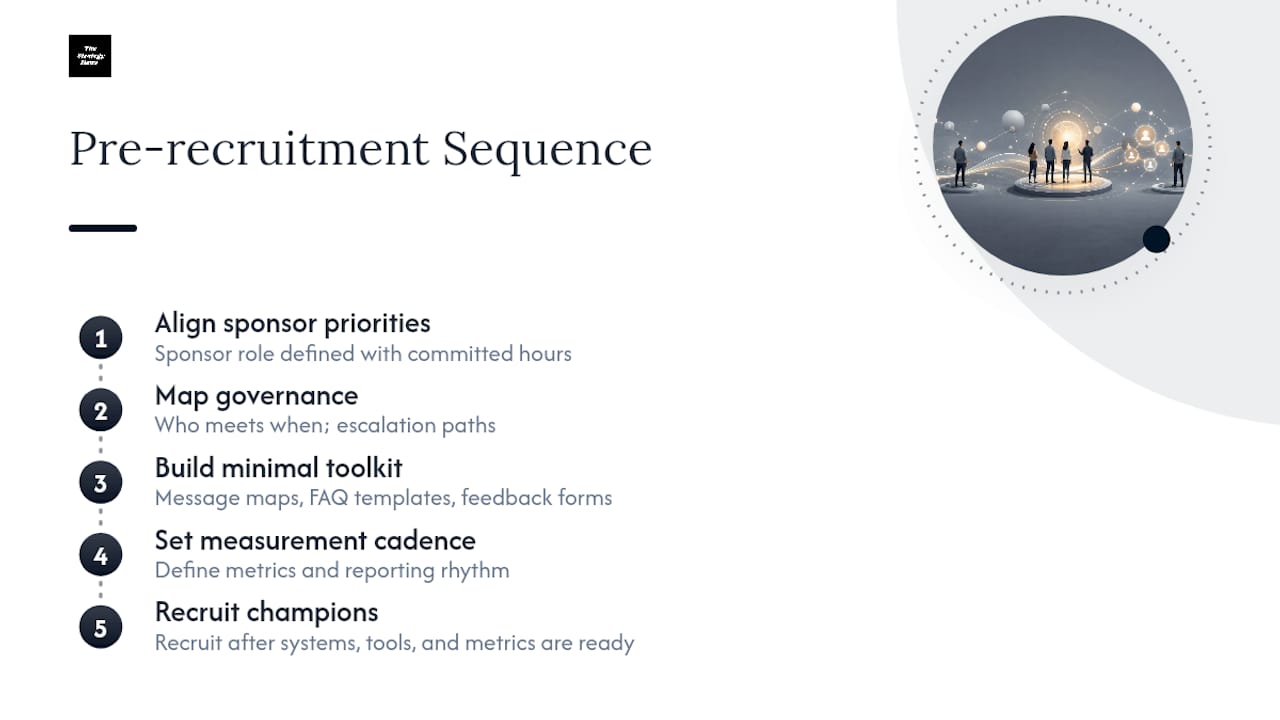
A champion network is best treated as a system that needs sequencing, rather than a list of good intentions. An execution-focused framework starts by aligning sponsor priorities with the network's actual purpose, so the sponsor commitment is a defined role with real hours attached.
From there, the concrete work looks like this: mapping governance (who meets when, who escalates to whom), building the minimal toolkit (message maps, FAQ templates, feedback forms), and setting the measurement cadence before a single champion is recruited. That sequencing matters because organizations that skip straight to recruiting champions almost always end up rebuilding the role descriptions and governance rules mid-program, after confusion has already cost them momentum.
Effective consulting work centers on removing the chaos that stalls most internal builds: unclear ownership, missing templates, and no one accountable for keeping the rhythm going past month two.
Three Priorities for Your First 90 Days
If you're standing up a network right now, resist the urge to do everything at once. Sequence it.
In your first 30 days, secure a sponsor who commits real time, not just a name on a chart, and write a one-sentence purpose statement everyone can repeat without checking notes. Design a small pilot, one team or one region, rather than launching everywhere simultaneously.
In days 30 to 60, recruit champions using the manager-and-peer overlap method, run the initial training, and start the regular sync cadence immediately. Don't wait for a "perfect" toolkit; a rough FAQ beats no FAQ.
By day 90, pull your first real numbers: adoption trend, activation rate, and champion feedback. Use that data to adjust the operating rhythm before scaling beyond the pilot. Networks that skip this checkpoint tend to scale their mistakes along with their coverage.
— Ashanti
How Thestrategyhaus Can Help You Build One
If your team has the bandwidth and the internal relationships to run this build alone, do it yourself. If you're short on either, external execution support can help close that gap faster than trial and error. Rather than just receiving guidance, some firms provide direct help standing up networks, governing them, and keeping them running past the initial period.

The work runs from design straight through execution: role playbooks, coaching for network leads, meeting cadences, and minimal toolkits adapted to an organization's structure rather than generic templates. This approach suits organizations mid-rollout with a stalled or under-resourced network, as well as those at the start who want to avoid learning by trial and error in the initial phase. If a champion network sits in your near-term plans, visit the Thestrategyhaus services page to talk through what an execution-focused build looks like for your organization.
Sources
The distinction between informal advocates and formally designated agents comes from Kellogg Executive Education, which frames the transition as a matter of connection and accountability. Prosci's guidance outlines the stepwise build process referenced throughout this piece. The step-by-step launch checklist from OCM Solution informed the selection and enablement sections. The UNSSC review of UN-system networks provided the cross-context lessons on sponsor backing and adaptive design.