

An automation roadmap is the enterprise plan that sequences discovery, pilots, governance, and scale across a business. It maps which processes get automated, in what order, and who owns each step. The first move for most leadership teams: run a focused discovery exercise and pick one 90-day pilot to prove the model before committing to anything bigger.
TL;DR:
- Prioritize processes with the highest impact, achievability within 90 days, and potential for transferability to ensure successful pilot outcomes.
- Reuse technology stacks and focus on integration leverage to maximize ROI and reduce dependencies during sequencing and scaling.
- Allocate more SME hours for design, testing, and validation, while accounting for legacy system complexities that often delay IT integration.
- Define clear ownership for each automation process from the start to prevent loss of accountability and ensure sustainability.
- Measure baseline metrics before automation launch and create a regular review cadence that includes stakeholder feedback for continuous improvement.
Table of Contents
- What Are the Phases of an Automation Roadmap?
- How Do You Score and Sequence Automation Candidates?
- What Does a 90-Day Pilot Plan Look Like?
- Who Owns Governance and the Center of Excellence?
- How Do You Measure ROI and Keep the Feedback Loop Alive?
- How Much Time and Budget Should You Really Plan For?
- Why Strategy Haus's Execution-First Framework Reduces Risk
- The Mistakes Leaders Keep Making
- How Strategy Haus Designs and Runs Your Roadmap
- Sources
What Are the Phases of an Automation Roadmap?
Every enterprise automation program moves through three phases, and skipping one is the most common way programs stall. The phased Discovery, Prioritization, Pilot, and Scale approach works because each phase produces evidence the next phase needs.
Define comes first. This is where you map processes, capture baseline metrics like cycle time and error rate, score candidates against a rubric, and get executive sign-off on priorities. Skip this and you end up automating whatever the loudest department head wants, not what actually moves the business.
Standardize follows. You stand up a lightweight Center of Excellence, build reusable templates, and validate your first pilot. This phase proves the operating model works before you multiply it across a portfolio.
Scale is where the roadmap earns its return. Orchestration, portfolio management, and continuous funding replace one-off projects. At this stage:
- Define phase: process discovery, baseline data, prioritization scoring, executive alignment
- Standardize phase: CoE formation, delivery templates, pilot validation, documented playbooks
- Scale phase: cross-process orchestration, portfolio governance, ongoing budget cycles
Most organizations that struggle with automation try to jump straight to Scale. The Everest Group's enterprise automation playbook points to process discovery and CoE governance as prerequisites, not afterthoughts.
How Do You Score and Sequence Automation Candidates?
Not every automatable process deserves your first pilot slot. A scoring rubric keeps the selection honest instead of political.
- Impact — Does this process touch revenue, customer experience, or a real cost center?
- Achievability — Can you complete it with current tools and staff in 90 days?
- Representativeness — Does it resemble other processes you'll want to automate later, so lessons transfer?
- Time-to-value — Will leadership see a measurable result before the next budget cycle?
Sequencing logic matters as much as scoring. Reuse the technology stack from your first pilot rather than introducing a new platform for round two. Prioritize processes with integration leverage, meaning they touch systems you'll need connected anyway. Order the backlog by ROI and dependency, not by whichever department asks loudest.
Where available, process mining and task mining tools pull directly from ERP and CRM logs to surface candidates humans miss, and what-if simulations can estimate ROI before you commit resources.
Pro Tip: *Run your ROI simulation against the worst-case adoption scenario, not the best case.
What Does a 90-Day Pilot Plan Look Like?
A 90-day pilot works because it forces decisions instead of endless planning. The 90-day milestone structure below breaks into four two-week to month-long blocks.
- Days 1 to 14: Map the process and set baselines. Interview the people who actually do the work, not just their managers, and measure current cycle time, error rate, and volume.
- Days 15 to 30: Design the solution and prepare data. Build an integration checklist covering every system the automation will touch.
- Days 31 to 60: Build, test, and run the automation in parallel with the manual process. Document every edge case that breaks it.
- Days 61 to 90: Go live, measure against baseline, and write up outcomes to justify funding the next pilot.
Who Owns Governance and the Center of Excellence?
Governance fails when ownership is vague, and vague ownership is the fastest way to watch a promising pilot decay within six months.
A program owner reports progress to leadership and holds the roadmap's overall budget and timeline. Each individual automation needs its own process owner responsible for monitoring performance, handling exceptions, and requesting updates when the underlying process changes. The Center of Excellence sits above both, setting technical standards, running code reviews, governing citizen developers, and enforcing security checkpoints before anything reaches production.
- Program owner: budget, timeline, executive reporting
- Process owner: daily monitoring, exception handling, change requests
- CoE: standards, security review, training, citizen developer governance
Pro Tip: Name the process owner before the pilot launches, not after. An automation without a named owner on day one rarely gets one on day ninety.
How Do You Measure ROI and Keep the Feedback Loop Alive?
Baseline metrics only matter if you capture them before the automation goes live, not after someone asks for a report. Track processing time, error rate, cost per transaction, and stakeholder or customer outcomes. Measuring customer experience and decision quality alongside time saved gives leadership a fuller picture than hours-saved alone.
- Baseline: cycle time, error rate, cost, customer or stakeholder impact
- Review cadence: weekly for automations under 90 days old, monthly once stable
- Feedback loop: log every edge case the automation misses and route it into the next iteration
Statistic Callout: Programs that map and simplify a process before automating it, rather than automating it as-is, avoid the most common cause of automation failure: unclear scope layered onto a broken process.
How Much Time and Budget Should You Really Plan For?
Underestimating stakeholder time is the quiet killer of automation timelines. Subject matter experts routinely need more hours for interviews, testing, and validation than leadership budgets for, and IT integration complexity almost always pushes timelines past initial estimates once legacy systems enter the picture.
- SME time: budget more hours than initial estimates suggest, especially during design and testing
- IT integration: legacy system connections routinely add weeks to realistic timelines
- Maintenance: budget annually for monitoring and fixes, and name a dedicated owner for every live automation
Skipping the maintenance conversation at launch is how a working pilot becomes a broken one by next quarter.
Why Strategy Haus's Execution-First Framework Reduces Risk
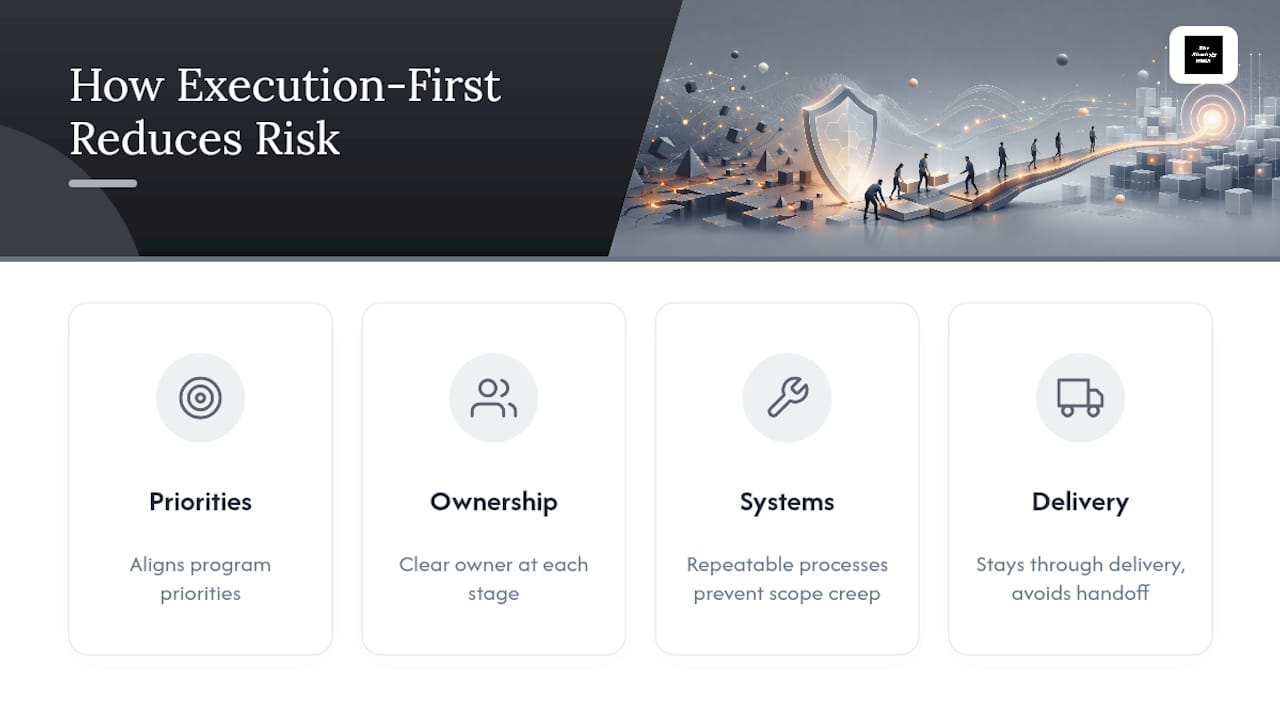
Thestrategyhaus specializes in turning strategy into an executable roadmap, then staying through delivery instead of handing off a document and walking away. The framework aligns priorities, assigns clear ownership at each stage, and uses repeatable systems designed to prevent the scope creep that derails most automation programs before they reach scale.
The Mistakes Leaders Keep Making
The recurring error isn't picking the wrong technology. It's treating automation like a purchase instead of a program, something you buy once and walk away from. Require a named owner and a measurable pilot before you approve anything. Ask yourself honestly whether your team can commit real SME hours for 90 days, because that answer predicts your outcome more than any vendor demo will.
— Ashanti
How Strategy Haus Designs and Runs Your Roadmap
Thestrategyhaus is the alternative to hiring a strategy firm and an implementation vendor separately. One team designs the roadmap and stays to build the pilot with you, so nothing gets lost in the handoff between the people who planned it and the people who built it.
The engagement starts with discovery: mapping your highest-priority processes and interviewing the people who run them. From there, you get a draft roadmap, a resource plan sized to your actual team capacity, and defined 90-day milestones for your first pilot, not a generic slide deck. Ongoing implementation support carries you through build, parallel run, and go-live, with governance structures already in place for the next wave.
If your leadership team is ready to commit to a real pilot instead of another planning cycle, visit the Strategy Haus services page to start the conversation.