

ADKAR solves individual adoption problems; Kotter solves leadership alignment and organizational sequencing. Use Kotter when the blocker is executive sponsorship or coalition-building, ADKAR when people lack the knowledge or ability to change, and combine both when you're running an enterprise-wide transformation with real stakes.
TL;DR:
- Use Kotter to address leadership and organizational alignment issues, especially when sponsorship or coalition-building is the main barrier, and apply ADKAR for individual readiness and skill gaps, typically within three to twelve months.
- Large-scale strategic transformations requiring political capital and cross-department coordination benefit from a combined approach, with Kotter guiding governance and ADKAR diagnosing adoption at the workstream level.
- Conduct ADKAR assessments at defined project gates and track coalition activity simultaneously to catch early signs of resistance or misalignment before full rollout failure.
- When change involves identity shifts or role eliminations, incorporate Bridges' Transition model alongside Kotter and ADKAR to address emotional resistance.
- Failures often stem from stopping follow-through after initial planning; sustained execution requires ongoing leadership commitment, visible wins, and active coalition engagement over 18 to 36 months.
Table of Contents
- ADKAR Explained: Five Elements, Diagnostic Use, and Practical Implications
- Kotter's 8-Step Model Explained: Sequence and Sponsorship
- ADKAR vs Kotter: A Side-by-Side Comparison
- Strengths and Limitations: Where Each Model Breaks Down
- How to Choose: A Decision Checklist for Sponsors and Change Leads
- Implementation Patterns: What Practitioners Actually Do
- A 90-Day Checklist to Launch a Combined Program
- Strategy Haus's Perspective on Choosing a Change Model
- Primary Sources and Further Reading
- Sources
- FAQ
ADKAR Explained: Five Elements, Diagnostic Use, and Practical Implications
ADKAR breaks individual change into five sequential outcomes a person must hit before the change actually sticks. It was developed through Prosci's research and works as both a model and a diagnostic. The five elements are:
- Awareness — the person understands why the change is happening and what happens if it doesn't.
- Desire — the person wants to support the change, not just tolerate it.
- Knowledge — the person knows how to change, including new skills, processes, or systems.
- Ability — the person can actually perform the change in real conditions, not just in training.
- Reinforcement — the change sticks because of recognition, accountability, or corrective feedback.
What makes ADKAR genuinely useful isn't the acronym. It's that you can survey a population against these five stages and find exactly where adoption is breaking down. ADKAR frames change as five outcomes individuals must achieve in sequence, which means a manager can ask a simple diagnostic question at each stage instead of guessing why a rollout stalled.
A Kotter lens tells you almost nothing useful here, because the organizational strategy was never the problem. An ADKAR assessment might reveal that Awareness and Desire scored high, but Knowledge scored low. That's not a motivation problem. That's a training gap, and it needs a different fix than a communication campaign.
This is why ADKAR shows up most often in system rollouts, process changes, and role-based training programs, where the population is identifiable and the barrier is usually personal, not structural. Managers using ADKAR need to measure each stage separately, not just track go-live dates. A pulse survey after Awareness-building communications, a skills assessment before go-live, and a 30-day post-launch check on Ability and Reinforcement will tell you more than a single "percent adopted" metric ever will. Training and development managers typically own this work day to day, since capability-building and adoption programs fall directly in their lane.
Kotter's 8-Step Model Explained: Sequence and Sponsorship
Kotter's model answers a different question entirely: what does leadership need to do, in what order, to make organizational change stick? It was built around eight sequential steps, each summarized here in one line:
- Create urgency — make the case that the status quo is riskier than change.
- Build a guiding coalition — assemble leaders with enough credibility and reach to drive it.
- Form a strategic vision — define where the organization is headed and why.
- Enlist a volunteer army — get broad buy-in beyond the executive team.
- Enable action by removing barriers — clear structural and process obstacles.
- Generate short-term wins — prove the change is working early and visibly.
- Sustain acceleration — keep momentum after the first wins fade.
- Institute change — lock the new behavior into culture, systems, and incentives.
Kotter's model is organizational by design. It assumes the biggest risk isn't individual resistance, it's leadership failing to align, sequence, or sustain the effort. That's why sponsorship isn't optional here. Without a visible, active coalition, steps six through eight tend to collapse. Short-term wins need someone with authority to declare and publicize them. Institutionalization needs someone with the power to change incentive structures and reporting lines.
This model fits strategic transformations, cross-functional restructuring, mergers, and culture shifts, cases where the change touches multiple departments and requires political capital to move forward. The 2012 "Accelerate!" revision reframed this further, proposing a dual operating system for organizations running continuous change rather than a single discrete initiative, which matters more now than it did when the original eight steps were published.
Executive sponsors running a Kotter program should measure coalition activity (are the right leaders actually showing up and advocating?), the visibility and frequency of communicated wins, and whether new behaviors are showing up in performance reviews and budget decisions by month 18 to 24. If none of those are moving, the program isn't stalling on tactics. It's stalling on leadership commitment.
ADKAR vs Kotter: A Side-by-Side Comparison
The clearest way to separate these models is by asking what each one actually measures and who it's built for.
| Dimension | ADKAR | Kotter |
|---|---|---|
| Unit of change | Individual | Organization |
| Core question | Where are people stuck? | What must leadership do, and in what order? |
| Best-fit use cases | System rollouts, process adoption, role training | Strategic transformation, restructuring, culture change |
| Typical horizon | 3 to 12 months per campaign | 18 to 36 months per program |
| Sponsorship needs | Line manager coaching, HR support | Visible executive coalition, sustained political capital |
| Diagnostic capability | Direct: five-stage individual survey | Indirect: coalition strength, momentum, institutionalization signals |
| Primary output | Individual adoption and behavior change | Vision, coalition alignment, and sustained institutional change |
ADKAR campaigns typically run three to twelve months, while Kotter programs commonly stretch eighteen to thirty-six months, so budgeting a single "change management" timeline for both is a mistake most sponsors make early. That mismatch alone explains a lot of failed transformations: leadership expects Kotter-scale patience for what's actually an ADKAR-scale adoption problem, or vice versa.
Here are six rules of thumb for deciding which lens leads:
- If executives disagree on direction or won't publicly commit, start with Kotter. No amount of individual coaching fixes a coalition that doesn't exist.
- If the strategy is clear but adoption is stalling at the front line, start with ADKAR. The organization knows where it's going; individuals don't know how to get there.
- If the change touches identifiable populations (a department, a job function, a specific tool), ADKAR's diagnostic will surface the exact bottleneck faster than a Kotter-style review.
- If the change reshapes reporting lines, incentive structures, or company identity, Kotter's institutionalization steps matter more than any individual training plan.
- If you're running dozens of smaller rollouts inside one larger initiative, treat Kotter as the outer frame and ADKAR as the inner diagnostic for each rollout.
- If sponsorship is weak and there's no real coalition, expect Kotter's later steps to underperform regardless of how well you execute steps one through five.
None of this means picking one model locks you out of the other. Scholarly comparisons of change frameworks find no single model performs universally better because effectiveness depends heavily on context and scope, not on which framework has the catchier acronym.
Strengths and Limitations: Where Each Model Breaks Down
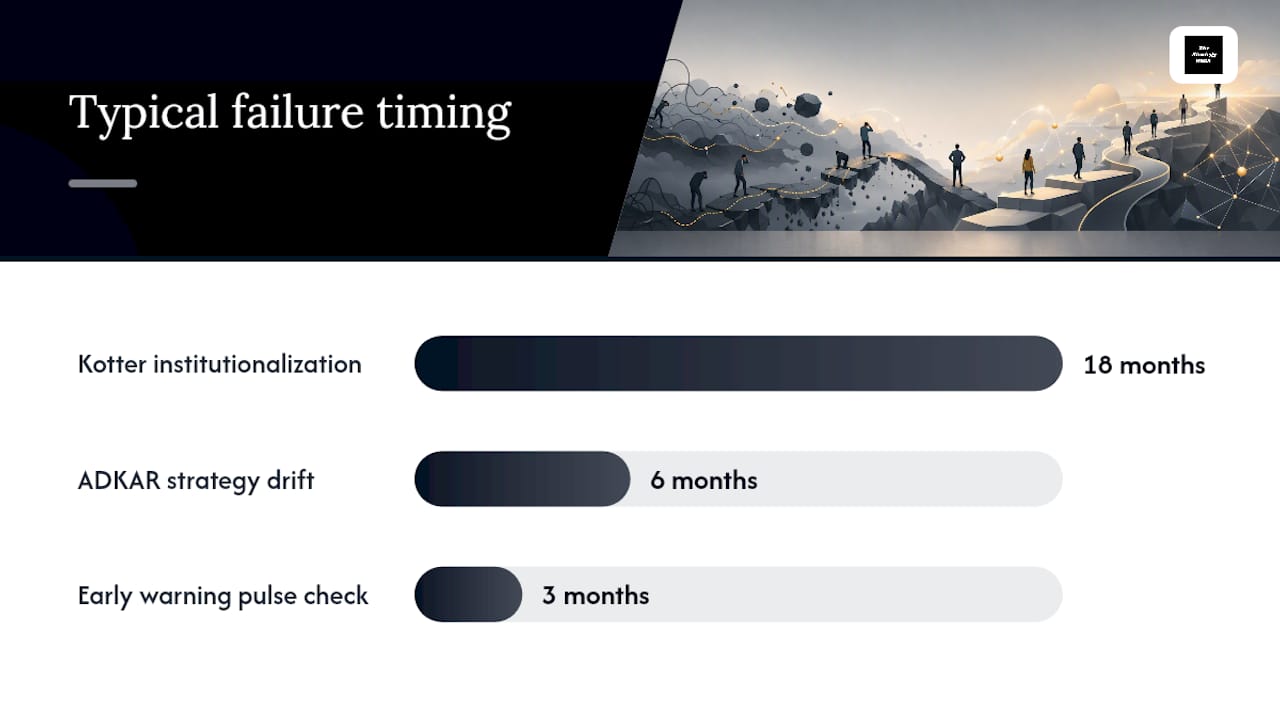
Kotter's biggest failure mode is strategic design without adoption follow-through. Leadership builds the coalition, announces the vision, generates a few early wins, and then assumes the rest happens on its own. It doesn't. Without a mechanism for tracking individual readiness, organizations often discover eighteen months in that the frontline never actually adopted the new process, they just stopped complaining about it publicly.
ADKAR's failure mode runs the opposite direction. Teams build excellent training programs, communication plans, and reinforcement mechanisms for a change that leadership never fully committed to. The individual adoption work is technically sound, but it's aimed at a moving target because the organizational strategy behind it kept shifting. All that carefully designed capability-building gets wasted on a direction that changes again in six months.
Some situations need a third lens entirely. When a change involves real identity loss, a merger that eliminates roles, a restructuring that changes who reports to whom, or a rebrand that shifts how people see their own work, neither ADKAR nor Kotter fully accounts for the psychological experience of ending and beginning that Bridges' Transition model was built to address. If your rollout keeps hitting resistance that looks emotional rather than skill-based or strategic, that's the signal to bring in a Bridges-style lens alongside whichever primary model you're running.
Watch for these red flags as signals to re-evaluate:
- Coalition members stop showing up to steering meetings (Kotter is losing sponsorship).
- Individual adoption scores plateau below 70% despite repeated training (ADKAR intervention isn't addressing the real blocker).
- Resistance shows up as grief or anger rather than confusion (you likely need Bridges, not more ADKAR training).
- Short-term wins get announced but nobody outside the project team notices (Kotter's institutionalization is failing).
Pro Tip: Run a quick ADKAR pulse check even inside a pure Kotter program. If Awareness and Desire scores are low three months after a big leadership announcement, that's an early warning that your coalition's message isn't reaching the frontline, and it's far cheaper to fix at month three than month eighteen.
How to Choose: A Decision Checklist for Sponsors and Change Leads
Start with four diagnostic questions before committing to a model. Each answer points toward a different path.
- Is leadership aligned and visibly committed? If executives are still debating direction, or if sponsorship is inconsistent across departments, start with Kotter's early steps: build urgency, form the coalition, and lock the vision before spending money on individual training.
- Is the change confined to an identifiable population with a clear skill or process gap? If yes, and leadership is already aligned, go straight to ADKAR. Run a stage-by-stage assessment, then design interventions targeted at whichever stage scores lowest.
- Does the change span multiple departments, alter incentive structures, or require sustained political capital? That's a Kotter-scale program. Expect an 18 to 36 month horizon and assign an executive sponsor with real authority to remove barriers, not just a project manager tracking a Gantt chart.
- Does the change involve role elimination, restructuring, or identity shifts alongside process change? Run Kotter for governance, ADKAR for adoption inside each workstream, and bring in a Bridges-style approach for the populations facing the heaviest psychological transition.
A simple decision matrix helps translate those answers into ownership and metrics:
| Diagnostic answer | Recommended path | Owner | Key metric |
|---|---|---|---|
| Leadership misaligned | Kotter, steps 1 to 3 first | Executive sponsor | Coalition attendance and public commitment |
| Clear population, skill gap | ADKAR only | Line manager or L&D | Stage-by-stage adoption score |
| Multi-department, incentive change | Kotter, full program | Steering committee | Institutionalization signals by month 18 |
| Identity/role loss involved | Kotter + ADKAR + Bridges lens | Cross-functional team | Adoption score plus qualitative resistance tracking |
HR and project leadership bodies increasingly frame this as a shared responsibility, with HR championing the adoption side while project and executive leadership own strategic sequencing. That division of labor maps almost exactly onto the ADKAR/Kotter split, which is probably why it works.
A quick example: a mid-sized logistics firm rolling out a new warehouse management system with full leadership buy-in doesn't need a Kotter program, it needs a well-run ADKAR campaign targeted at warehouse staff and shift supervisors. A firm merging two regional divisions into one operating unit, on the other hand, needs Kotter running the governance layer from day one, with ADKAR assessments feeding into each functional workstream as the merger progresses. Teams looking for tactical playbooks on the operational side of that kind of rollout can find useful patterns in proven operations consulting methods that pair well with either model.
Implementation Patterns: What Practitioners Actually Do
Three patterns show up repeatedly across practitioner guidance on combining these models, and each fits a different situation.
Pattern A: Kotter for governance, ADKAR inside each workstream. This is the most common approach for large technical transformations, ERP migrations, AI adoption programs, multi-year restructurings, because it aligns organizational governance with individual-level adoption diagnostics. Kotter's coalition sets direction and removes structural barriers; ADKAR assessments run at kickoff and at defined gates within each workstream to catch adoption problems before they surface as visible failure. Expect a 12 to 36 month horizon and a staffing model that includes both a program-level steering committee and workstream-level change leads running their own ADKAR pulse checks.
Pattern B: ADKAR-driven rollouts sequenced inside a Kotter program's short-term wins. Instead of treating ADKAR as a background diagnostic, this pattern uses successful ADKAR-based adoption in one business unit as the visible "short-term win" that Kotter's step six calls for. It sequences deliberately: pick a workstream with a strong adoption case, run ADKAR to completion there first, then use the results to build momentum for the rest of the organization.
Pattern C: Bring in a different lens entirely. When the change is dominated by identity loss rather than skill gaps or strategic misalignment, ADKAR and Kotter both undersell the emotional dimension. Bridges' Transitions model, focused on endings and new beginnings, often gets paired alongside whichever primary model is running.
- Pattern A fits most large-scale technical or system transformations with clear leadership backing.
- Pattern B fits situations where leadership needs early proof before committing to a full multi-year program.
- Pattern C fits mergers, layoffs tied to restructuring, or any change where roles disappear or fundamentally change meaning.
One practical note worth building into any of these patterns: running ADKAR assessments at kickoff and at pre-defined gates lets a workstream lead decide locally whether an issue needs escalation to the steering coalition or can be resolved with a targeted training fix. That gate structure is what actually prevents Pattern A from collapsing into two disconnected programs running in parallel.
Resource planning matters here too. Without a visible, active coalition, Kotter's later mechanisms, short-term wins and institutionalization, tend to stall even if ADKAR work at the ground level is executing well. If sponsor visibility starts slipping, that's the signal to pause the rollout schedule and fix governance before pushing further adoption work into a vacuum.
A 90-Day Checklist to Launch a Combined Program
- Days 0 to 30: Build urgency and assemble the coalition. Run a baseline ADKAR diagnostic across the target population and draft the communications plan leadership will use to build Awareness.
- Days 31 to 60: Design segmented ADKAR interventions based on where the baseline showed the biggest gaps. Identify one or two short-term wins Kotter's coalition can announce publicly. Start manager coaching on Ability and Reinforcement.
- Days 61 to 90: Launch the first wave. Measure adoption scores and coalition activity side by side. Lock in reinforcement mechanisms, recognition, accountability checkpoints, before momentum fades.
Deliverables at each stage: a baseline ADKAR scorecard, a documented coalition charter, and a short-term win communication package ready to distribute by day 60.
Pro Tip: Build a simple two-column tracking sheet from day one: coalition activity on one side, ADKAR stage scores on the other. When they move together, the program is healthy. When one stalls while the other climbs, you've found your next problem before it becomes a crisis.
Strategy Haus's Perspective on Choosing a Change Model
Most organizations don't fail at change because they picked the wrong model. They fail because they picked a model and then stopped executing once the framework was on a slide. Thestrategyhaus sees this constantly: the strategic plan is sound, the coalition is named, and then nobody owns the follow-through past week four.
Pragmatic teams don't treat ADKAR and Kotter as competing philosophies. They treat them as two dashboards measuring different risks, and they check both. The mistake is expecting a framework to run itself.
— Ashanti
Primary Sources and Further Reading
- Accelerate! (Harvard Business Review) — Kotter's dual operating system revision for continuous change.
- The ADKAR change management model (MindTools) — canonical breakdown of the five ADKAR stages.
- Change management frameworks (TAMUCC) — comparative overview of ADKAR, Kotter, and related frameworks.
- Choosing Among ADKAR, Kotter, and Bridges (Compel Framework) — practitioner patterns for combining models.
- Comparative study of change management models (Springer) — peer-reviewed comparison finding no universally superior model.
Sources
- Change management frameworks (TAMUCC)
- Accelerate! (Harvard Business Review)
- Choosing Among ADKAR, Kotter, and Bridges (Compel Framework)
FAQ
Is Kotter's Model Still Relevant?
Yes. Kotter's own 2012 "Accelerate!" revision reframed the original eight steps around a dual operating system for organizations facing continuous change rather than one-off initiatives. It remains a standard reference for organizational sequencing and leadership coalition-building in strategic transformations today.
Is ADKAR the Same as Prosci?
No, but they're closely linked. ADKAR is the change model itself, built from Prosci's research, while Prosci is the organization that developed and maintains it, along with related training and certification programs.
What Are the Five Stages of ADKAR?
The five stages are Awareness, Desire, Knowledge, Ability, and Reinforcement, each representing a sequential outcome an individual must reach for a change to stick. Skipping a stage, like moving straight to training without building Desire, is a common reason adoption programs stall.
What Are the Top Change Management Models?
ADKAR and Kotter's 8-Step model are the two most widely referenced, alongside Lewin's Unfreeze-Change-Refreeze model and Bridges' Transition model. Comparative research finds these models share common stages but differ in scope, individual versus organizational focus, and no single one performs best across every context.
Can I Use ADKAR and Kotter Together?
Yes, and it's a common approach for large transformations. Practitioners typically run Kotter for program-level governance and ADKAR for adoption diagnostics inside each workstream, checking ADKAR scores at kickoff and at defined gates throughout the program.
Organizations that need help turning either model, or a combined approach, into an actual working program can review Thestrategyhaus's implementation and systems setup services, which focus on execution and ongoing support rather than stopping at the strategy document.